While Northern California is famous for its wines, it is also full of olive groves, many of which have been owned by the same family for generations. Since 2018, Aishwarya Iyer has devoted her life to persuading the world to appreciate American olive oil through her brand, Brightland. Her trick? Putting it in gorgeous glass bottles with art-adorned labels. “The bottles were a Trojan horse,” Iyer says. “They’re what pulls you into the brand, but what’s inside is magnificent. It was the tactic we used to convert Americans to using better-quality olive oil.”
The strategy worked well—possibly too well. The 375-milliliter bottles, which sell for $37, went viral on Instagram. People took pictures of them on their kitchen counters. They brought them out for their dinner parties. The bottles suddenly became the go-to hostess gift, and one of Oprah’s favorite things. Iyer was thrilled: Today, one Brightland bottle is purchased every minute. And in 2022, the company landed $6.83 million in venture funding to continue growing.
But in some ways the beautiful bottles were also limiting. People saw them as precious objects, meant to be rationed for special occasions. And yet Iyer’s bigger goal is to get Americans to use California olive oil for all their cooking needs—and in doing so, to support American farmers.
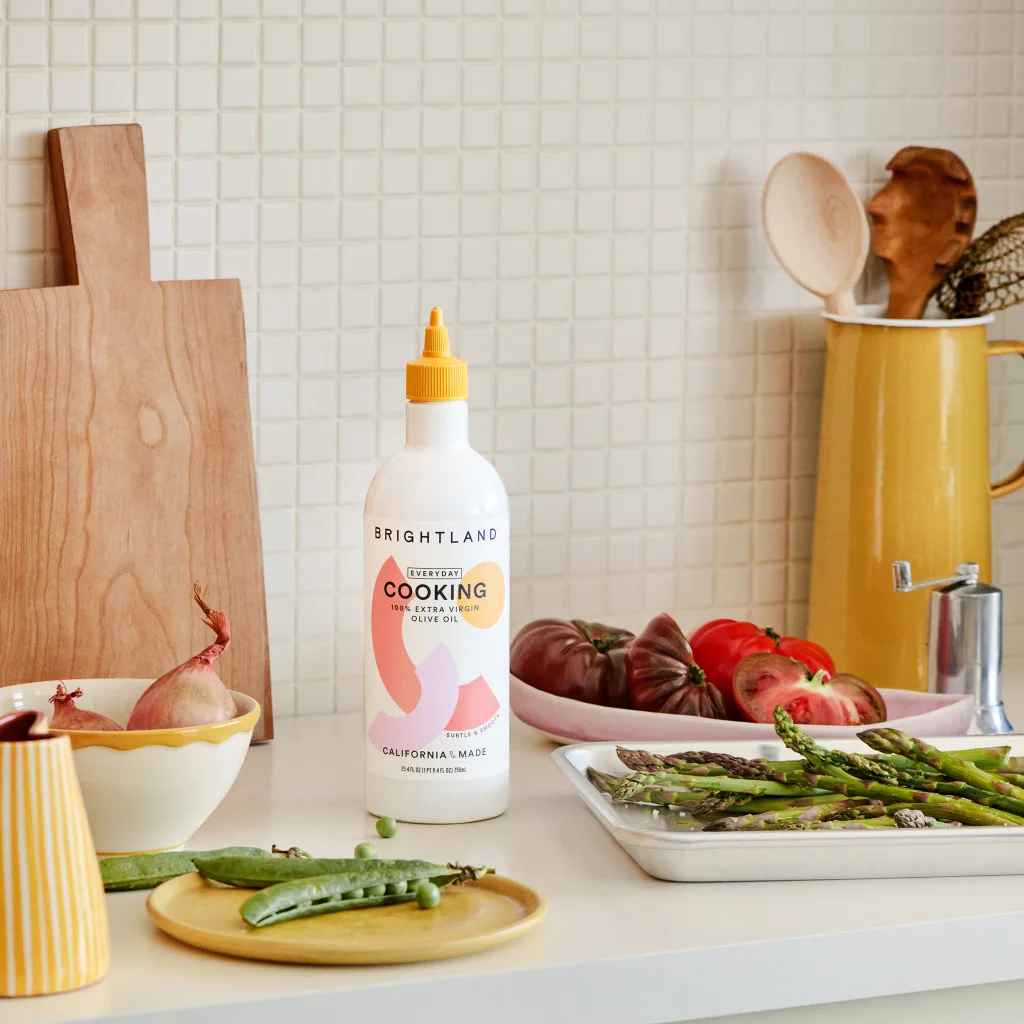
To broaden Brightland’s appeal, Iyer has just launched a new line of products called the Everyday Set featuring an oil for cooking and an oil for dressing salads. They come in a different format: a plastic squeeze bottle. The products are slightly less expensive than those in the glass bottles ($65 for 750 milliliters), although this is still four or five times the price of many other bottles of olive oil on store shelves. But these new Brightland products will soon be sold at Whole Foods stores across the country, allowing the brand to better compete in the olive oil wars.

We love squeezing our olive oil
Over the past three years, the squeeze bottle has become the vessel for olive oil. This is partly thanks to Graza, an olive oil brand founded by Andrew Benin in 2022 that has raised $2.8 million in VC capital, which stood out for selling its products in forest-green squeeze bottles.
The squeeze bottle format allows you to better control how much oil comes out of the bottle and to squirt it more precisely into frying pans or salads. This is why chefs and home cooks have decanted olive oil into squeeze bottles for decades. (Many brands, including OXO, sell squeeze bottles for this purpose.) It has also been widely used in adjacent food categories, like hot sauce.
Graza’s innovation was selling its oil in these bottles wrapped in fun, modern branding. But Graza couldn’t copyright the bottles, since they were already commonly used. And it’s become clear that consumers love the format, as many other brands have started selling their oil in squeeze bottles, including California Olive Ranch, O Olive Oil, DeLallo, and Pompeian.
Brightland is among them. In 2023, it launched a pizza oil in a squeeze bottle that was a hit. The company sold out of its first 10,000 units within hours of launching. (Graza’s founder wrote an angry LinkedIn post about how Brightland had created a copycat product, but quickly apologized; Brightland did not comment on the incident.) From this pizza oil launch, Iyer realized that different bottles work in different contexts. “In this case, the squeeze bottle was a little more casual and playful, which is what you want on pizza night,” she says.
The New Olive Oil Aisle
For Iyer, it’s been interesting to observe how the format of the bottle has shaped people’s perception of the oil inside. With the glass bottle, people saw Brightland as a luxury or art object. But Iyer wants consumers to reach for high-quality California olive oil whenever they’re cooking or making a salad. “I live in California, and I feel really passionately about supporting these farmers who are just a couple of hours north of us, and who have had these farms for several generations,” she says. “If we don’t cultivate demand for their oil, it won’t exist much longer.”
Iyer also points out that California has the highest quality standards when it comes to olive oil. As has been well-reported, many olive oils in the grocery store are adulterated with cheaper ingredients, like palm or canola oils. Some olive oil that is purportedly made in Italy actually comes from other countries, like Morocco and Tunisia. But the California Department of Food and Agriculture has high standards, and products made here are regularly tested to ensure they are pure.
Iyer wasn’t sure she would be able to get the prices any lower, since domestic olives oils are higher in quality and the cost of labor here is higher than it is overseas. But she found a farm that was able to manufacture at scale for Brightland, which helped bring down the price a little bit. At $65 for the pair of bottles, this olive oil is much more expensive than the average American is used to spending. Graza’s oil bundle, for instance, which comes from Spain, costs $37.
Iyer believes there are some consumers who will recognize the value in Brightland’s offering. The brand is trying to tell a story about how much fresher this oil is, and how it contributes to the livelihoods of American farmers. And ultimately, she believes that what is likely to convince them is the taste. That’s why she works with farmers to create a very specific flavor profile, much like winemakers do with wines. “It all comes down to flavor,” she says. “We’re blending varietals to be the right deliciousness right out of the bottle.”
Related Posts
LinkedIn cofounder Reid Hoffman says he learned a lesson from a visit to Epstein’s island: ‘Note to self, Google before going’
Hoffman said he was told Epstein would be more likely…

AI tools won’t get products out faster, but they’ll solve 2 coding problems, says a16z partner
Martin Casado, Andreessen Horowitz Andreessen Horowitz AI coding tools like…
GM lays off about 1,750 employees amid ‘slower near-term EV adoption’ and ‘evolving regulatory environment’
GM's latest cuts were in response to "slower near-term EV…