Damian Kulash, guitarist and lead singer of the rock band OK Go, is also kind of a creative director.
His band has become world famous for its inventive, elaborate, and absurdly complicated music videos, including its breakout dance video made on synchronized treadmills, a stop-motion video shot over the course of 21 hours, and another that was made up of 64 films playing simultaneously on 64 iPhones. By the band’s own tally, its videos have been viewed 11 billion times. It’s achieved this success by approaching the creative process in a unique way.
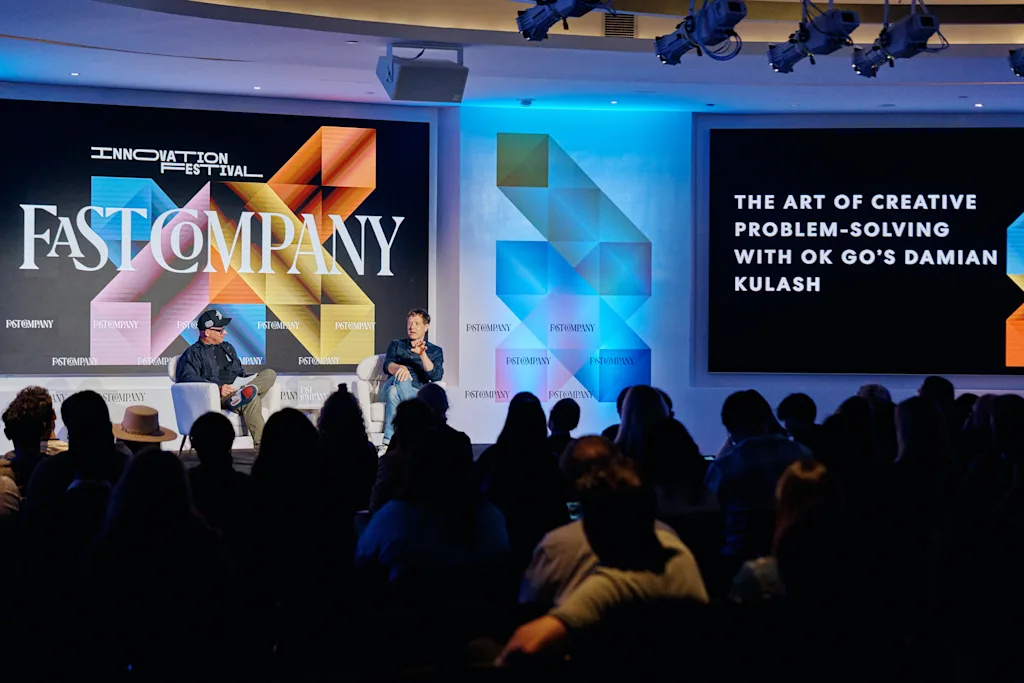
Kulash was recently on the main stage at Fast Company’s Innovation Festival in New York to talk about the inspiration behind these projects. Speaking to a capacity crowd, Kulash broke down the band’s process into simple terms: “The abstract version is that we look for the things in the world that make us go ‘Ooh.’”
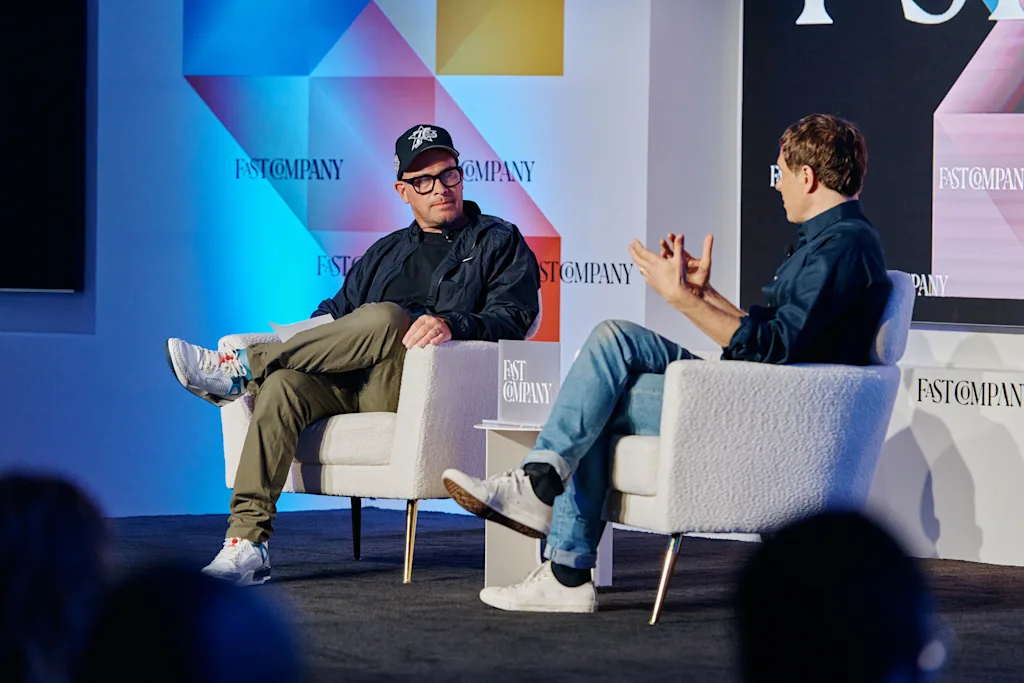
He was being interviewed by Karl Lieberman, global chief creative officer of the advertising agency Wieden+Kennedy. The two spent a lot of time talking about their creative processes, and revealed some surprising ways a rock band can work like an ad agency. Lieberman, whose firm is known for its campaigns for brands like Coca-Cola and Nike, noticed that Kulash uses an analogy for describing OK Go’s creative process that’s almost identical to his own.
“Once you get an idea, you have a ‘sandbox,’ you called it, and that resonates with me because I often call ideas ‘buckets,’” Lieberman said. “It’s not an idea that’s fully formed, it’s more of a notion or a direction of an idea in the form of a space that can be filled with even more thinking and . . . hopefully from even more people.”
Kulash says his sandbox concept is one based on play. “It’s all about discovering the thing,” he said. “We don’t start knowing it. It also allows everybody who’s involved to actually make the project better.”
An example he shared was the filming of one of OK Go’s most famous music videos, “Upside Down & Inside Out,” which takes place in zero gravity. Aside from knowing the video would have no gravity, the band boarded the gravity-free airplane without any preconceived idea for what they’d actually do.
“It was seven flights of pure play, seven flights of a rehearsal, and then six flights of actually shooting it,” Kulash said. “There is no idea until you’ve played. You have to see the thing and be like, things feel cool in zero gravity or things feel cool in slow motion, or things feel cool in stop motion.”
For Kulash, play is an essential part of OK Go’s creative process, even when the band is working in partnership with a company like Apple or General Motors to help finance the project. But that doesn’t mean there’s no pressure to turn all that sandbox time into something great.
Earlier this year, OK Go gave Fast Company global design editor Mark Wilson an exclusive inside look at the filming of its latest music video, “Love,” which was so technically challenging to film the band was only able to get the shot it needed on the very last try before the daylight—and the budget—ran out.
“We’ve got a ton of skin in the game ourselves,” Kulash said. “We often pay for [the videos] ourselves, even when we have a sponsor. We can’t afford to fail at them, ever.”
Plus, Kulash told the audience, the band’s got a reputation to uphold. “Can you imagine if the next OK Go video is the one that was really boring?”
Related Posts
Read the memo: Tesla rival Lucid cuts 12% of its US workforce as EV winter takes hold
Lucid launched its latest EV, the Gravity SUV, last year.…
Why one founder personally onboarded every influencer in the early days to build his $2.1 billion AI startup
Gamma's cofounder, Grant Lee, said he onboarded every early influencer,…
The most innovative data science companies of 2026
AI innovations have long promised productivity at scale, powered by…