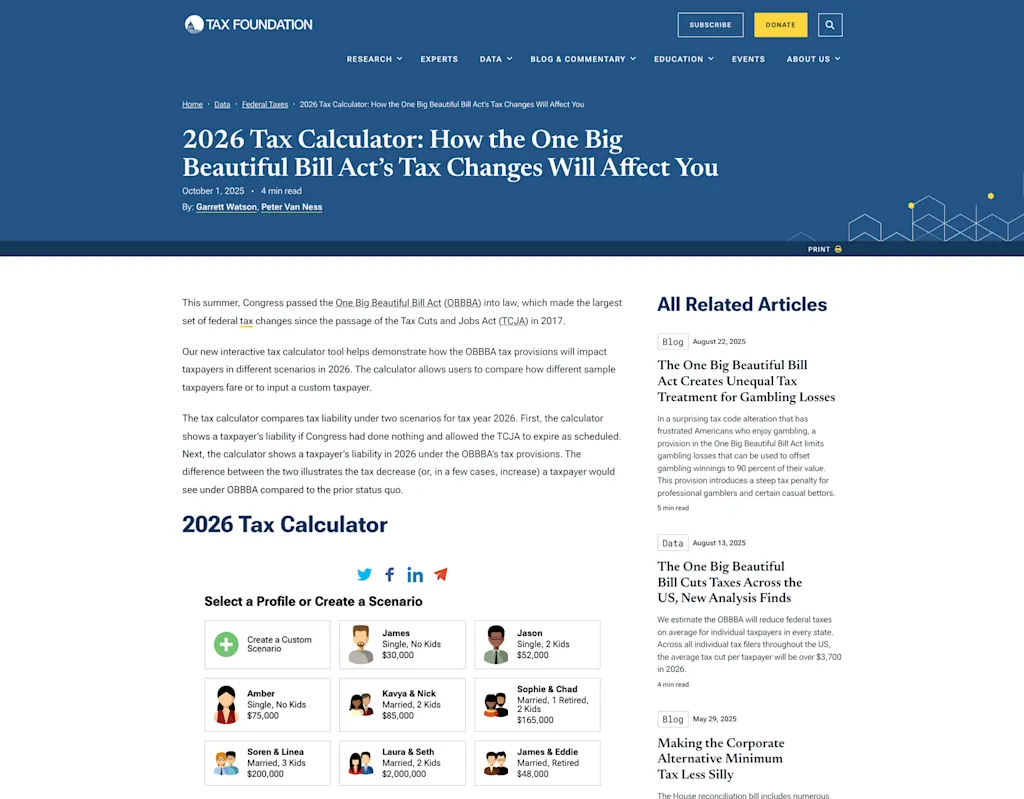
There is a new calculator that shows how President Donald Trump’s “big, beautiful” law will affect your 2026 tax bill, and how much additional take-home pay you’ll be getting.
The calculator, from the Tax Foundation—an independent, tax policy research organization—looks at the new exemptions and tax write-offs in the massive 940-page One Big Beautiful Bill Act (OBBBA), which was signed into law in July.
The savings are the result of the OBBBA extending the 2017 Tax Cuts and Jobs Act, making many of the changes permanent, while adding some new short- and long-term tax rules, including the “No Tax on Tips” provision (which allows eligible tipped workers to deduct a portion of their income from tips on their federal income taxes), a car loan deduction, a deduction for charitable donations, and a child credit.
The new interactive tax calculator tool allows users to compare their tax liability for the 2026 tax year—before and after OBBBA’s tax provisions.
The nonprofit Tax Foundation found that taxpayers will see an increase in after-tax incomes of about 5.4%, on average, with the bottom 20% of earners saving 2.6% in after-tax income, and those at the top 60th to 80th percentiles saving 6.3% in after-tax income.
How the new 2026 tax law affects take-home pay, by income bracket
Here is the breakdown on how much American taxpayers are expected to save based on earnings brackets, according to the Tax Foundation and CNBC:
- 0%-20%, up to $17,735 in annual income:
- 2.6% increase in take-home pay
- 20%-40%, $17,736–$38,572 in annual income:
- 5.2% increase in take-home pay
- 40%-60%, $38,573–$73,905 in annual income:
- 5.7% increase in take-home pay
- 60%-80%, $73,906–$130,661 in annual income:
- 6.3% increase in take-home pay
- 80%-100%, above $130,661 in annual income:
- 5% increase in take-home pay
Meanwhile, the nonpartisan think tank Tax Policy Center (TPC) estimates the law will, on average, reduce taxes for Americans by about $2,900 in 2026, with some 85% of households receiving a tax cut in 2026.
The calculations come as Americans face skyrocketing living costs, inflation, tariffs, and a tight job market, all of which are making it much harder for the average person in the U.S. to stay economically afloat.
Related Posts

OpenAI’s latest proposal shows it’s very aware that data centers are unpopular
OpenAI's first major data center was in Abilene, Texas. Bloomberg/Getty…

I’m Gen X and job hunting for the first time in 20 years. It’s been a roller coaster, but these 3 things help.
Me at my first visit to Google's headquarters in Sunnyvale,…

The Ball in OpenAI’s court
Dean Ball in San Francisco's City Lights Bookstore. Christie Hemm…