Hello again, and welcome back to Fast Company’s Plugged In.
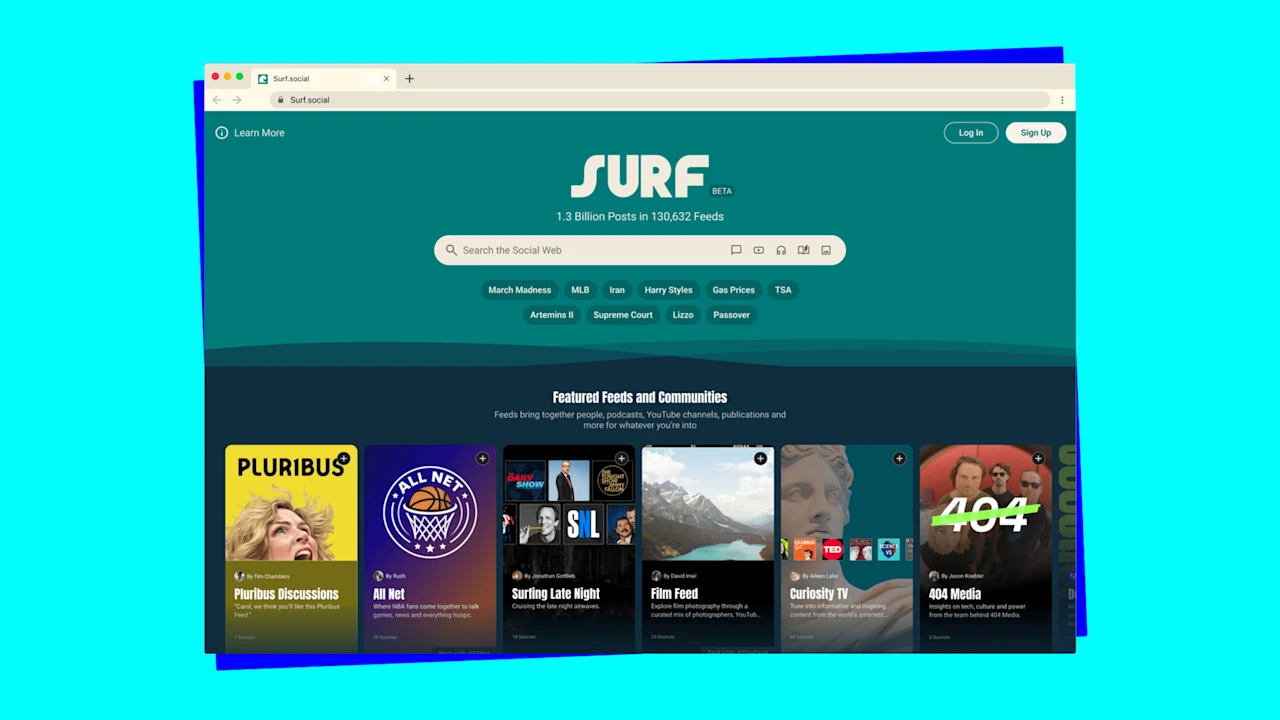
More than 15 months ago, I wrote about Surf, a discovery engine for the social web from Flipboard—itself an earlier twist on the same concept dating to the early days of the iPad. At the time, it was still a rough draft, and in private beta. Rather than rushing it out to a broader audience, Flipboard took its time. The app went through a series of revisions that were both numerous and substantial, ending up significantly different than the intriguing prototype I tried in December 2024.
This week, the company finally deemed Surf ready for prime time. It’s now live in web form at Surf.social; a beta Android version is in the Google Play store. (The iPhone and iPad versions still have a waitlist.) If you’ve grown jaded about social networking or the web in general, I recommend taking a look.
Surf’s sheer ambition makes it a challenge to describe coherently. It weaves together material from Bluesky, Mastodon, and Threads—along with YouTube videos, podcasts, blog posts, and articles—and yet it isn’t really a substitute for those services’ own apps. It’s a way to create and share custom feeds about your interests that run on autopilot once you’ve set them up, but that’s optional—you can also just lurk and peruse other people’s feeds. And even though it runs inside a web browser, it feels a little like what browsers themselves might have become if they hadn’t largely stopped evolving almost 20 years ago.
All I know for sure is that using Surf leaves me feeling better about the state of the internet. I am aware that the net is rapidly filling up with AI-generated slop, and that, furthermore, the technology’s impact on search and advertising threatens to disincentivize humans from bothering with the medium at all. But for now, there’s still lots of great stuff out there—and Surf is a refreshingly inventive way to find it.
It would be inaccurate to describe Surf as an algorithm-free zone. Like Flipboard before it, it uses computer science to help identify what individual pieces of content are about so they can be woven together thematically. Unlike Facebook or TikTok, however, it isn’t a giant machine designed, above all, to keep you scrolling. Flipboard worked with individuals and outlets such as The Verge, 404 Media, and Rolling Stone to ensure that the app launched with a bevy of feeds worth following. The result feels curated, not stuffed to capacity.
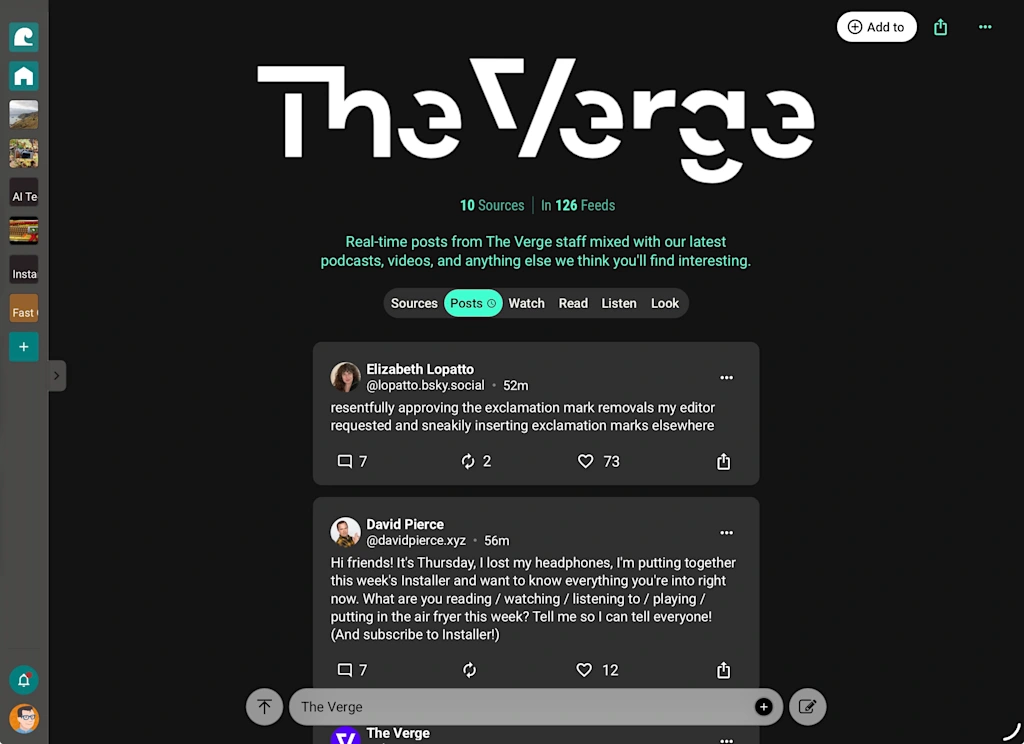
Even though Surf is decidedly human, it’s organized around interests and passions, not friendships or followers. It’s possible to skim individual Bluesky and Mastodon accounts, but that’s secondary to subscribing to topic-based feeds. Not surprisingly, politics and current events are available in great supply. But so are quieter pursuits that can get drowned out in the din of social networking in its more conventional form: books, cooking, hobbies, and fandoms of all kinds.
The other thing about Surf that it has in common with Flipboard—and darn few other ways to consume digital content—is that it tries to present everything to its best advantage. Much of the rest of the field has a stunted feel, as if the highest possible aspiration was to rekindle the aesthetic of early Twitter. Surf, by contrast, complements its Posts tab with ones called Watch, Read, Listen, and Look, each optimized for a different sort of media. In Look, for example, photos are so downright expansive that they make the ones in other social apps look like postage stamps.

Surf lets you sign in with your Bluesky and/or Mastodon accounts, allowing you to comment, like, and share on those networks. Some of its feeds are set up as communities unto themselves, letting you post items with a hashtag to pipe them into the flow. Overall, though, it has a magazine-y vibe that’s conducive to leaning back and enjoying what other people are sharing. If all those Twitter-style apps have the spirit of talk radio, this one feels more like a Sunday newspaper.
Even after well over a year of incubation, Surf is clearly a first pass at a bigger idea. I occasionally found the way it intermingles multiple social networks befuddling, especially when I was thinking about liking or sharing something and couldn’t quite tell if that involved Bluesky or Mastodon. The long-term goal, Flipboard CEO Mike McCue told me recently, is not only to make that cross-pollination smoother, but to render it irrelevant for many users.
“Some people have a Bluesky account, some people have a Mastodon account, some people don’t have either of those,” he explained. “In fact, most people don’t even know what those things are. So what we want to do is make it all about the community, not about joining the social web.” Participating in Surf, McCue said, should be as easy as joining Substack and easier than joining Discord, regardless of where items of interest originated.
Given the temptation to give in to dark thoughts about where the internet is headed, I am excited to see where this bright spot could take us.
You’ve been reading Plugged In, Fast Company’s weekly tech newsletter from me, global technology editor Harry McCracken. If a friend or colleague forwarded this edition to you—or if you’re reading it on fastcompany.com—you can check out previous issues and sign up to get it yourself every Friday morning. I love hearing from you: Ping me at hmccracken@fastcompany.com with your feedback and ideas for future newsletters. I’m also on Bluesky, Mastodon, and Threads, and you can follow Plugged In on Flipboard.
More top tech stories from Fast Company
How Disney Imagineers are using AI and robotics to reshape the company’s theme parks
From robotic Olaf to reinforcement learning, the company is rethinking how its attractions come to life. Read More →
Y Combinator’s CEO says he ships 37,000 lines of AI code per day. A developer looked under the hood
After Garry Tan touted his agentic coding output, a developer found inefficiencies, code bloat, and rookie mistakes lurking in production. Read More →
I ate lab-grown salmon. It was nothing like I expected
A San Francisco startup is trying to make ‘cultivated’ fish a thing. Read More →
OpenAI’s gigantic new funding round renews fears about the company’s profitability and cash burn
The stakes of Big AI’s bet that it will transform business and personal life seem to be growing by leaps and bounds. Read More →
The AI industry loves token inflation. Your company shouldn’t
The brute-force model is starting to look less like technological inevitability and more like lazy architecture. Read More →
Apple at 50: The tech giant’s best, worst, and weirdest ideas
Over five decades, Apple has built some of the most influential tech ever made—and some genuinely strange flops. These are the highs, lows, and oddities. Read More →