Want more housing market stories from Lance Lambert’s ResiClub in your inbox? Subscribe to the ResiClub newsletter.
There was a five-week window this spring during which four different U.S. homebuilders—one of them publicly traded, Tri Pointe Homes—were acquired by Japanese firms. At the time, ResiClub estimated that, once those deals close, Japanese firms would control more than 5.5% of the U.S. single-family homebuilding market.
This wave of Japanese firms buying U.S. homebuilders isn’t just a 2026 phenomenon—it’s been building for a decade.
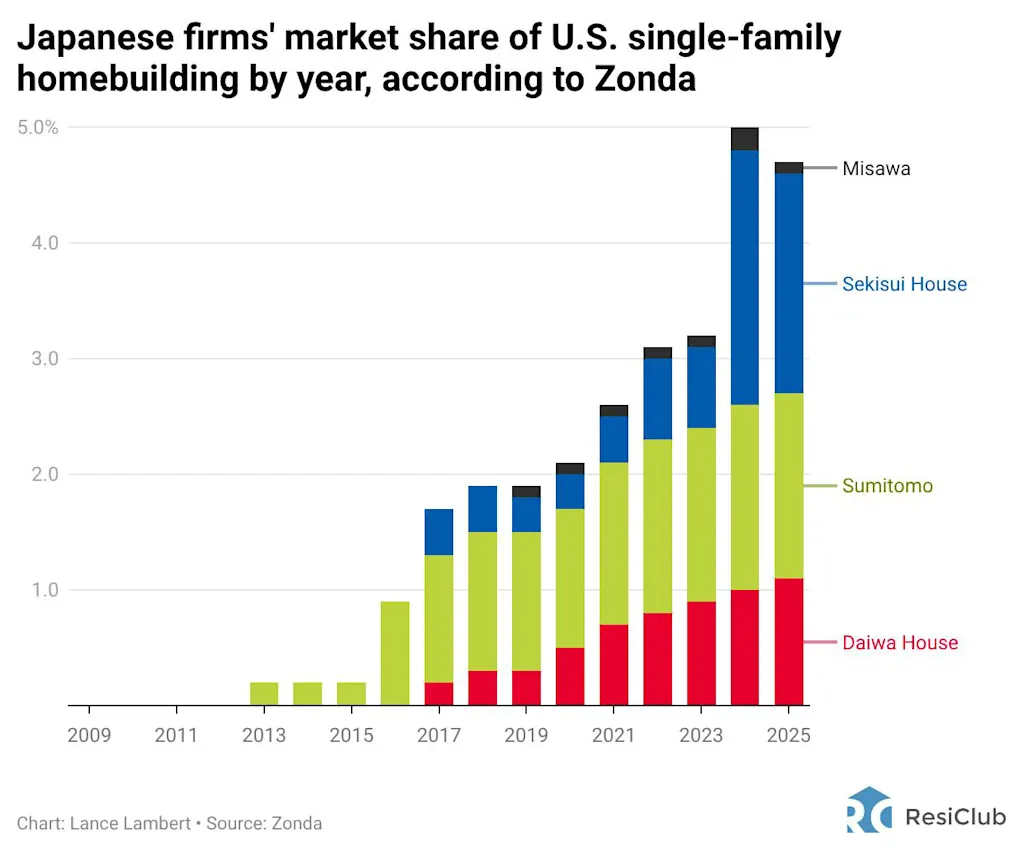
According to new construction analytics firm Zonda:
- Back in 2015, Japanese firms owned U.S. homebuilders that accounted for around 0.2% of the U.S. single-family homebuilding market.
- By 2025, Japanese firms owned U.S. homebuilders that accounted for around 4.7% of the U.S. single-family homebuilding market.
Why are Japanese firms making such a large bet on U.S. housing?
At a high level, the answer is demographic and structural. Japan’s domestic population is shrinking and aging (fast!), limiting long-term housing growth and risking a sharp contraction for Japanese homebuilding firms like Daiwa House, Sekisui House, and Sumitomo Forestry.
The United States, by contrast, continues to experience population growth and household formation—particularly in the Sun Belt markets where many big U.S. homebuilders operate. For Japanese firms seeking stable, long-duration growth, U.S. homebuilding offers scale and better demographic tailwinds.
There’s also a strategic element. The U.S. homebuilding industry remains fragmented beyond the top few public builders, creating opportunities for well-capitalized global players to roll up regional operators while preserving local brands and management teams. Both Sumitomo Forestry and Sekisui House say they prioritize locally led operations, supported by centralized capital and global expertise—a structure designed to preserve builder culture while providing financial and operational backing.
Another factor is that many Japanese conglomerates have access to lower borrowing costs, which, in theory, gives them an advantage when buying companies abroad. Japan has had extremely low interest rates for decades due to persistent low inflation and slow growth. For much of the past decade, the Bank of Japan kept short-term policy rates at or below 0%.
Zonda chief economist Ali Wolf tells ResiClub:
“Japanese homebuilders are bringing a distinctly long-term perspective to the U.S. housing market, shaped by demographic challenges at home and opportunity abroad. Their growing footprint reflects confidence in U.S. housing demand, including World Bank projections for 25 years+ of domestic population growth. The Japanese players are not just adding capital but also introducing new approaches to scale, efficiency, and construction that could meaningfully reshape the industry over time.”
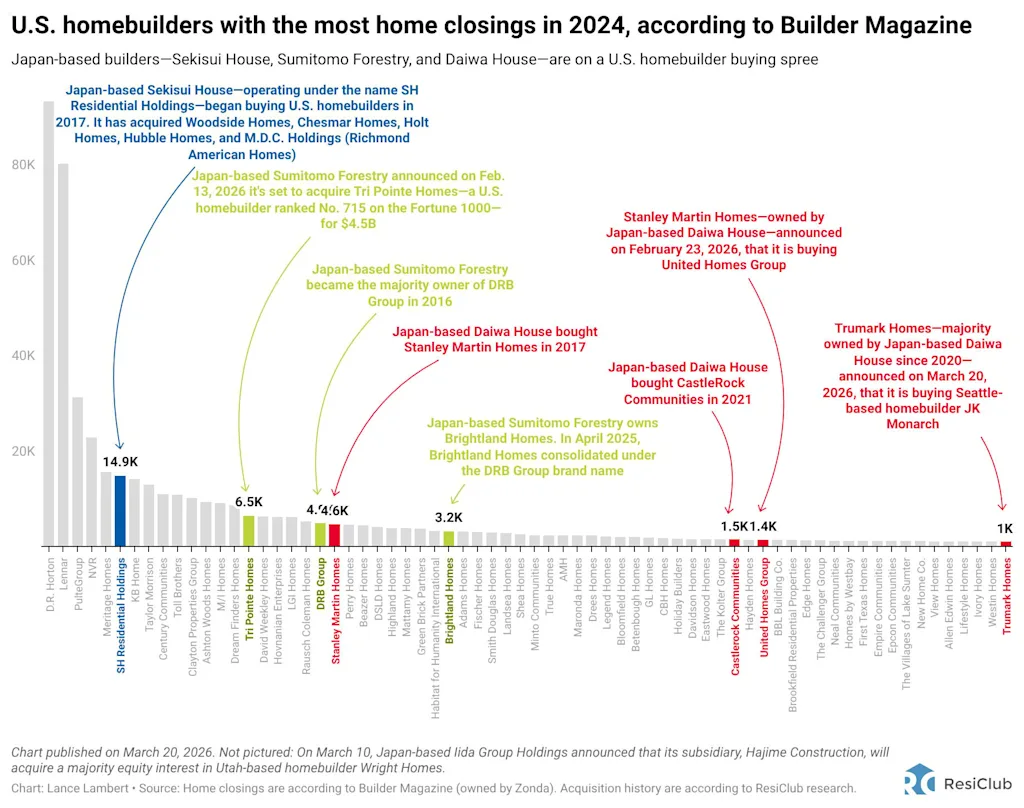
This spring alone, four U.S. homebuilders were acquired by Japanese firms, including Japan-based Sumitomo Forestry’s $4.5 billion purchase of public homebuilder Tri Pointe Homes (Feb. 13); Stanley Martin Homes (owned by Japan-based Daiwa House) agreeing to acquire United Homes Group (Feb. 23); Japan-based Iida Group Holdings subsidiary Hajime Construction agreeing to acquire a majority equity interest in Utah-based homebuilder Wright Homes (March 10); and Trumark Homes (majority owned by Japan-based Daiwa House since 2020) agreeing to acquire Seattle metro–based homebuilder JK Monarch (March 20).
Below is a summary of most of the major U.S. homebuilder acquisitions by Japanese firms over the past decade:
Daiwa House: Japan-based Daiwa House has quietly built one of the most geographically diversified U.S. homebuilding footprints among Japanese builders. It entered the U.S. market in 2017 with its acquisition of Stanley Martin Homes, followed by the purchase of Trumark Homes (No. 67 largest U.S. homebuilder) in 2020. In September 2021, Daiwa House completed its acquisition of CastleRock Communities (No. 49 largest U.S. homebuilder), giving it a strong presence in Sun Belt markets in Arizona, Texas, and Tennessee. In February 2026, Stanley Martin announced a $221 million acquisition of United Homes Group, followed in March 2026 by Trumark announcing its acquisition of JK Monarch.
Sumitomo Forestry: For Sumitomo Forestry—a Japan-based forestry, timber, and homebuilding company—its Tri Pointe Homes acquisition last month meaningfully accelerates its U.S. expansion goals, including its stated target of delivering 23,000 homes annually in the U.S. by 2030. In 2016, Sumitomo Forestry became the majority owner of DRB Group (America’s No. 20 largest homebuilder). In April 2025, Brightland Homes (America’s No. 24 largest homebuilder—which Sumitomo Forestry acquired a majority stake of in 2016) consolidated into DRB Group.
Sekisui House: Japan-based homebuilder Sekisui House, operating in the U.S. under SH Residential Holdings (America’s No. 6 largest homebuilder), has also been on a multiyear U.S. homebuilder buying spree. Since 2017, Sekisui House has acquired homebuilders Woodside Homes, Chesmar Homes, Holt Homes, and Hubble Homes. In April 2024, Sekisui House really shook up the industry when it acquired M.D.C. Holdings (Richmond American Homes) for a staggering $4.9 billion. Sekisui House has also expanded into the U.S. with its homegrown Japanese builder brand, Shawood.
Related Posts
I’ve spent 75 hours on overnight Amtrak trips. I wish I had known 9 things before stepping aboard.
Business Insider's reporter spent 75 hours in Amtrak sleeper cars…

Welcome to the Anxiety Economy, where safety sells and streaming is optional
Americans are seriously worried about their finances. Between high costs…
Ukraine is using powerful quadcopters to destroy nearly a third of all the Russian air threats it hits, commander says
Ukrainian interceptor drones are often propeller-driven. Ed JONES / AFP…