
Across Europe, a record-breaking heat wave has led to “red weather warnings,” thousands of school closures, and already multiple deaths.
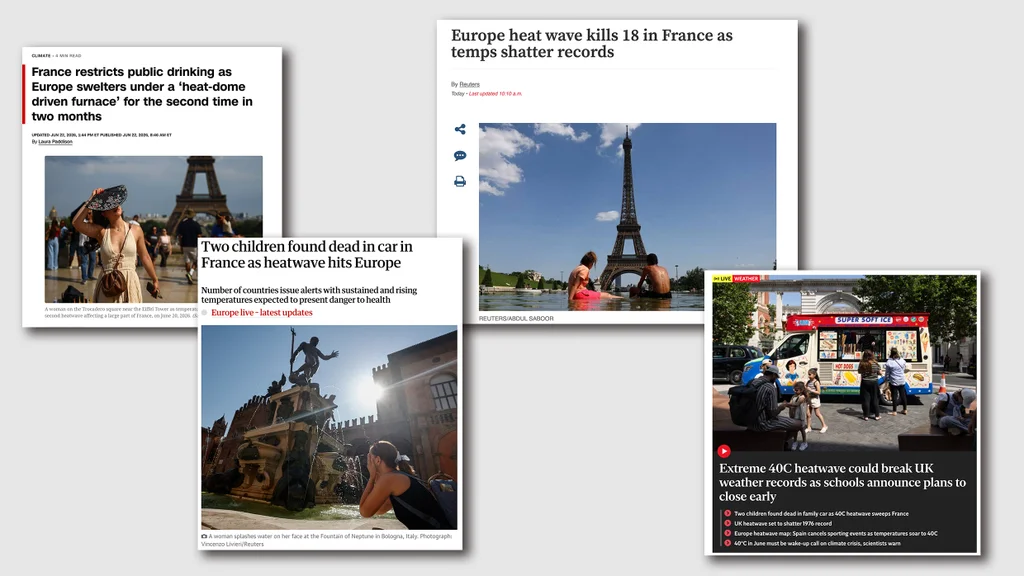
But alongside some news articles about this extreme heat are images of crowded beaches and people frolicking in fountains or lounging in parks.
Those pictures fail to convey the danger of heat waves, climate experts say—and even risk people not taking extreme heat seriously.
How hot is this European heat wave?
Multiple European countries are under high heat warnings, from Britain to Germany to Portugal. Temperatures could reach as high as 104 degrees Fahrenheit, or 40 degrees Celsius, in parts of France, Spain, and the United Kingdom, in particular.
Those aren’t just one-day peaks, experts warn; temperatures could stay that high for multiple days in a row.
Humidity is expected to be intense as well, which “could lead to some of the most dangerously high heat indexes several countries have ever recorded,” according to meteorologist Bob Henson, writing for Yale Climate Connections.
That moisture in the air means that there isn’t much relief at night; the UK’s Met Office warned of “tropical” nights where the temperature never dips below 20 degrees Celsius, or 68 degrees Fahrenheit.
Across Europe, air conditioning is still uncommon, making warm night weather a health risk.
This relentless, unprecedented heat wave in general threatens “population-wide adverse health effects,” according to the red weather warning British officials declared through Thursday, June 25—including “serious illness or danger to life.”

Dangers of extreme heat
There have been multiple deaths already in this June heat wave. Thirteen people drowned across France over the weekend, prompting government officials to urge people not to swim in unsupervised areas in an attempt to cool off.
Two children were found dead inside their family car in southeast France in an incident the local prosecutor said “is probably linked to the heat wave,” according to the BBC. At least three people over 80 years old have also died, related to the intense heat.
These impacts aren’t uncommon: The World Health Organization (WHO) recently revealed that more than 200,000 people across Europe have died from heat in the last four years alone.
Most of those deaths “were entirely preventable,” Hans Henri P. Kluge, WHO Regional Director for Europe, said in a statement. They’re also “just the tip of the iceberg,” he added, “with millions more people being affected physically and mentally.”
Extreme heat is also linked to an increase in hospitalizations for cardiovascular, kidney, and respiratory diseases; heat exhaustion and heat stroke; and what some experts have called heat-adjacent illnesses like dehydration, rapid pulse, dizziness, or fainting.
Not so fun in the sun
It’s these dangerous effects of extreme heat that make pictures of a day at the beach seem so inappropriate to climate experts.
Online, multiple experts have called out certain news outlets for running these low-stakes, “fun” images alongside stories about this record-breaking heat wave.
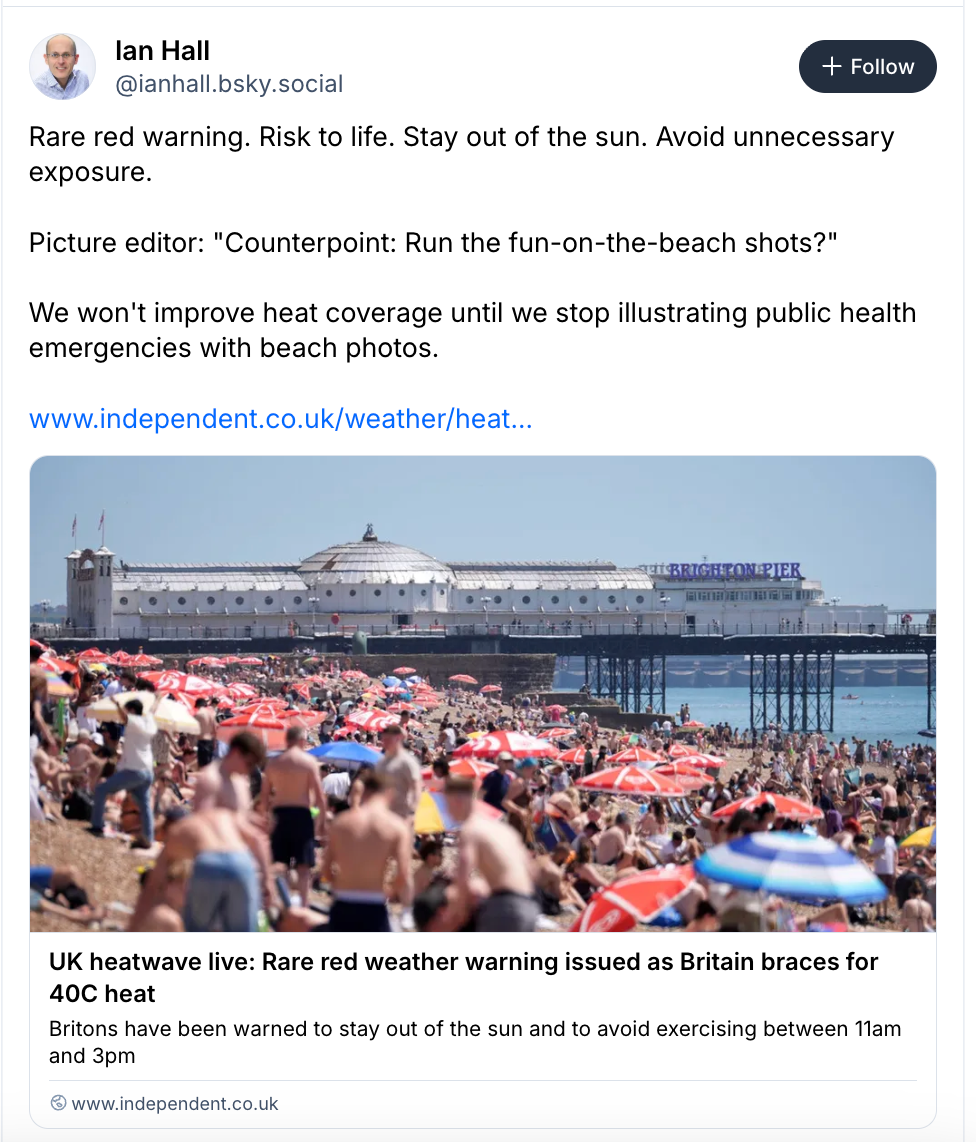
“Rare red warning. Risk to life. Stay out of the sun. Avoid unnecessary exposure. Picture editor: ‘Counterpoint: Run the fun-on-the-beach shots?’” climate scientist Ian Hall wrote on Bluesky, above an article showing a packed beachfront.
“We won’t improve heat coverage until we stop illustrating public health emergencies with beach photos,” he added.
Another news outlet shared an image of a woman in a red dress, wetting her hair in a fountain, alongside a story about canceled sport events in Spain and Germany and the news that France banned alcohol in red-alert areas due to the heat.
But that isn’t the right kind of image to illustrate such a heat wave, Gernot Wagner, a climate economist with Columbia Business School, wrote on Bluesky. “It’s a young woman on a gurney, fighting for her life after a heat stroke.”
Fast Company reached out to both news outlets for comment.
The media images alongside heat waves matter
The images alongside news stories of extreme heat may seem unimportant, but they do matter.
A Yale Program on Climate Change Communication study from February found that positive images of heat waves reduce people’s worry about extreme heat.
When messaging about extreme heat was paired with “negative or neutral” images, like someone showing signs of heat exhaustion or sitting in the shade, then people “became significantly more worried about heat waves and more convinced that climate change is making heat waves more likely,” the authors wrote.
But when that messaging was paired with positive images like people at the beach or in a pool, there were no such effects, the study found.
(For this June European heat wave, climate change made the extreme heat five times more likely, what Climate Central called an “exceptional climate-influenced event.)
Conveying the serious impacts of extreme weather is part of the responsibility of such news articles, Wagner says.
“Heat kills—people, productivity, you name it. Saying as much in words—and yes, also with pictures, which, no offense, is how most people consume the news—is one of the more basic functions of journalism,” he told Fast Company via email.
“Most people don’t experience heat waves as a pleasant day on the beach,” he adds. “They experience them sweltering, trying to keep up with daily life.”
The images also directly contrast expert advice.
Though articles showed shirtless men on beaches or by water, Britain’s Met Office specifically warns people to “keep out of the sun,” or if they are outside, to stay in the shade.
It’s difficult to show the impacts of extreme heat. Unlike a flood or hurricane, heat waves aren’t always as visually destructive. (In some instances, though, they have caused infrastructure damage, like buckling roads and train rails.)
But heat has other impacts too. Along with the health effects, Wagner thinks about the economic effects. He knows that it’s a challenge, he says, to show that “one additional day above 32 °C (90 °F) lowers annual payroll by 0.04%, equal to 2.1% of average weekly earnings.”
“I do know a picture of young people having fun at the beach isn’t it,” he adds.