
If you live in a place with a cold winter, dressing for work in the middle of January is more complicated than it seems.
You want to wear your jeans to the office, but ordinary denim doesn’t provide enough warmth on freezing day. The available solutions aren’t great. You could wear thermal leggings under your jeans, but you’ll start sweating the minute you leave the sidewalk to enter your heated building. Fleece-lined jeans are often stiff and bulky.

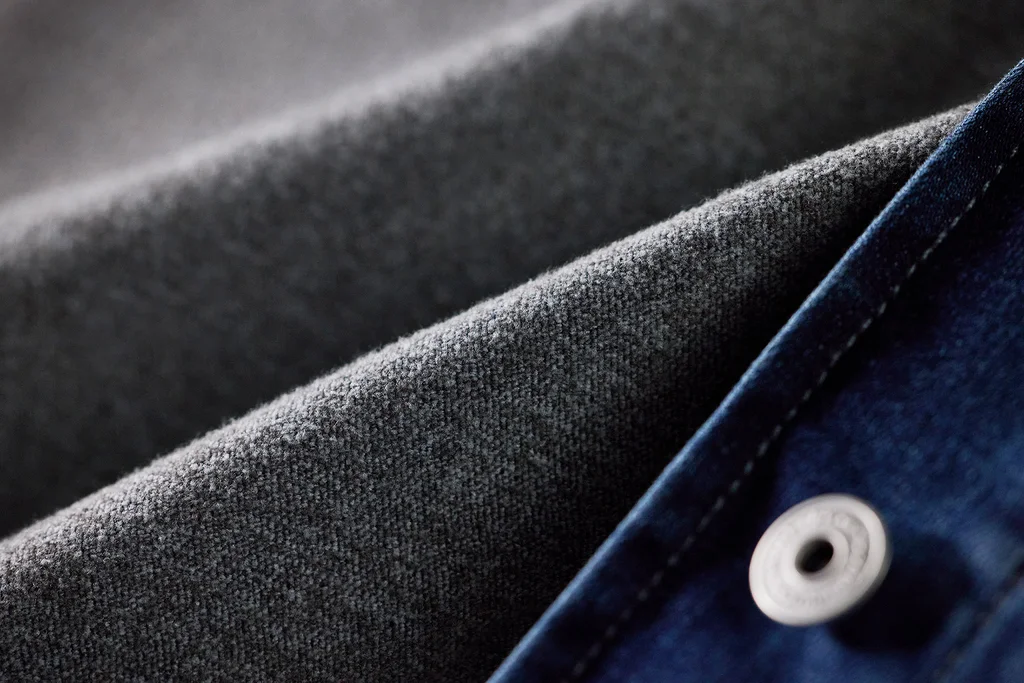
Du/er, a decade-old Canadian brand, has been working on a better alternative. Today it launches Tech Fleece, a fabric that weaves fleece and denim together at the yarn level instead of attaching a separate liner inside a jean. On the exterior, the pants look and feel like a regular pair of jeans. But on the inside, the part that rubs against your skin feels soft and fleecy, while holding warmth. Du/er’s design team also focused on making the fabric stretchy, breathable, and water repellent, so it keeps you dry in rainy weather.
They are releasing it in two styles, a men’s jean and a women’s utility pant, which are both available online and in the brand’s stores for $159.
Jeans for bicyclists
Gary Lenett, Du/er’s founder and CEO, spent nearly four decades in denim manufacturing, working for some of the biggest players in the industry, including Levi’s. At 56, though, he felt burnt out from a career that required him to spend a third of the year in Asia, visiting factories. He decided to quit his job, retire early, and downsize his lifestyle. He gave up his car, and started biking around his hometown of Vancouver.
That’s when he realized that he had nothing to wear. His jeans weren’t comfortable for biking and he had no interest in wearing activewear. “I don’t want to wear my gym clothing throughout my day,” he says. What he was looking for was everyday clothing, like jeans and flannel shirts, that had some of the benefits of athleisure. And given his background in manufacturing, he knew how to turn this vision into reality.
At the time, most men’s denim was heavy and rigid. Lenett had spent years running women’s brands, where lightweight stretch fabrics were standard, and he says the industry was skeptical about bringing them to men. “The conventional wisdom was that men were going to find them too feminine,” he says. “But I thought that once men tried them out and saw how much easier it was to move in them, they would love them.”
He was right. After two years of developing the brand, he launched Du/er in 2015 with two men’s trousers. There was a “Performance Denim” that is blended with a fabric called Coolmax, which is used in athletic wear to regulate temperature and wick sweat. Then there was a “No Sweat” trouser that feels like sweatpants. The brand got traction immediately. These two pieces still make up about 70% of sales.
The company has since gone into womenswear, and is rapidly expanding. It doubled its women’s business last year, and is growing at an overall rate of 40% year over year. It has 14 stores across North America—another five are planned for next year—and also sells through 1,000 retailers, including REI and Nordstrom. Du/er has no outside investors, has been profitable since its third year, and expects to generate $70 million this year.
Life after leggings
Athleisure dominated the 2010s and peaked during the COVID-19 pandemic, but the category is now cooling. Lululemon—another Vancouver brand that arguably invented athleisure with its yoga pants—is feeling it. Sales of its women’s leggings dropped about 20%, which the company attributed to shoppers shifting toward looser silhouettes. In early September, Lululemon cut its full-year outlook to a revenue decline of up to 7%. A new CEO, Heidi O’Neill, took over earlier this month.
Lululemon raised the bar for all of apparel. Shoppers now expect everyday clothes to stretch, breathe, and move with them. That’s the gap Du/er is trying to fill. And now, Lennett is hoping to bring a new level of technical innovation to denim with Tech Fleece.
Historically, most warm jeans have been made by bonding a layer of denim and fleece together. But this creates a very thick fabric that can be uncomfortable. And worse: The two layers can separate if you launder them too much. Du/er’s version is just a single layer of woven fabric. It deploys a weaving technique that creates a dual-sided fabric: an exterior side that looks like denim and an inner lining that feels soft.
But it also has all the features of athleisure. It is lightweight and stretchy, thanks to spandex in the fabric blend. The brand uses Coolmax, a polyester that is designed to pull moisture away from skin and dry quickly, which helps wearers regulate their temperature when they move from the cold into a warm indoor environment, and may start sweating. “You’re getting warmth without the weight,” Lenett says. “You could wear this into the office and no one’s going to know you’re wearing a lined jean.”
Tech Fleece arrives just as temperatures drop across the Northeast and Canada, and just as Du/er pushes deeper into the U.S. market. Lenett knows competitors will likely try to mimic it. While the fabric is patented, he points out that companies can alter the fabric by just 1% or 2% and get around the copyright. “Does it mean someone else can’t copy us?” he says. “No. We just have to keep innovating.”