
Want more housing market stories from Lance Lambert’s ResiClub in your inbox? Subscribe to the ResiClub newsletter.
In today’s article, we’re sharing the full results from the Zoodealio-ResiClub Real Estate Agent Survey—Q3 2026. To conduct our real estate agent survey, ResiClub partnered with Zoodealio, a cash-offer platform and iBuyer-management software designed for real estate agents.
Among the 208 real estate agents/brokers who took the survey, nearly half (44%) have been real estate agents for 15 years or longer.
The survey was fielded between August 17 and September 29, 2026. Respondents included real estate agents spanning all regions of the U.S., giving us a ground-level view of seller urgency, seller motivation, leverage shifts, commission structures, and expectations for the next 12 months.
Here’s what the results revealed.
Buyer demand cools, and leverage continues to shift away from sellers
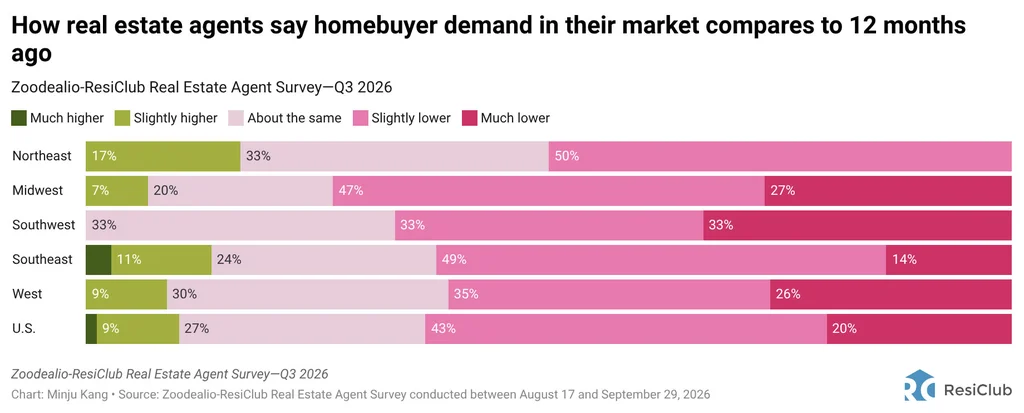
Nationally, a majority (63%) of agents report lower homebuyer demand relative to 12 months ago. The pullback is most pronounced in the Midwest, where 74% of agents reported seeing lower demand. In the Southwest, no agents reported seeing demand pick up, and 66% reported lower demand.
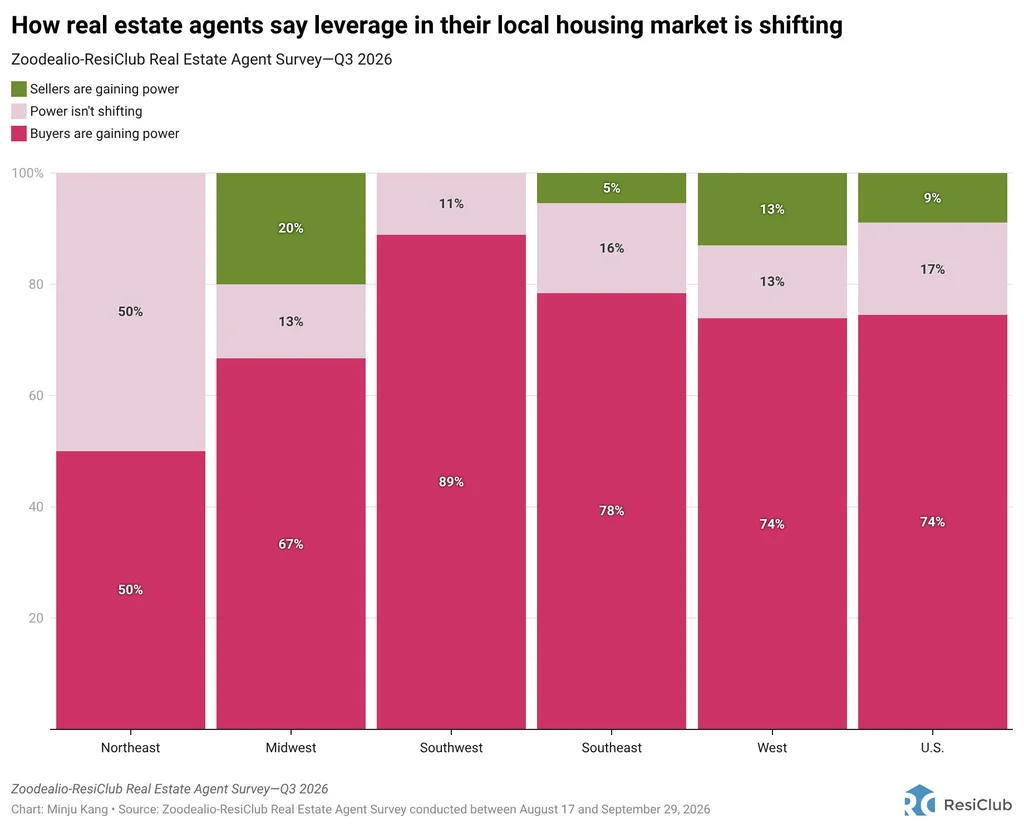
As buyer demand softens, nearly three in four U.S. agents (74%) say leverage is shifting toward homebuyers in their local housing markets. That share is highest in the Southwest (89%), followed by the Southeast (78%) and the West (74%).
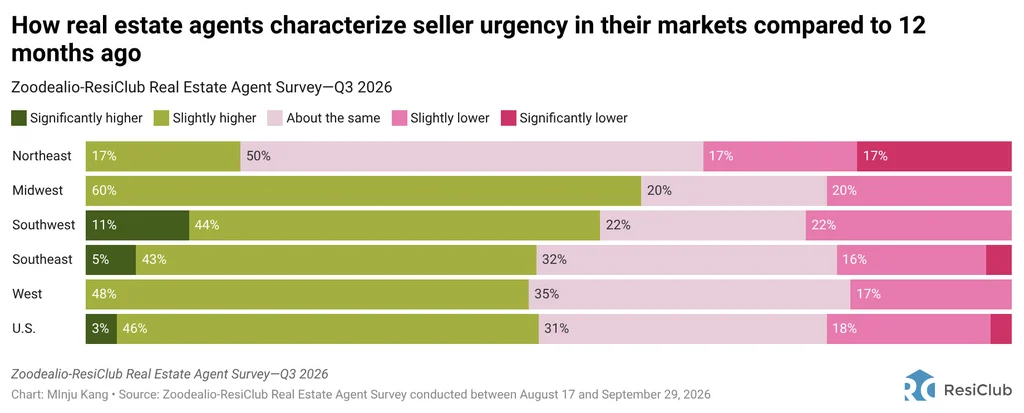
As buyer demand fades, seller urgency is rising. Nationally, 49% of agents say seller urgency is higher than it was 12 months ago, led by the Midwest (60%), Southwest (55%), and Southeast (48%). In these regions, fewer sellers appear willing to wait for conditions to improve.
By contrast, the Northeast looks more stable: 50% of agents there say seller urgency is about the same as a year ago, and half say leverage isn’t shifting in either direction.
Agents’ 2027 expectations
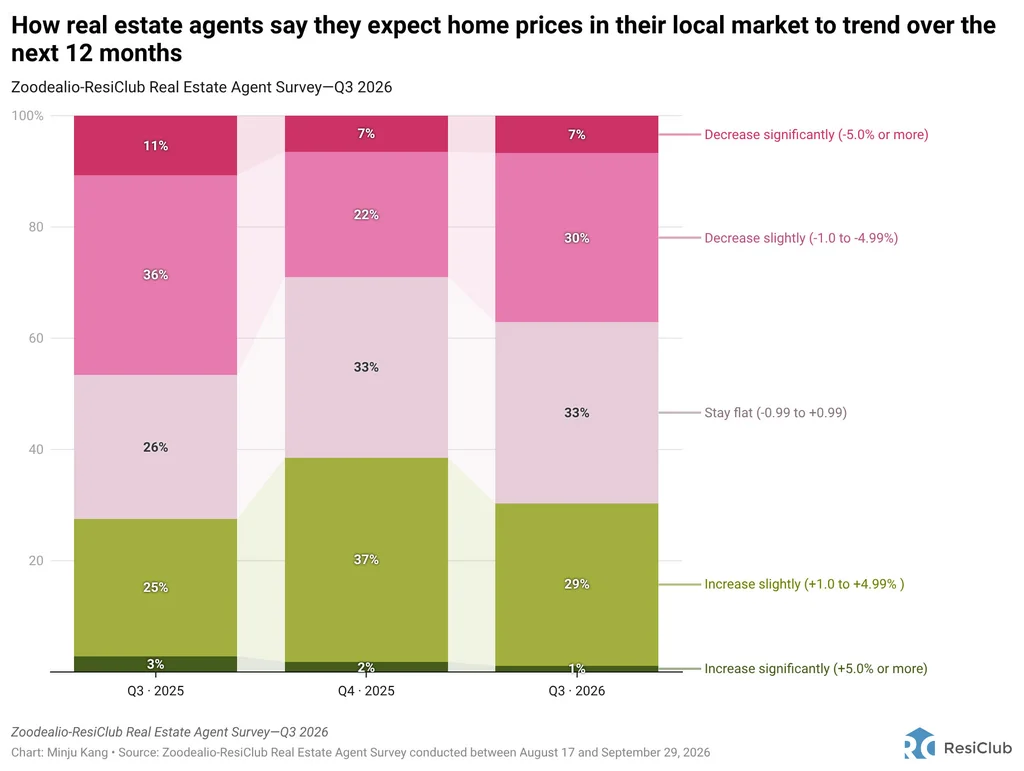
In Q3 2026, 30% of agents surveyed expected home prices in their local market to increase over the next 12 months, down from 39% in Q4 2025. The shift was driven by a rise in agents expecting slight declines (30%, up from 22%), while the share expecting prices to stay flat held steady at 33%. Only 1% of agents anticipate price increases of 5% or more.
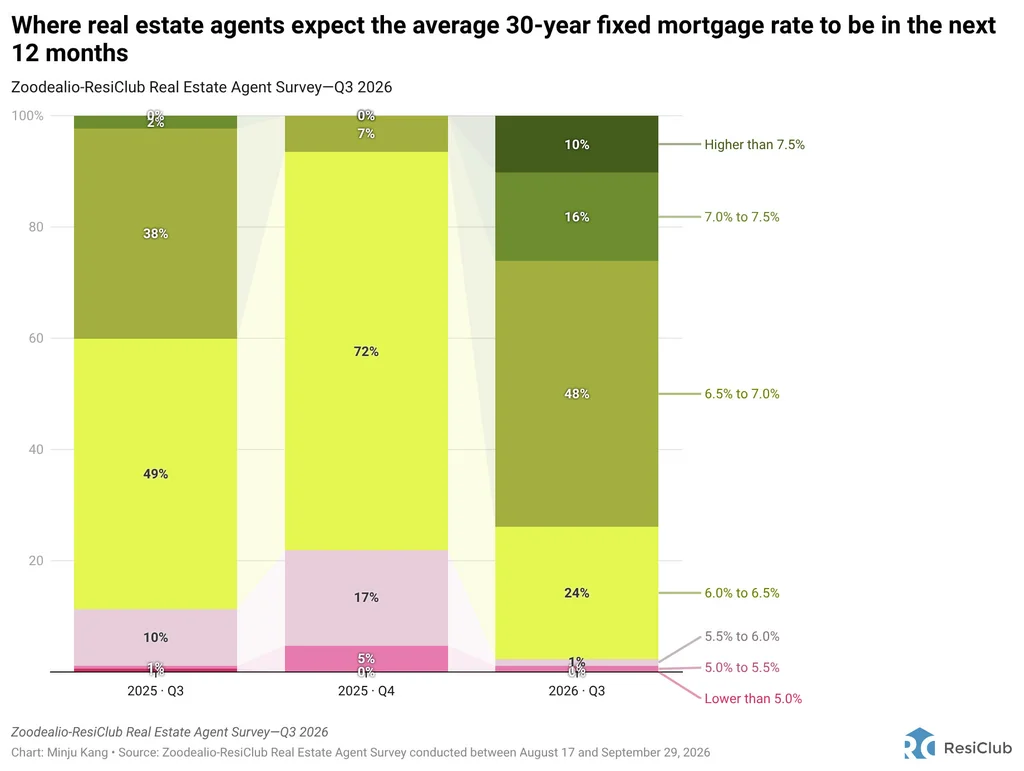
Mortgage-rate expectations have moved higher since our last survey. At the end of 2025, most agents were bracing for a lower-rate outcome, with expectations centered on a low-6% range. As 2026 progressed, that view shifted: in Q3 2026, the largest share of agents said they expect rates to land in the upper-6% range over the next 12 months, with far more expecting the average 30-year fixed mortgage rate to hold above the 7.0% range or higher.
Agent confidence weakens, with fewer than half optimistic about the year ahead
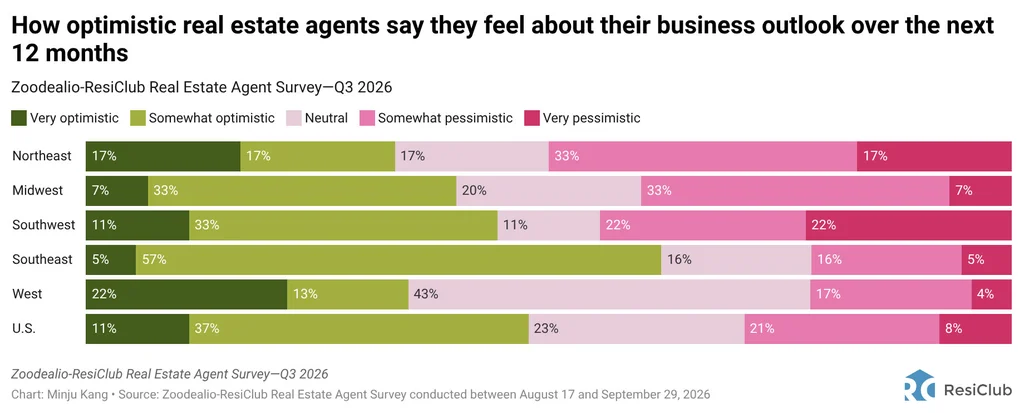
Among real estate agents surveyed, 48% describe their business outlook for the next 12 months as optimistic, down from 60% in Q4 2025. Agents in the Southeast remain the most optimistic (62%), while pessimism is highest in the Northeast, where half of agents (50%) describe their outlook as pessimistic. Agents in the Southeast operate in relatively larger new construction markets, which haven’t contracted nearly as much as resale volumes over the past four years. Northeast agents, by contrast, rely far more on resale transactions, so they’ve been hit harder by resale turnover hovering near 40-year lows.
Agent commissions are holding up—but they’re still mad at NAR
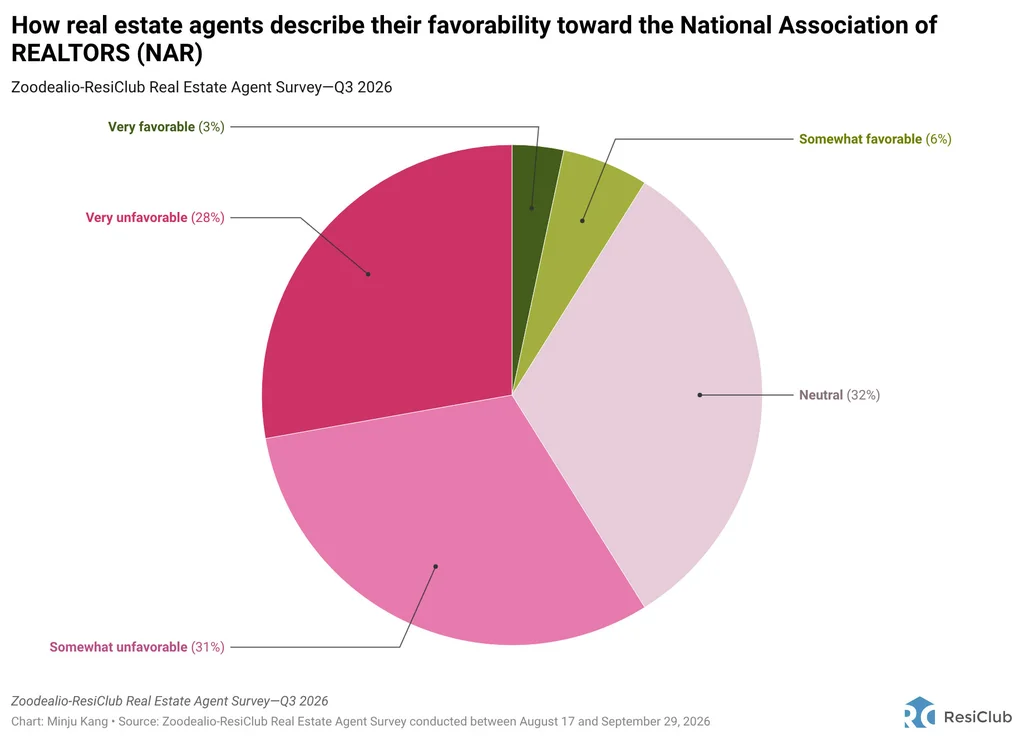
Sentiment toward the National Association of Realtors remains weak: 59% of agents describe their view as somewhat unfavorable (31%) or very unfavorable (28%), while only 9% express a somewhat favorable (6%) or very favorable opinion (3%) of the trade organization.
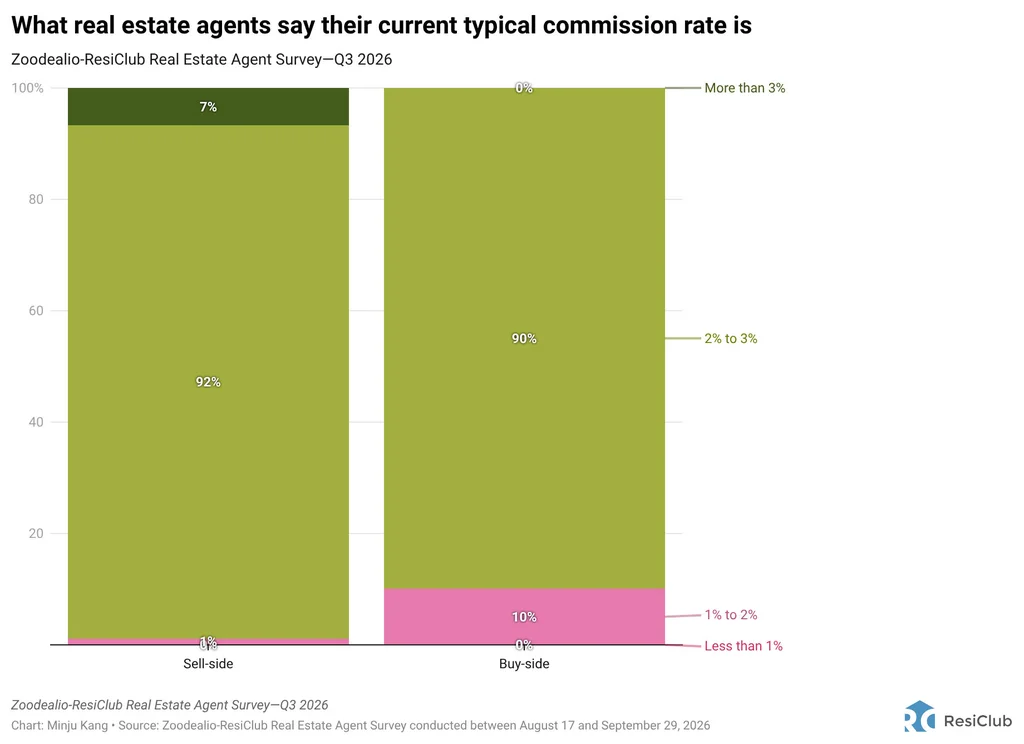
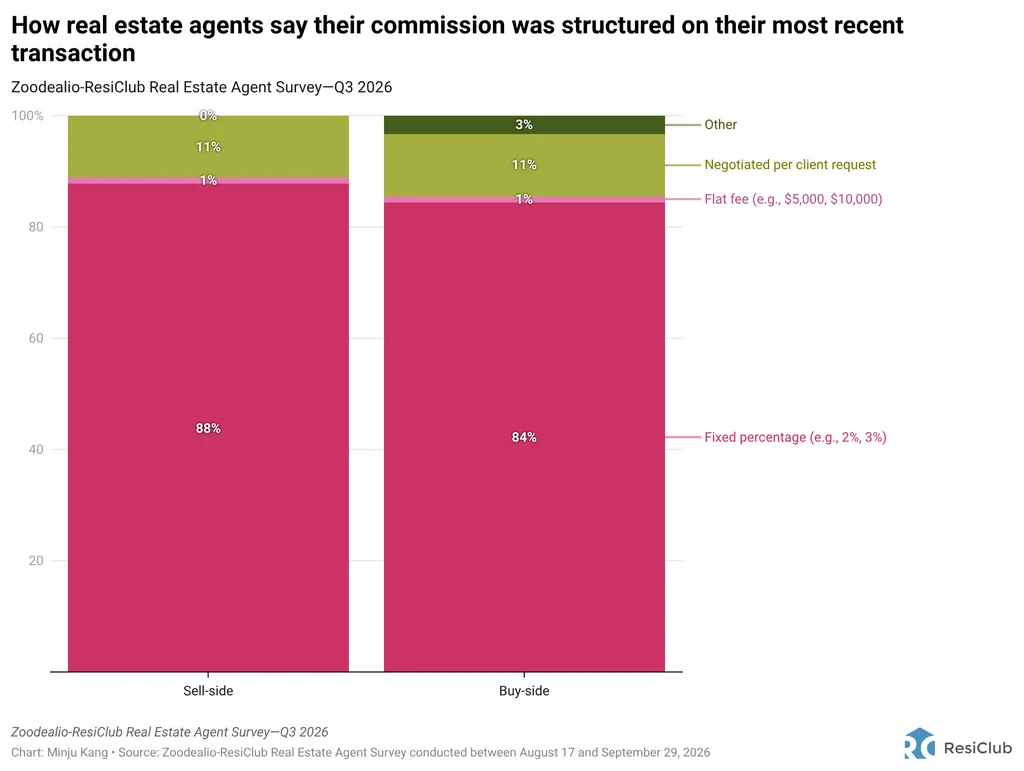
Agent compensation structures remain largely similar to the way they were prior to the March 2024 National Association of Realtors settlement: 88% of sell-side deals and 84% of buy-side deals still use fixed-percentage commissions, mostly in the 2% to 3% range. Alternative structures are more common on the buy side but remain a minority.
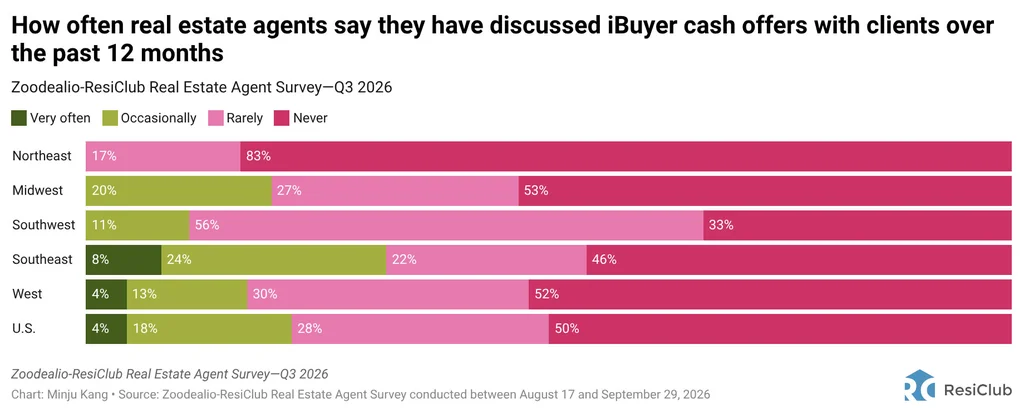
Meanwhile, about 4% of U.S. agents say they have discussed iBuyer cash-offer options with clients “very often” in the past year. These conversations are most common in the Southeast, where 32% of agents discussed them very often or occasionally, while 83% of agents in the Northeast say they have never discussed them.
Clients are bringing AI to the table—and agents are using it too
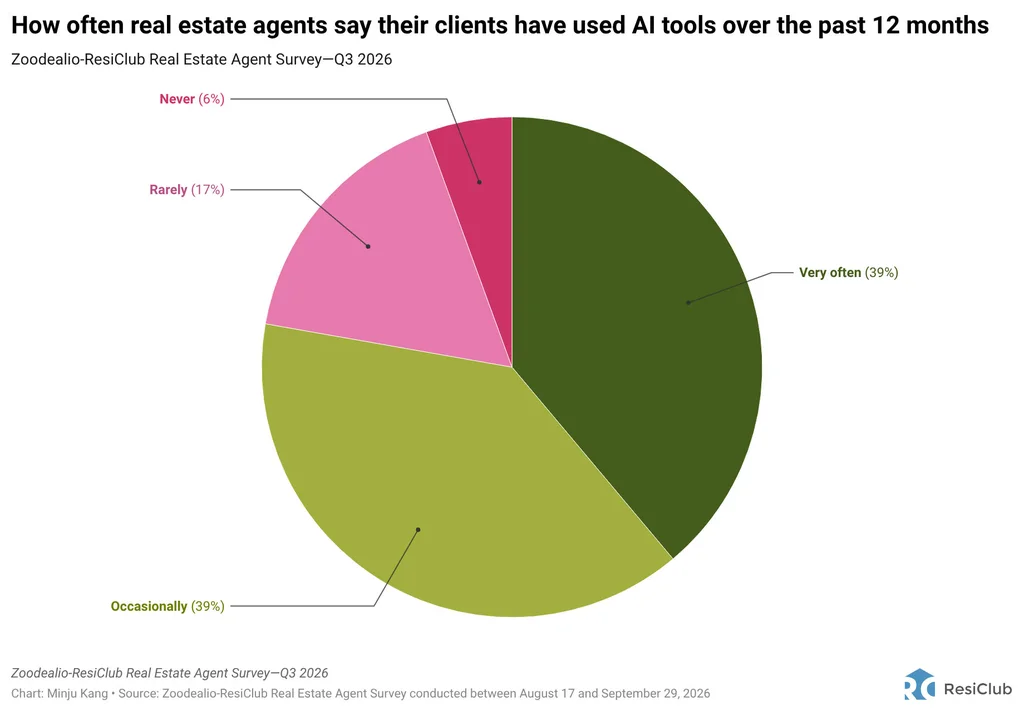
AI has quickly become part of the home buying and selling process. Among agents surveyed, 78% say their clients have used AI tools to research pricing, listings, or the transaction at least occasionally over the past 12 months, including 39% who say clients have done so very often. Only 6% say their clients have never used AI tools.
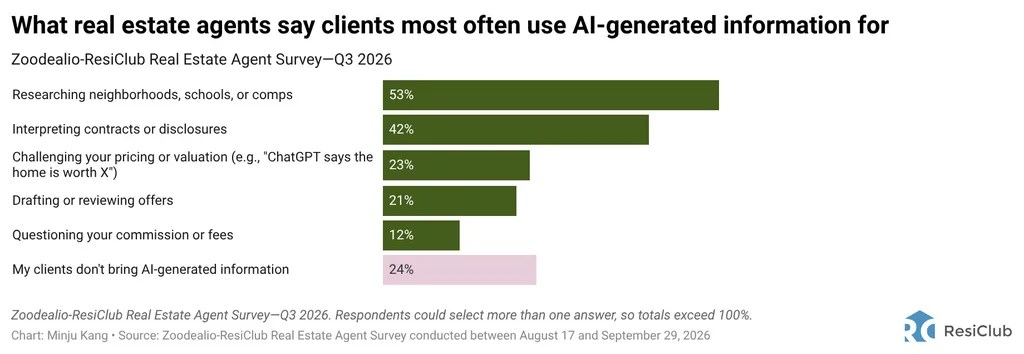
When clients bring AI-generated information, they most often use it for researching neighborhoods, schools, or comps (53%), followed by interpreting contracts or disclosures (42%). Among real estate agents surveyed, 23% say clients have used it to challenge their pricing or valuation, and 12% say clients have used it to question their commission and fees.
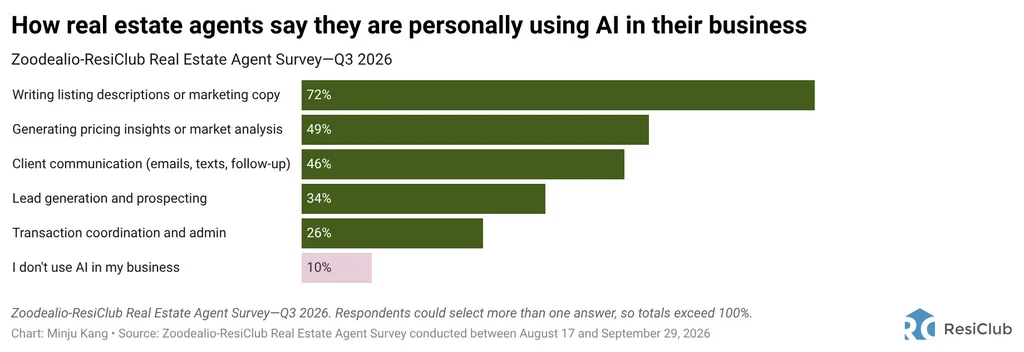
Agents are adopting AI themselves, with 90% saying they use it in their business. The most common use is writing listing descriptions or marketing copy (72%), followed by generating pricing insights or market analysis (49%) and client communication (46%).
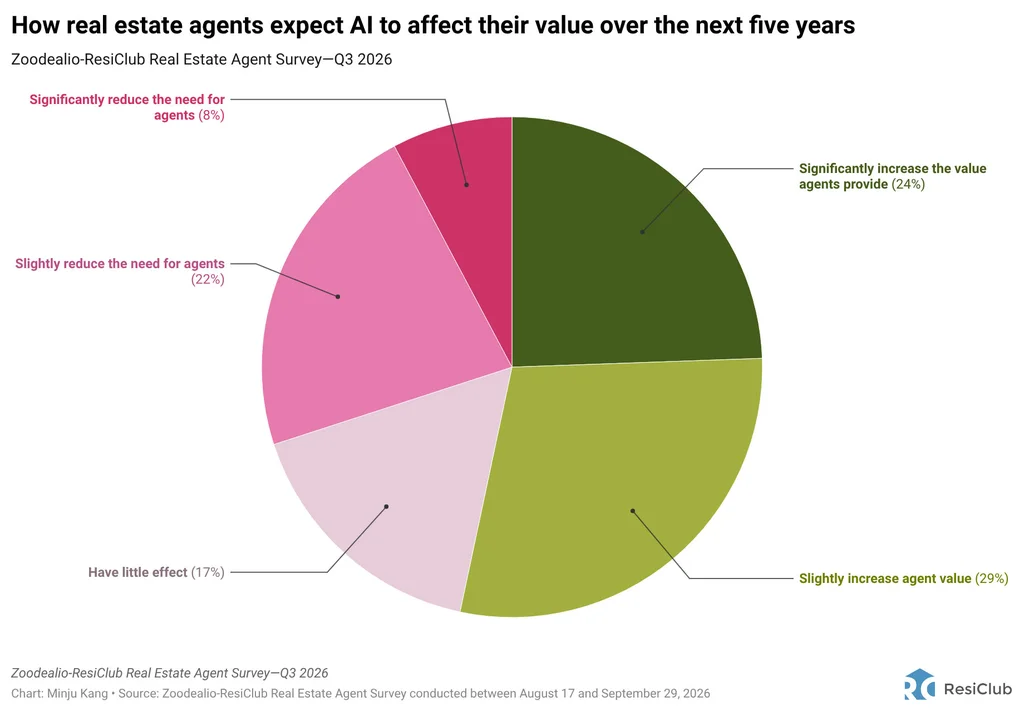
Looking ahead, most agents see AI as a tool rather than a threat. Over the next five years, 53% believe AI will increase the value agents provide, while 30% think it will reduce the need for agents, including 8% who expect a significant reduction.
Big picture
Relative to the Q4 2025 survey, the Zoodealio-ResiClub Real Estate Agent Survey results from Q3 2026 show a market moving in the same direction, but with softer momentum. Buyer urgency has cooled further, seller urgency has picked up, and the majority of agents (74%) say negotiating power continues to shift toward buyers, though that share is down from 82% (Q4 2025).
At the same time, expectations have turned more cautious: fewer agents anticipate home price increases over the next 12 months, more expect slight declines, and agents now expect mortgage rates to land higher, mostly in the upper-6% range. Agents’ business outlook has dimmed as well, with fewer than half (48%) describing themselves as optimistic, down from 60% (Q4 2025). Meanwhile, post-settlement agent sentiment toward NAR remains poor, and commission structures remain largely unchanged.