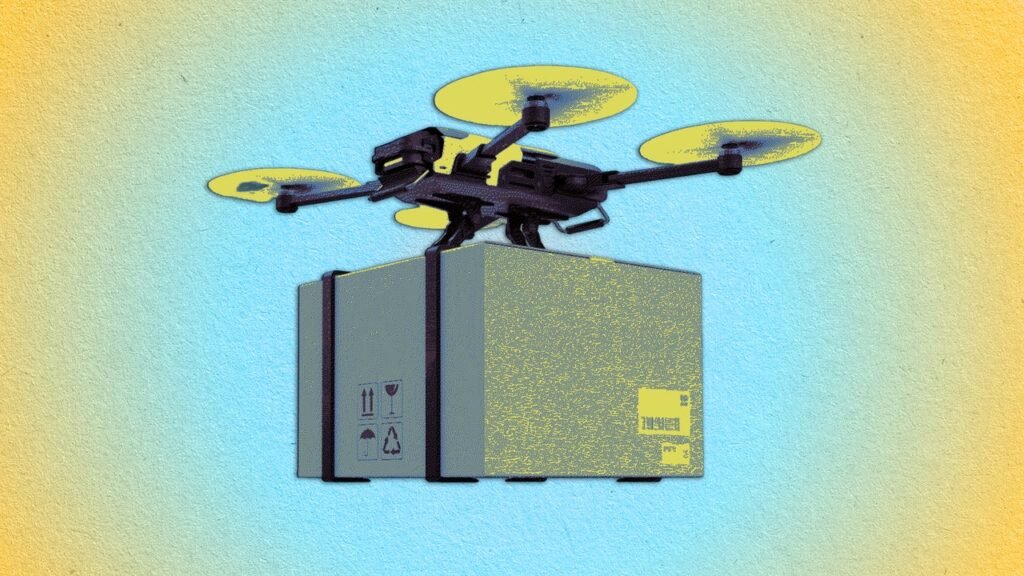
For more than a decade, the story of drone delivery was about improving the technology and getting federal permission for the drones to take to the airwaves. Could companies get the Federal Aviation Authority to approve flights beyond the operator’s line of sight? Would regulators let one pilot supervise many aircraft? The assumption was that once Washington said yes, the drone business would take off.
Washington is edging toward saying yes. What comes next is less predictable, because once drones are out in the wild, it’s hard to know how people will interact with them in real life. In Richardson, Texas, a Dallas suburb, residents running their own trackers have logged more than 50 low-altitude flights on some days, at roughly 170 feet, close enough to be heard indoors. Neighbors have started calling the traffic a “drone highway.” In College Station, Amazon’s longtime test market, the FAA found residents’ complaints meritless or outside its jurisdiction. Amazon cut flights anyway, switched to a quieter drone, and planned to let its lease lapse.
That is a weak signal worth paying attention to. The first-order expectation for incorporating drones in delivery systems is that packages can be delivered more quickly and, without the need for human labor, potentially more cheaply than alternatives. Indeed, when Jeff Bezos first announced Amazon’s intention to add drones to the mix in 2013, the idea attracted widespread, and mostly positive, attention. The second-order effects appear only once the technology scales, and they may change the viability of the model more than any rule from the FAA.
The assumptions hiding in the business plan
In discovery-driven planning, I ask teams to write down what has to be true for their plan to work, then test those assumptions before committing serious resources. For drone delivery to be successful, one of the biggest assumptions is that drones will be less expensive than comparable tasks performed by humans using conventional methods.
In a cautionary report from 2023, McKinsey challenged that assumption. The consultancy found that the cost of a single drone delivery was $13.50, more expensive than a similar delivery task performed by either electric cars or vans or any vehicle making multiple deliveries on a run. In the same study, McKinsey estimates that if one operator can eventually manage 20 drones at once, a delivery could cost about $1.50 to $2. That is roughly what a van costs when it delivers 100 packages on a single route. In other words, even in the best case, drones are about even with a well-run delivery van. There isn’t much room for things to go wrong.
The picture gets gloomier for drones if citizen objections forces delivery companies to restrict the routes they can use. Most economic assumptions about drones assume that they can fly in straight lines. Not necessarily so fast. Local governments can’t dictate flight paths. The FAA has been clear that states and cities may not regulate aircraft operations. But local governments have a strong lever: they can regulate land use and takeoff and landing locations, even though the airspace is federally controlled. Given the limited range of battery-powered drones, lawyers have pointed out that a citywide ban on takeoffs and landings would, in practice, amount to a ban on drone operations.
So, I would expect the question of routes to be settled through negotiation. A city might approve a hub only if the operating company commits to routing flights over rail lines, utility corridors, commercial land, and waterways, and away from backyards and schools. Some companies will make that commitment before anyone asks, to protect the community goodwill that lets them keep operating. However it happens, the result is the same: the straight line assumption in the business model starts to look more like a squiggle.
What corridors do to the math
A delivery van becomes cheaper per package as demand grows, because each added stop on the route doesn’t add a lot of extra costs. Drone delivery doesn’t have those economics—each individual delivery costs the same. Restrictions on where they can fly makes that basic problem worse.
Suppose a customer is two miles away in a straight line but three miles away by the approved route? Several costs follow.
The first is lost reach. Battery range is limited, so every extra mile of detour shrinks the effective delivery radius. The number of reachable customers depends on the area served, which grows with the square of the radius. A 25% cut in effective radius therefore removes about 44% of the households a hub can serve.
The second consequence is thinner coverage of fixed costs. Each hub has a lease, permits, staff, and charging infrastructure. With fewer customers per hub, each package carries more of that cost.
The third is fewer trips per drone. Longer flights mean each drone completes fewer deliveries per hour, which is the productivity measure the whole model depends on.
The fourth is hubs moving farther out. Communities will push launch sites toward industrial areas, farther from where customers live, which makes every flight longer still.
Put these together and drones look less like a replacement for the delivery van and more like a premium courier service.
Opposition grows with success
Ironically, the more successful drones become, the more likely they are to spark local opposition. Route optimization concentrates traffic on the most efficient paths. The benefits are spread widely: many people each get a phone charger or a ham sandwich in 30 minutes. The costs fall heavily on a few: the families living under the flight path. Political economists have long observed that concentrated costs produce organized opponents, while spread-out benefits rarely produce organized supporters.
There is also an irony in who gets served. After a drone ran into trouble near a large building, Amazon said it had removed all buildings of similar height and size from its delivery portfolio, meaning big multifamily developments. That shifts the service toward single-family suburbs, which is where homeowners’ associations, the most organized opponents of any neighborhood nuisance, are strongest.
If only allowing flights along approved corridors become the price of permission, the underlying economics of owning the corridors changes as well. Railroads, utilities, and pipeline easement holders suddenly have something valuable to rent out, and they will want to be paid for that. Add possible compensation for homes under flight paths and ongoing spending on community relations, and the cost structure picks up expenses that probably weren’t in the original spreadsheet.
Implications for our drone delivery future?
The economics of the business will need to be reconsidered to at least model out corridor-based routes. Model the extra distance, the smaller service radius, and hubs on the industrial edge of town. If the business only works with straight-line flights, that’s a lesson better learned early before a lot of investment has been made.
Community consent should also be treated as a design requirement, not a public-relations task after launch. In Richardson, several neighbors said only one homeowners’ association was notified before operations began. Local opposition was powerful enough to kill off Amazon’s desired second headquarters in New York City, prevent Walmart from setting up shop there and forced Airbnb to strictly limit its operations in many places. It should be taken seriously.
Drones may never become a cheaper version of the delivery van. They could well find markets for delivering prescriptions, or urgently needed parts. They may also make sense in rural areas where speed matters more than price and there are fewer neighbors to object. Indeed, in some places such as Rwanda, delivering medical supplies by drone has been a longstanding practice.
Amazon shut its Lockeford, California, site, is leaving College Station, and faces protests in Richardson. Each one is a cheap lesson about what full scale will need to look like.
The drone delivery business case was written with the sky in mind. Its fate will be decided on the ground.