
Gabrijelagal/Getty Images
- Social Security’s 3.6% cost-of-living adjustment exceeds recent job stayers’ wage growth.
- Economist Aaron Terrazas warns inflation could drive economic inequality.
- Baby boomers are helping to prop up the economy, as they’re in their core retirement spending years.
There’s an income premium for job switchers — and for retirees.
The Social Security Administration recently released the cost-of-living adjustment for next year. About 72 million recipients will experience a 3.6% increase in their benefits in January, higher than the September three-month moving average year-over-year median wage growth for job stayers at 3.4%.
Independent economist Aaron Terrazas said cost-of-living increases for Social Security beneficiaries were higher than job-stayers’ increases in three of the past six years, the most recent being the 8.7% 2023 increase announced in 2022 amid the post-pandemic inflation spike.
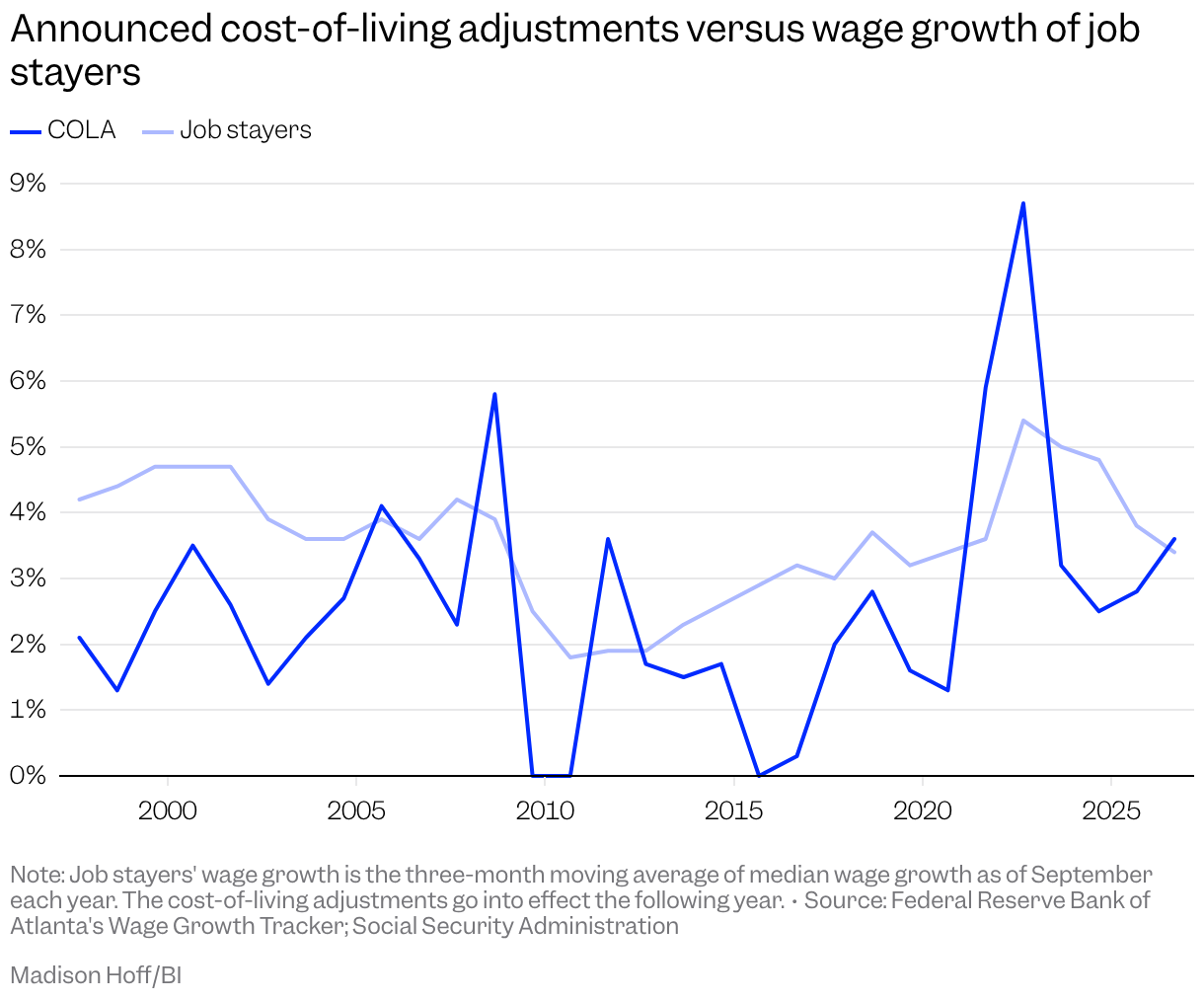
“Retiree income is adjusted with the cost of living, whereas people who are working are mostly compensated according to the cost of labor,” Terrazas said. “For most of the past decades, we’ve been in a low inflation labor shortage world, so that’s worked out in workers’ favor, but it feels like that’s shifting underneath the surface.”
The headline consumer price index increased 3.7% from a year ago in September, moving away from the Fed’s 2% inflation target but down from the high rates back in 2022. The Social Security Administration bases the annual cost-of-living adjustment on the average of a related inflation rate during the third quarter of each year.
“Indexing incomes to the cost of living rather than cost of labor is a big part of what fueled inflation, the wage-price spiral in the 1970s,” Terrazas said. “We moved away from that practice for most of the workforce, but not for retirees. With the growing share of Americans in their retiring years, more and more consumers are, whether we want it or not, having their incomes indexed to inflation rather than the cost of labor.”
This, Terrazas thinks, could continue to drive the K-shaped economy of the haves and the have-nots, as he said older consumers are driving an outsize share of spending, although that could change as boomers start to age out of the peak retirement spending years.
“Baby boomers are in their core retirement spending years,” he said. “When we think about consumer trends and what’s holding up the economy, that is something we can’t forget — that once people reach their 80s, we should expect that spending to start to contract as people become homebound.”
Meanwhile, the three-month moving average for job switchers was higher than for job stayers and higher than the announced COLA, so job-hopping could be better than job-staying if you prioritize earning more. The problem is that it may be hard to find a new opportunity, depending on where you’re looking. White-collar fields have been experiencing job loss, and employment levels in the leisure and hospitality sector have been pretty volatile.
The US has spent the last couple of years in a low-hire, low-fire period: Layoffs are low, so if you have a job, you’re likely doing OK, but job openings and hiring have also been anemic, making an ominous situation for job seekers.
While that means employees may be more secure if they have a job, it also means employers don’t have to do a lot to convince people to stay. Some workers have turned to “loud working” to try to make sure their accomplishments are being heard internally at their company or externally via LinkedIn or other platforms, whether that be because of fear of job cuts, to make the case for a raise, or some other reason.
“It’s tough, I think, for job seekers to see headlines when we get the jobs report that unemployment is low, we’re continuing to create jobs, but it’s something very different from what they’re feeling,” Terrazas said. “And so I think it is important for them to understand that message that they’re not alone. Many people, especially in white-collar work, are struggling to find new jobs or struggling to stay afloat in their workplaces.”