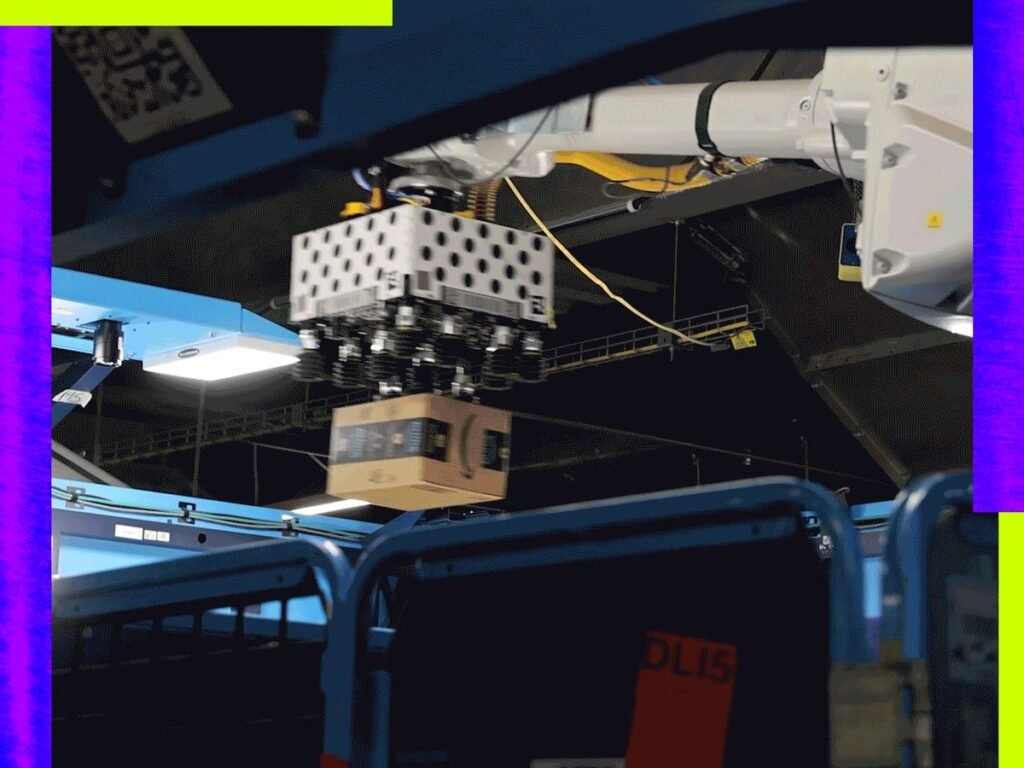
At Amazon’s sprawling fulfillment center in Tracy, California, robots carry shelves, sort packages, and move carts toward delivery trucks.
But this is not a fully automated operation.
Thousands of people still work alongside the machines, picking and packing orders, loading trailers, clearing jams, handling damaged items — and stepping in when the automated system hits a problem it cannot solve.
Business Insider toured the facility recently to see how warehouse work is changing as Amazon deploys more robotics technology.
These photos and videos show how people and robots work side by side, offering a glimpse of a more autonomous future.
This is the latest installment of Robonomics, Business Insider’s series on the rise of robots and their impact on business, jobs, and everyday life. We’ve unpacked the investment boom in robotics and spoken to Amazon warehouse workers to see if machines were taking their jobs.
This is the entrance to Amazon’s robotics fulfillment center in Tracy, California.
Jess Lynn Goss for BI
Workers and visitors pass through security gates before entering.
Amazon’s robotics warehouse in Tracy, CA
Jess Lynn Goss for BI
The Tracy warehouse spans 1.4 million square feet, roughly the size of 23 football fields.
Eugene Kim
Amazon says its next-generation fulfillment centers are about 25% more productive, and support roughly 30% more skilled jobs.
Jess Lynn Goss for BI
At Tracy, employees stow items in fabric pods that Hercules robots carry to pick stations.
Jess Lynn Goss for BI
Hundreds of Hercules robots carry towering yellow inventory pods to employee workstations.
Jess Lynn Goss for BI
This is Robin, a robotic arm that picks finished packages from a conveyor.
Jess Lynn Goss for BI
The packages are then placed on Pegasus mobile robots.
Jess Lynn Goss for BI
The Cardinal robotic arm then loads the sorted packages into tall metal carts.
Jess Lynn Goss for BI
Proteus, a mobile robot, then carries the carts toward outbound trucks. Loading trucks still remains manual work, with employees arranging packages to make the most of the available trailer space.
Jess Lynn Goss for BI
This is what Proteus looks like up close.
Jess Lynn Goss for BI
Human process assistants oversee warehouse robotic systems, coordinating responses when a chute jams or a robot stops working.
Jess Lynn Goss for BI
Briana Brager joined Amazon about two years ago as an entry-level employee. Now, she’s a process assistant who monitors the machines and responds when something goes wrong.
Jess Lynn Goss for BI
When a Proteus robot breaks down, it is sent to this diagnostic center for inspection and repair.
Jess Lynn Goss for BI
Another area of the warehouse is called “Jackpot,” where the automated system sends packages that get lost. A human worker determines where each wayward package belongs and returns it to the correct flow.
Eugene Kim
The employee cafeteria at Tracy. The facility employs more than 3,000 people, up from roughly 1,000 when it opened in 2023.
Jess Lynn Goss for BI
Mohammed Khan started as an entry-level picker 12 years ago and is now a senior manager at the warehouse. He said robots streamline work without necessarily eliminating it. “It’s not that the amount of work has changed, it’s how we approach it.”