Since August 2010, typing into Yahoo Search has meant getting a list of purple links yodeled by Microsoft Bing. That changes today. The Sunnyvale, California, company has rebuilt its engine powering its search using Scout, its AI answer engine launched as a beta in January. Eric Feng, senior vice president and general manager of the Yahoo Research Group, calls it “truly the biggest update that we’ve made to Yahoo search in years.” Scout is also colonizing all of Yahoo’s properties.
Feng showed me Scout over a video demo, and the redesign makes sense. Everything starts with a single input field and a choice right under it: Search or Scout. Pick Search, and Yahoo builds a results page around your query, mixing quick facts, links, and short AI summaries of news and different bits of information. Pick Scout, and you get a conversation with the AI, which cites its sources with inline links. The two views of the same query sit side by side.
Whatever you pick, you can quickly flip between the two views by clicking on a Search/Scout switch that is placed at the top of the window. Yahoo calls this Pivot Search. You can also “pivot” to Scout by clicking on a follow-up question or any other thing that shows the Scout icon. According to Feng, it’s AI and search fused into one experience, letting you “move seamlessly between those two types of experiences.”
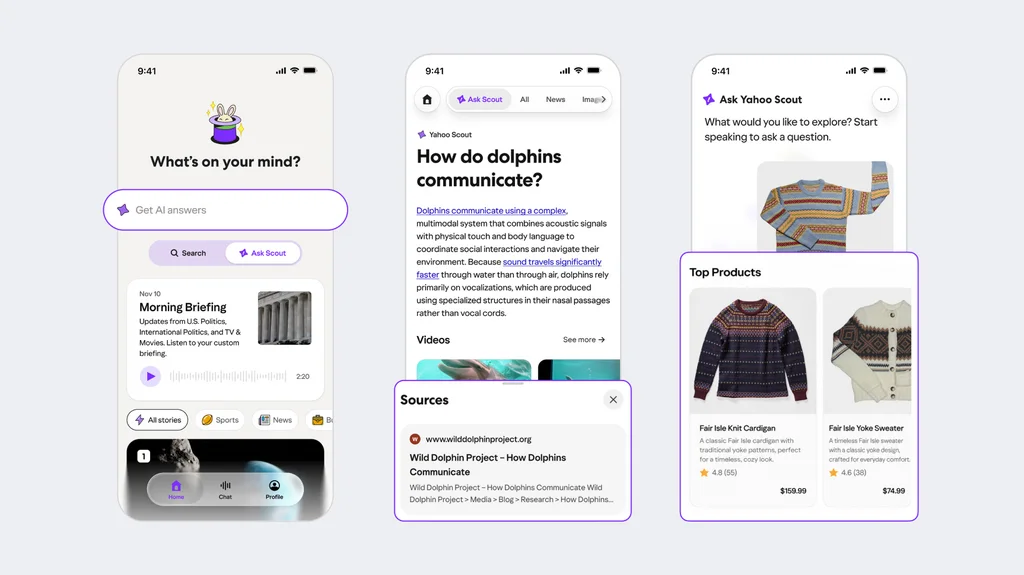
Scout started as a standalone answer engine built on Yahoo’s knowledge graph, a giant database of people, places, and things, powered by Bing and Anthropic’s Claude. Since it was introduced, Feng tells me, Yahoo has cut Scout’s response time in half and swapped that single Claude model for several third-party models, including Google’s Gemini. Each of these models gets assigned to the job they do best depending on the information you are looking for.
Having a free AI that gives nice answers is cool, but the models are all rented, so someone has to pay the bill. That’s ads, for now. Jim Lanzone, Yahoo’s CEO, says the goal is to use advertising to keep Scout free for everyone. “Maybe one day we’ll also have a paid tier,” he pointed out, “but free search is extremely important.”
Smart looks, smart answers
Yahoo’s redesign takes a swing at the question every search company is fumbling with. When a model can write you an answer, when do you still want links?
Yahoo’s solution—distilled from its nearly 10-month beta and about 3 billion Scout responses—is that whatever you type should decide what the page looks like. Cards, links, an AI explanation, or a mix of everything in the right quantities. Weather, sports, finances, life and entertainment, celebrities, news . . . all of them get a special layout treatment that, to my eye, looks nicer than Google’s templates.
Search for the Chicago Bears, and the top of the page fills with glanceable facts. The last game, the next one, the coach, and different useful bits of information that Yahoo—depending on the subject and its memory of you (more on this later)—thinks is what you will want to look at. Below come news stories, each with short “AI takeaways,” shopping links, plus common follow-up questions.
Search for Netflix, and Yahoo assumes you’re trying to get to Netflix. “I don’t want to read an explanation like, oh, how does Netflix’s recommendation system work?” Feng says. The AI answer is still on the page, “but look how far down we’ve slotted it.” Ask how to calculate compound interest, though, and the explanation leads. “Right now the users often need to understand the answer before they ask the question, which is strange,” he says.
Google is inching toward the same conclusion. In the U.S., since November 2, according to Search Engine Roundtable, its AI Overviews for brand searches have moved to the right-hand column on desktop, out of the way of the links. And for some queries, the summary now opens to full length on its own, with a chat box waiting underneath. But Google keeps shuffling AI pieces around a page built for blue links.
Yahoo’s new search results page, by contrast, feels like a clean, well-lighted place. The organization of the information in the search is clearer. And the Pivot Search feature is more intuitive to use than Google’s approach, which mostly puts its AI Mode at the same level as its other search types.
Scout leaves the search box
Outside of Pivot Search, Scout is showing up just about everywhere across Yahoo’s services. On Yahoo News and Yahoo Sports, a floating button opens a Scout chat window with questions tailored to the story you’re reading. You can talk to it and it will talk back to you—literally, with voice as well as text. In Sports, it knows which teams you follow. Yahoo Finance docks Scout on the right side of the page and lets it take actions for you there, agent-ish things like adding Nvidia’s earnings date to your calendar. Or dropping Shopify into your stocks watchlist.
That’s probably Scout’s biggest strength, since some of Yahoo’s services—like Finance or Sports—are very popular.
Feng tells me that Scout keeps memories to better serve you on any page you’re on. If you show interest in Nvidia news on Yahoo Finance, it will clock that. Right now, what you ask in Finance stays in Finance. Yahoo is looking at letting those memories carry over to other services too, which could be very helpful, though it means giving away some of your privacy. Feng points out that the memories can be controlled by the user and turned off. “We want to give users complete control over their data,” he says.
Yahoo also worked with ElevenLabs on a voice you can interrupt mid-answer, and one option is a clone of Yahoo’s cofounder, Jerry Yang. Talk to it long enough, Feng says, and it yodels. No, that’s not an obscure pun. It literally starts to yodel.
Scout’s biggest escape out of the search box, however, is that it now lives in Mozilla’s Firefox, too, just like Gemini lives in Chrome and Copilot lives in Edge. The company says it’s the first deal of this kind for its AI chat.
Whether this new search makes a dent in Google or Microsoft’s market share is yet to be seen. Yahoo is third after Microsoft, with both light-years behind Google. Feng hopes it does, as he points out that moving the needle just a point means billions in revenue and shareholder value. But the Scout integration across all Yahoo’s properties goes beyond the pure search. For its 700 million users, a free AI built built into their favorite services will be really useful. This new revamped Yahoo may actually have a fighting chance.