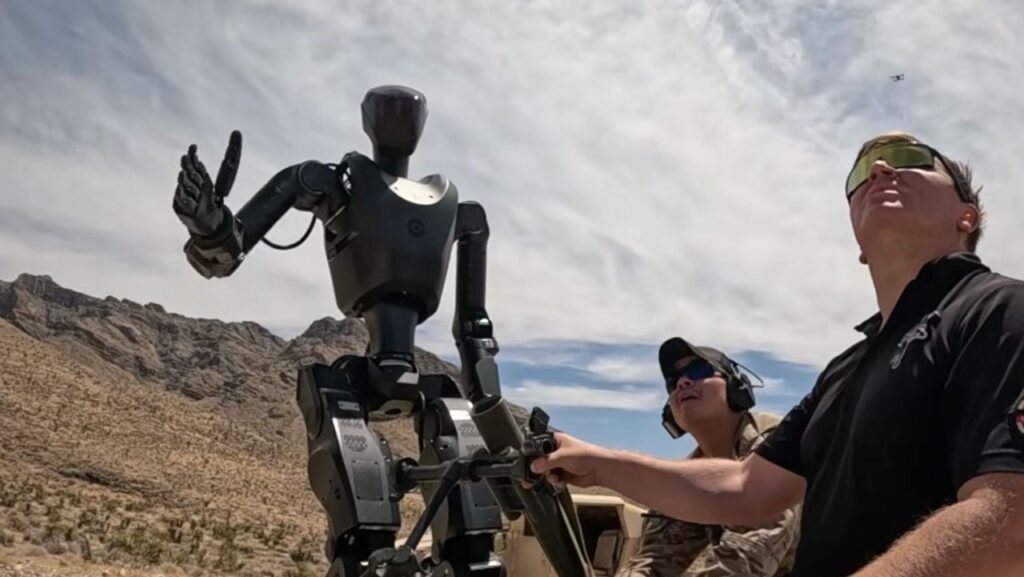
Foundation Future Industries, a startup backed by Eric Trump, has unveiled a humanoid robot that can carry 200 pounds while walking through rain, snow, and dust. The company wants its new Phantom MKII to work on construction sites and in factories—but the CEO isn’t ruling out putting weapons in its hands.
Sankaet Pathak, founder and CEO of Foundation, tells Fast Company his company would consider arming its machines if asked to by the U.S. military, arguing that deploying robots on the ground could reduce reliance on drones and air strikes.
“We’re not anti-weaponization and warfare,” he says. “That’s not something we have a blanket policy of just saying we’re not going to do.”
Phantom MKII is a second-generation humanoid designed for heavy industry and defense, unveiled today alongside Cortex II, the AI system that controls it. Foundation, which counts Eric Trump among its investors and advisers, has been particularly open about military applications—at times drawing controversy.
Earlier this month, the Financial Times reported that Foundation’s cofounder and president, Mike LeBlanc, was in direct talks with the Israel Defense Forces to supply up to 1,000 of its first-generation Phantom MKI robots for operations in tunnels beneath Gaza. Pathak disputes that characterization. “We’re not in talks with the IDF in any official capacity on deploying robots there,” he says. “What we have are very early exploration conversations.” When pressed about LeBlanc’s comments, Pathak says there is “literally nothing actively going on,” and there are no conversations progressing toward a contract.
Previously, Foundation said its machines had been tested with Ukrainian forces, while LeBlanc has described potential uses for them in detecting booby traps and trip wires.
For now, Pathak says most of Foundation’s defense work focuses on logistics rather than combat—though he doesn’t rule out deploying his machines on the battlefield. “Any time DOW [Department of War] will come to us and say, ‘Well, we need these robots more on the active battlefield with a weapon,’ to me that indicates that means less drones, less air strikes, more precision,” he says.
Pathak believes ground-based robots could accomplish military objectives without bombing entire buildings, potentially shortening wars.
Whether deployed in war or on construction sites, which Pathak sees as the robot’s ideal initial use, the Phantom MKII is designed to be more capable than its predecessor. Foundation says the robot has weather-resistant joints and modular parts that can be replaced in the field, along with a battery that can run for up to six hours, though heavier payloads reduce that figure. At maximum capacity, Pathak says the machine can walk while carrying 200 pounds, compared with roughly 50 to 60 pounds for the previous version.
The Phantom MKII can do so thanks to significant redesigns of its actuators, the motors and gearing that make its limbs move. Its joints have been shrunk to around three-quarters the size of its predecessor’s, Pathak says, while delivering more than 1.5 times the performance. Smaller also means somewhat cheaper. Pathak claims the company has halved its bill of materials cost while simplifying assembly to make large-scale manufacturing more practical.
The goal is to begin producing MKII robots in early 2027. Initially, the company hopes to manufacture several hundred before ramping up to a few thousand by the end of the year. Production will initially remain in the San Francisco Bay Area; Pathak claims most components now come from the U.S. or allied countries.
Alongside the hardware improvements, Foundation claims a significant leap forward in the software powering the machine. Its Cortex II artificial intelligence system is designed to learn physical tasks by observing humans perform them—requiring as few as 60 demonstrations for some tasks.
Pathak’s ambitions extend beyond construction sites and battlefields, though he rules out selling to countries that aren’t allied with the United States. In a manifesto published alongside the robot’s launch, Pathak outlines a vision of the future in which fleets of robots work in mining, materials processing, and construction. Humanoids could help bring the cost of a $1 million home down to between $60,000 and $80,000, he figures.
Beyond building your next home, the Phantom MKII could help keep it safe, too. Pathak is open to his robots taking on policing roles, provided they are deployed in ways that make people feel protected rather than intimidated. “I don’t think you can build a utopia and then not defend it,” he says.