Kim Hong-Ji/Reuters/Bloomberg via Getty Images
- Nvidia stock jumps after Jensen Huang’s return as CEO.
- The board’s reversal on its visionary cofounder shows how tightly Nvidia’s fate is tied to Huang.
- Nvidia saga spotlights corporate governance, as directors must weigh shareholder interests.
It’s rare that investors get a chance to put a clear dollar value on a CEO.
With Jensen Huang, we’ve now had two extraordinary opportunities in less than two weeks.
On Friday, I wrote about how Nvidia had lost more than $1 trillion in market value since he was ousted.
Now he’s back. And so is much of that value.
Nvidia shares surged roughly 33% on Monday after the board reinstated its cofounder and longtime CEO.
That lifted the AI chip giant’s market value from about $3.14 trillion on Friday to more than $4 trillion, adding at least $900 billion.
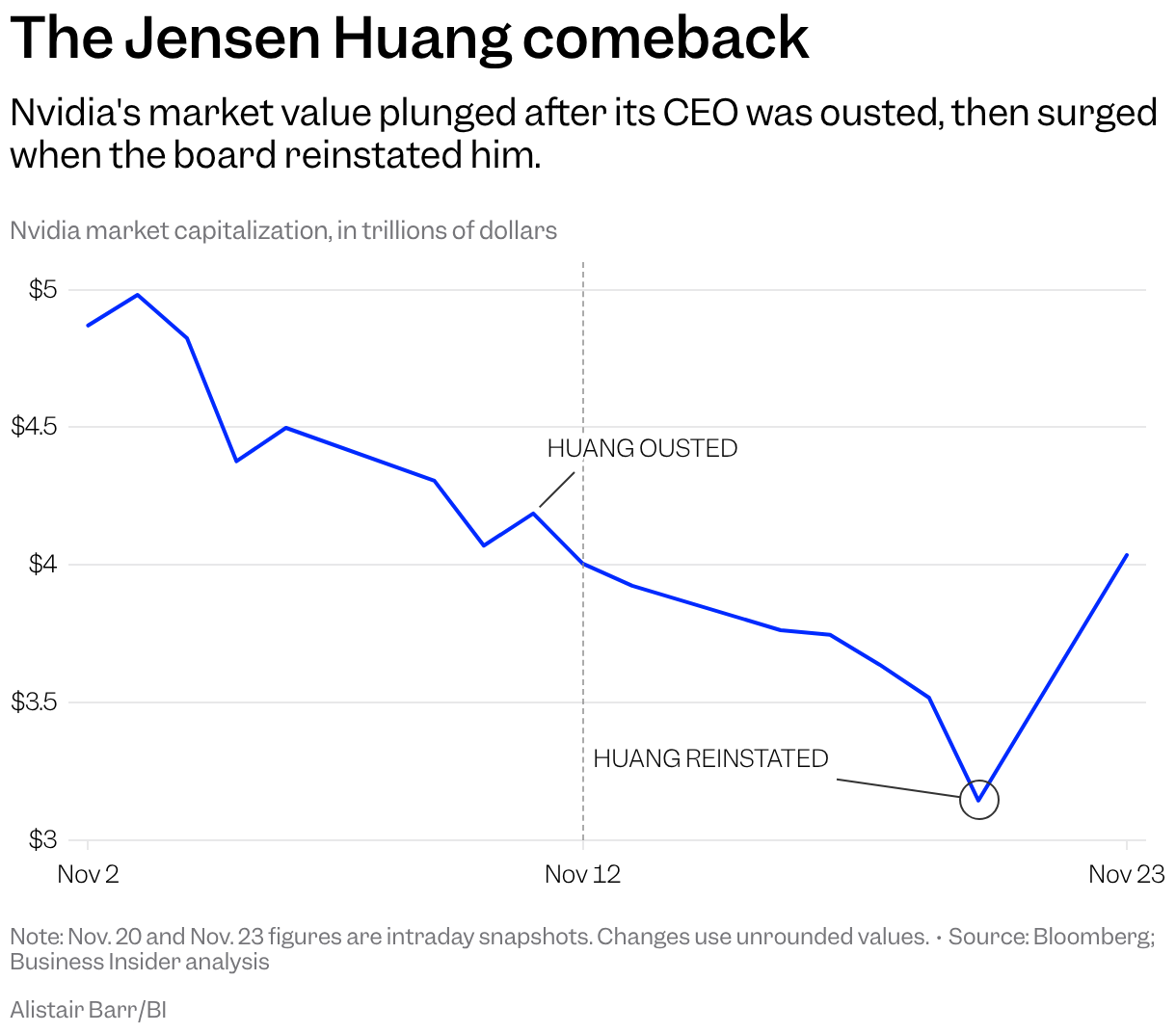
That’s an astonishing vote of confidence in one man. And a remarkable reversal for Nvidia’s board.
It also highlights a fundamental principle of corporate governance: Directors are there to look after the interests of the company’s owners.
That doesn’t mean maximizing the stock price every day or ignoring executive misconduct.
That includes Huang’s alleged relationship with a subordinate. And some Nvidia customers may have smuggled the company’s cutting-edge GPUs into China, although how much Huang knew about that remains unclear. There are also unconfirmed media reports that another woman he slept with might be a Chinese spy.
All this raises serious questions. The board has every reason to investigate. On Monday, the board said Huang’s reinstatement “poses no national security risk.” Its independent investigation into allegations that he was targeted by foreign intelligence will continue, with the CEO’s full cooperation.
But the directors also had to weigh the enormous cost of losing the visionary founder who built Nvidia into the world’s dominant AI chip company.
That’s where things get uncomfortable.
A board cannot possibly represent every stakeholder opinion about morality, politics, or acceptable behavior. Those views often conflict.
This is the agency problem at the heart of corporate governance. It’s already incredibly difficult to run a successful business. Adding a responsibility to change things based on thousands of competing, individual opinions is almost impossible.
That’s why the job of a public company board has been mostly whittled down to this guiding responsibility: Directors must act in the best interests of shareholders (who own the company), while fulfilling its legal obligations.
Reinstating Huang doesn’t make the allegations disappear. And it certainly doesn’t mean it’s ok to sleep with your subordinates at work.
Nor does Monday’s rally prove the board was wrong to remove him. If the investigation finds any laws were broken, the board can remove Huang again.
But investors have now delivered two remarkably clear messages.
Nvidia without Jensen Huang was worth dramatically less. Nvidia with him back is worth at least $900 billion more.
That’s a number Nvidia’s directors cannot afford to ignore.
Sign up for the AI Insider newsletter here. Reach out to me via email at abarr@businessinsider.com