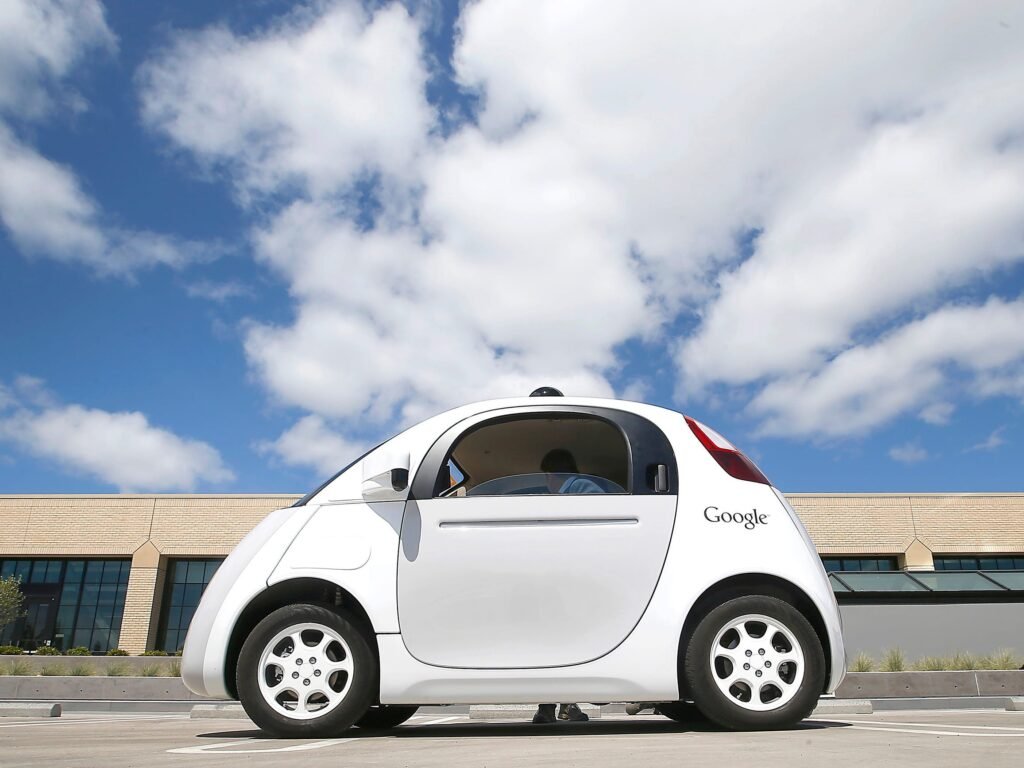
Waymo’s robotaxis underwent multiple evolutions, including a concept for a Google-built car, before settling on electric SUVs.
AP/Tony Avelar
Waymo’s operating robotaxi fleet is mainly made up of Jaguars and the Chinese-made Zeekrs.
But did you know Waymo also designed a proprietary self-driving car with no steering wheel?
Take a look at the different vehicle platforms Waymo explored before commercializing its service.
Once upon a time, in Waymo’s history, the Alphabet-backed robotaxi company designed its own autonomous car.
Waymo, by now, is a 17-year-old project-turned-product that provides more than half a million fully autonomous rides a week and has started to expand beyond US roads.
Its nearly two-decade legacy can be told through its pioneering figures, from Sebastian Thrun to Chris Urmson; through its fierce rivalry with Cruise, Uber, and Tesla; through its evolution as a Google-backed business; or through its technology. Perhaps more vividly, though, the story of Waymo can be told through its cars.
The Waymo robotaxi didn’t immediately appear as the retrofitted Jaguar I-PACE most riders are familiar with today. Its earliest roots can be traced to a diesel-powered Volkswagen Touareg that competed in a desert race backed by the Department of Defense.
As the company expands, Waymo has tapped companies abroad, including China’s Zeekr and South Korea’s Hyundai, to introduce newer vehicle platforms at lower costs.
Take a look at all the cars that helped shape the robotaxi company.
A 2004 Volkswagen Touareg retrofitted with a suite of sensors would get Google cofounder Larry Page’s attention.
Kim Kulish/Corbis via Getty Images
In 2005, a Stanford University team led by Sebastian Thrun, pictured above, won the first-place, million-dollar prize in the DoD-backed Grand Challenge of the Defense Advanced Research Projects Agency (DARPA) for successfully building a car that can autonomously traverse 132 miles of Mojave Desert terrain.
Volkswagen would provide Thrun’s team with the base vehicle: a 2004 Volkswagen Touareg R5 TDI. The team would retrofit the car with five lasers, one camera, two radars, a GPS, and a six-processor Intel computer. The car was nicknamed Stanley, after the university.
Stanley’s victory caught the attention of Google cofounder Larry Page. Page would tap Thrun to lead what was then known as the Google Self-Driving Car project in 2008.
A 2007 Chevrolet Tahoe showed that autonomous driving in urban environments was possible.
David Paul Morris/Getty Images
Two years after the Stanley victory, DARPA hosted another race. This time, the challenge required teams to navigate urban-like traffic rules and environments, including intersections, parking areas, and lane merging.
A team from Carnegie Mellon University won first prize with a 2007 Chevrolet Tahoe named “Boss.” The car was retrofitted with 13 lidars, 5 radars, and 2 cameras.
Another key member of the Google Self-Driving Car Project emerged out of the race: Chris Urmson. Urmson acted as the project’s chief technology officer before stepping into Thrun’s role as the project leader in 2013.
A modified 2008 Toyota Prius brought Google’s self-driving dreams to real-world traffic environments.
Karen Bleier/AFP via Getty Images
The Toyota Prius made up Google’s earliest real-world test fleet.
The choice of the eco-friendly car could be traced to Anthony Levandowski, a technical lead in the Google project.
In 2008, Levandowski, who by then had joined Google for its Streets project, and a team of Berkeley graduates built a self-driving Prius for a Discovery Channel series, “Prototype This!” The New Yorker reported. By 2009, Levandowski was brought in as a founding member of Google’s autonomous driving project.
The Prius would also become Google’s first vehicle platform to receive an autonomous-vehicle testing license in Nevada. At the time, Nevada was the first state to create such a licensing regime for AVs.
Google also had a brief taste for style with the Audi TT.
Adrian Moser/Bloomberg via Getty Images
Little’s known about what was going through the minds of the folks at Google’s self-driving project when they decided to include the Audi TT, a two-door luxury sports car, in its test fleet.
The New York Times reported in 2010 that the project was using six Priuses and one Audi TT in its test fleet.
A Waymo spokesperson told Business Insider that the TT was used as a support vehicle.
The Lexus RX 450h was Google’s first foray into self-driving SUVs.
WASHINGTON, DC – APRIL 23: Googles Lexus RX 450H Self Driving Car is seen parked on Pennsylvania Ave. on April 23, 2014 in Washington, DC. Google has logged over 300,000 miles testing its self driving cars around the country. (Photo by Mark Wilson/Getty Images)
Mark Wilson/Getty Images
Urmson, in a 2012 blog post, said the hybrid Lexus was added to the test fleet to help the self-driving technology become familiar with “different environments and on different terrain.”
The New Yorker reported that the Lexus would be used for highway testing. The car also appeared to feature a sleeker and more compact sensor suite, Wired reported.
Before the Tesla Cybercab, there was the Google Firefly.
Scenes of daily life at Google X in Mountain View, California. A new Google self driving car is demonstrated for the media, elderly and legally blind test drivers at Google X in Mountain View, California. (Photo by Kim Kulish/Corbis via Getty Images)
Kim Kulish/Corbis via Getty Images
Google’s Firefly was the company’s vision for what self-driving vehicles should become: a car built for autonomy that removes the steering wheel, accelerator, and brake pedal. Press a button, and it will drive.
The car was never meant to be commercialized, but more as a learning exercise, the company said.
“By designing and building a truly self-driving vehicle from scratch, we were able to crack some of the earliest self-driving puzzles — where to place the sensors, how to integrate the computer, what controls passengers need in a car that drives itself,” Waymo said in a blog post.
The dome sensor on the roof of the Firefly would be the precursor to the now recognizable lidar hat on Waymo’s current vehicle platforms.
The company provided its first self-driving ride in a Firefly to a legally blind passenger, traversing some of Austin’s roads.
The 2017 Chrysler Pacifica Hybrid begins taking members of the public on autonomous rides.
07 May 2018, US, Mountain View: A self-driving car made by Google’s sister company Waymo is on the road for a test drive. The car is a rebuilt minivan of the model Chrysler Pacifica by Fiat Chrysler. Photo: Andrej Sokolow/dpa (Photo by Andrej Sokolow/picture alliance via Getty Images)
Andrej Sokolow/picture alliance via Getty Images
In 2016, the Google Self-Driving Project announced a partnership with Fiat Chrysler Automobiles, which later became Stellantis, bringing Chrysler minivans to the robotaxi fleet. That same year, the project was spun out of Google and rebranded as Waymo.
The car would see Waymo through its first early-rider program, which began in Phoenix in 2017, and through the first time the company opened its paid, fully driverless service to the public three years later.
The Chrysler ran on Waymo’s fourth-generation autonomous driving system. It had 6 lidars, 6 radars, and 19 cameras, a Waymo spokesperson said.
Waymo retired the Chrysler in May 2023, giving the minivan a seven-year run.
The Jaguar I-PACE scales Waymo’s commercial robotaxi business.
Two Waymo self-driving Jaguar robotaxies drive on Tower Bridge Road, on 11th September 2026, in London, England. Waymo are testing their vehicles around the capital using a driver at the wheel. Waymo say they’re not yet offering commercial rides, but instead testing 24/7 to ensure their technology can safely handle all of London’s road conditions. From September 3rd, self-driving cars have been available for hire in central London. (Photo by Richard Baker / In Pictures via Getty Images)
Richard Baker/In Pictures via Getty Images
The Chrysler helped jump-start the Waymo brand, but the Jaguar I-PACE, an all-electric SUV, would turn the company into a multi-city business.
Waymo introduced the white Jaguars to the fleet in 2018. The cars quickly became a fixture of San Francisco roads even before Waymo began its paid service in the city in 2023.
The car also introduced Waymo’s fifth-generation driver, stacked with 29 cameras, 5 lidars, and 6 radars.
Today, the Jaguar remains Waymo’s main workhorse, making up the majority of the more than 4,000 robotaxis active across 15 metro regions in the US.
The Chinese-made Zeekr CM1e introduces the cheaper, next-generation Waymo driver.
Venice Beach, CA – May 27, 2026: Waymo’s new autonomous vehicle, called the Ojai, drives in Venice Beach on Wednesday, May 27, 2026. The all-electric vehicle, equipped with the company’s sixth-generation autonomous driving system, is expected to begin limited rides with select customers in Los Angeles, San Francisco and Phoenix in the coming weeks. (Allen J. Schaben / Los Angeles Times via Getty Images) The news is under embargo until May 28th at 8am.
Allen J. Schaben/Los Angeles Times via Getty Images
With plans to go international and expand its robotaxi business, Waymo introduced a new vehicle platform that it said costs a fraction of what the Jaguar I-PACE costs.
The vehicle is from Zeekr, a Chinese EV company, but Waymo rebranded the cars as Ojai.
The car also came with the sixth-generation Waymo Driver, which includes a reduced sensor suite: 13 cameras, 4 lidars, and 6 radars.
Waymo hasn’t specified how much cheaper the Ojais are. The company has said that, in addition to lower vehicle costs, the Ojai is easier to clean and maintain.
Business Insider reported during its ride test that the Ojai has more passenger room, more luggage space, and easier entry.
The Hyundai Ioniq 5 will continue Waymo’s expansion plans.
LOS ANGELES, CALIFORNIA – NOVEMBER 21: Waymo’s sixth-generation fully autonomous technology – the Waymo Driver – is outfitted on Hyundai’s all-electric IONIQ 5 SUV, which will be added to the Waymo One fleet over time, is on display during the Los Angeles Auto Show at the Los Angeles Convention Center on November 21, 2025 in Los Angeles, California. (Photo by Josh Lefkowitz/Getty Images)
Josh Lefkowitz/Getty Images
The Ioniq 5, made by South Korea’s Hyundai, is another extension of Waymo’s ongoing expansion plans that’s being tested on public roads. It’ll come equipped with Waymo’s sixth-generation driver.
Both the Ojai and the Hyundai will make up Waymo’s robotaxi fleet of the future, as the company eventually phases out the Jaguars.
Semafor reported on Monday that Waymo has plans to increase its robotaxi fleet to 8,000 by the end of the year and to 20,000 by the end of 2027, citing people familiar with the matter.
A Waymo spokesperson said it aims to roll out the Hyundai to the public sometime next year