When Tim Cook’s tenure as CEO of Apple was still young, tech-industry pundits obsessed over one aspect of his new gig above all others. After returning to the company he cofounded, Jobs presided over an incredible run of epoch-shifting products: the iMac, iPod, iTunes Music Store, iPhone, iPhone App Store, and iPad. If Cook didn’t extend that streak, conventional wisdom went, Apple’s glory days would be over.
That was always a silly way to look at the situation. In 2013, two years into the Cook era, I wrote that even the Jobs years were marked as much by relentless incremental progress as by sudden breakthroughs. Cook was a logistics wizard, not a product mastermind like Jobs, so it wasn’t shocking that his era turned out to be even more defined by ongoing refinement rather than great leaps forward. It’s been enough to make him one of the most accomplished CEOs of his era, and Apple most definitely remains Apple.
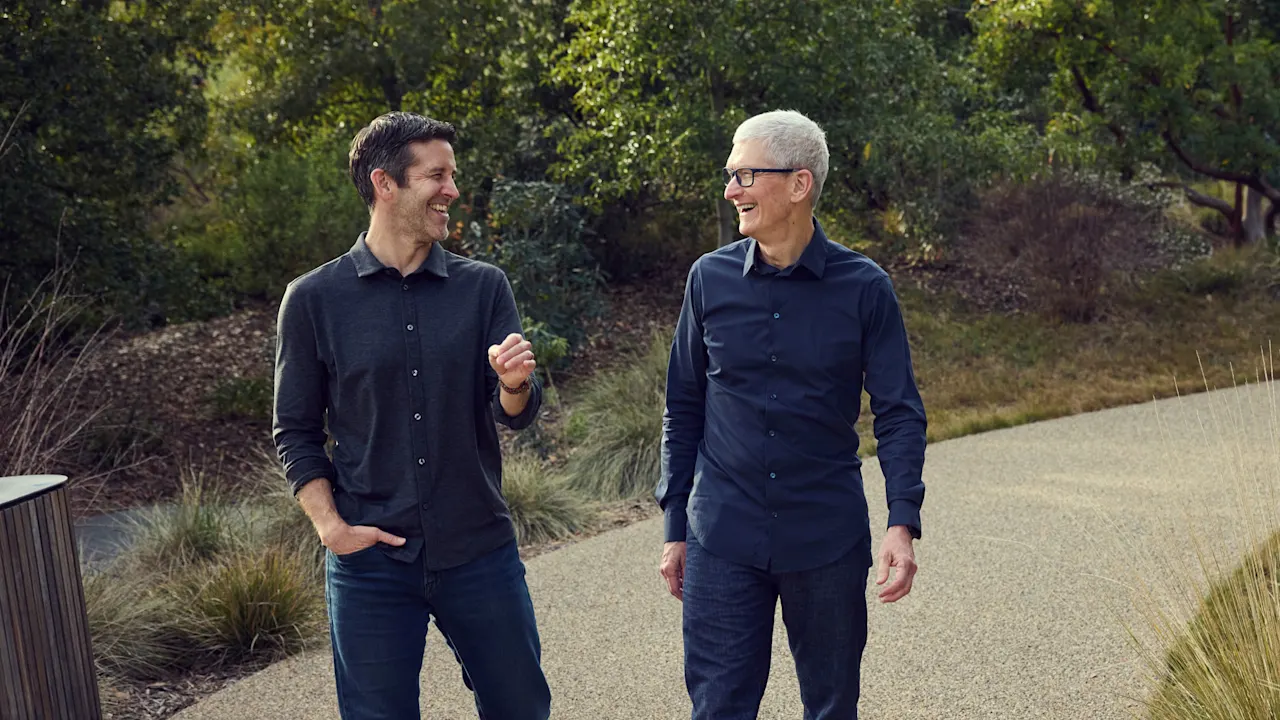
With Monday’s long-anticipated news that Cook will turn his job over to senior VP of engineering John Ternus in September—he’ll remain at Apple as executive chairman—it’s time to wonder once again what the future holds for Apple under a new CEO. This transition is freighted with far less drama, and I expect fewer grand pronouncements about what Ternus must do to keep Apple successful. Given how unproductive the conversation was last time, that’s a good thing.
Still, I’m obsessed with an area of tremendous opportunity in which Ternus can not only match Cook’s performance but also improve on it: the software side of Apple’s business.
Ternus joined Apple in 2001 to work on displays. Though his profile has steadily increased in recent years—I spoke with him in 2024 about the iPad Pro—he is not yet all that familiar a character outside the company. Mostly, we know that he’s an accomplished hardware guy.
His reputation rests on the quality of Apple’s devices, which in recent years have shown a remarkable streak of the year-by-year improvement it does so well. Products such as the Macs the company has released since shifting to its own CPUs—from the 2020 MacBook Air to this year’s MacBook Neo—have exuded competence and confidence.
But Apple software during the nearly 15 years that Cook has run the company has shown no similar trajectory of excellence building upon excellence. I’m not saying there have been no highlights: The first one I think of happens to be the Vision Pro’s visionOS, a tour de force I hope someday runs on a more affordable headset. It’s just that it’s much easier to come up with a timeline of Apple’s software mishaps, including ones still in the process of playing out.
The first one was a doozy. In September 2012, Apple replaced the iPhone’s onboard version of Google Maps with the first version of Apple Maps. It was instantly apparent that it was terrible at the one task any mapping app must ace: reliably getting you from point A to point B. Somehow, Apple had failed to identify this problem before shipping the software—assuming it hadn’t known and shipped it anyway.
Weeks later, while Apple Maps’ awfulness was still a major news story, the company’s software chief, Scott Forstall—a key Jobs associate—stepped down. According to scuttlebutt, he was pushed out for being insufficiently collaborative, and maybe for refusing to sign a public letter of apology over the Maps incident. Whatever the circumstances, his departure did not usher in a golden age of Apple software.
Cook’s subsequent executive reshuffling put Apple’s senior VP of industrial design, Jony Ive, in charge of design across Apple’s products. Then, at the height of his influence at the company, Ive made his most obvious contribution to its software with 2013’s iOS 7, which ditched lickable skeuomorphism for a more spare look that felt like the digital equivalent of his stately hardware. It was a medium-size whoop at best, relating more to aesthetics than functionality.
When Ive left Apple in 2019, one of his lieutenants, Alan Dye, became VP of human interface design, a job he held until leaving for Meta last December. The fit and finish of Apple software noticeably slipped with him in the job. His greatest legacy might be last year’s Liquid Glass interface, which—love it or hate it—is, like iOS 7, a visual refresh.
I have gotten this far into this article without mentioning Apple’s biggest recent software stumble: AI. In 2018, Cook hired Google’s John Giannandrea to head up AI and machine learning. It seemed like a coup at the time, and I expected it to quickly benefit Siri. Instead, at WWDC after WWDC, Apple’s AI assistant continued to feel like an afterthought.
In late 2022, the arrival of ChatGPT and generative AI in general forced the issue. At June 2024’s WWDC keynote, Apple introduced Apple Intelligence, a portfolio of features spanning its hardware platforms. Onstage, the company touted “a new era” in which “a more personalized Siri” could understand and fulfill requests such as “Add this photo to the email I drafted to Madiha and Josh,” “Show me my hotel reservation for my Boston trip,” and “Bring up the article about cicadas from my Reading List.”
Eight months later, with these capabilities still no-shows, Apple said it was postponing them until an unspecified date in “the coming year.” They still aren’t here. Last January’s announcement that Apple will leverage Google’s Gemini LLM to power the more personalized Siri suggests that the stuff it showed in June 2024 was even more vaporous than we knew last year.
All of which brings us to Ternus’s to-do list when he starts his new job in September. I find reason for guarded optimism that better times are ahead for Apple software. Or at least that they could be if Ternus makes that a priority.
For one thing, he might not have to clean house—in recent months, the house kind of cleaned itself. Dye is gone, replaced as head of human interface design by Steve Lemay, an Apple employee since the 1990s with a strong reputation. December also brought Giannandrea’s retirement and the hiring of Amar Subramanya, a Microsoft and Google veteran, as VP of AI. And as my colleague Mark Wilson has written, Apple’s deal to use Gemini gets it some of the world’s best AI without the need to burn through untold billions in the process.
The fact that Ternus’s background is in hardware rather than software could also be a plus. At its best, Apple has always been better at eliminating the seams between those two elements than anyone else; even as a hardware guy, he has surely thought deeply about that topic. It’s certainly far closer to his areas of expertise than it was to Cook’s. Now the responsibility for making that seamlessness real will be all his.
Even if the Cook-to-Ternus handoff is short on spectacle, this year’s WWDC keynote, on June 8, will be particularly resonant—Cook’s last as CEO and Ternus’s last before taking charge. After WWDC 2024 laid out a future for Siri that remains unfulfilled, there’s every reason to wait until Apple delivers on its keynote promises before taking them too seriously. But WWDC is still Apple’s clearest annual statement about where its platforms are going—and I, for one, will be particularly attuned to what it says about software in the age of Ternus.