It’s noon on a Monday, and the Wienermobile has just pulled up outside of my Chicago apartment. Soon I’m sitting in a red-and-yellow upholstered seat with a giant plastic hot dog in front of me. Two brand ambassadors, aka Hotdoggers—who have just introduced themselves as “Grill Master Maile” and “Lindsey Links”—instruct me to “buckle my meat belt,” please and franks.
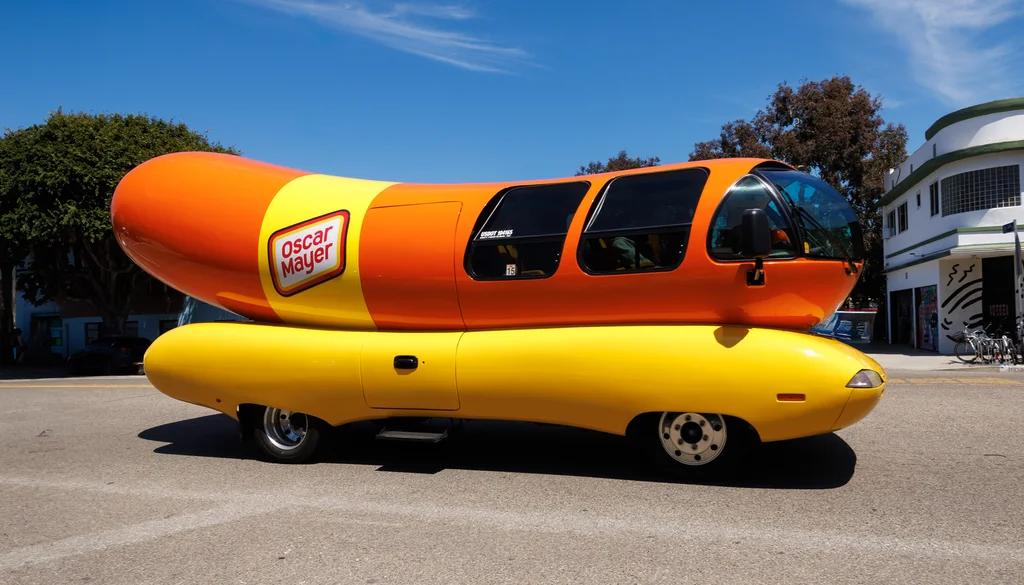
As Grill Master Maile (real name Maile Carballo) and Lindsey Links (Lindsey Kulesza) traverse the nation in their giant hot dog on wheels, they’ll be ringing in an important milestone: This summer marks the 90th anniversary of the Wienermobile’s debut.
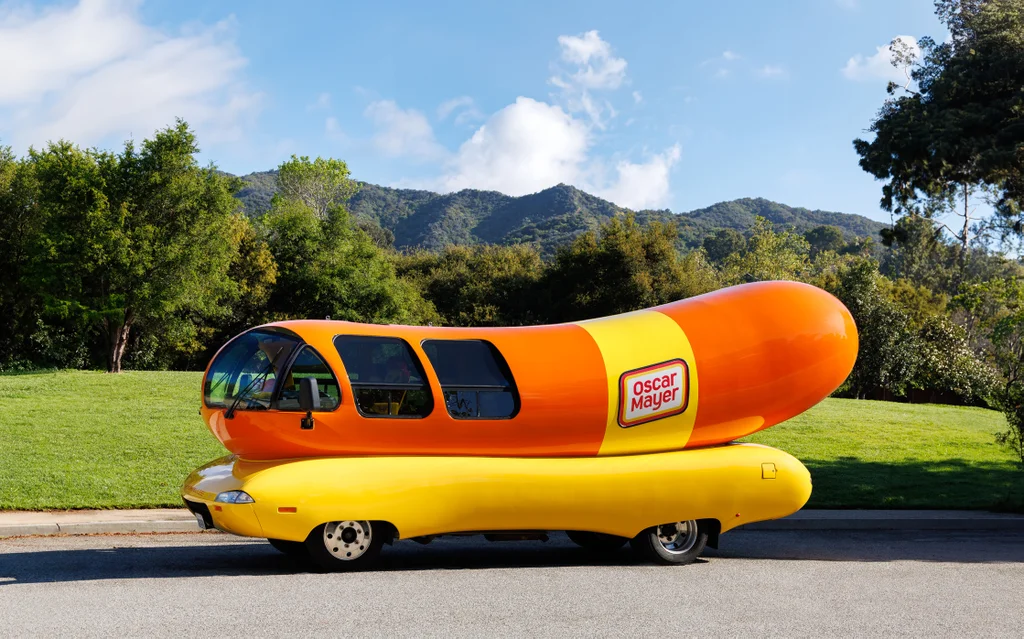
“The Wienermobile is one of the first examples of experiential marketing,” Carballo tells me. “Getting out there on the streets, boots on the ground, talking to people, finding out what they want—but also just making a memory out of it, too.”
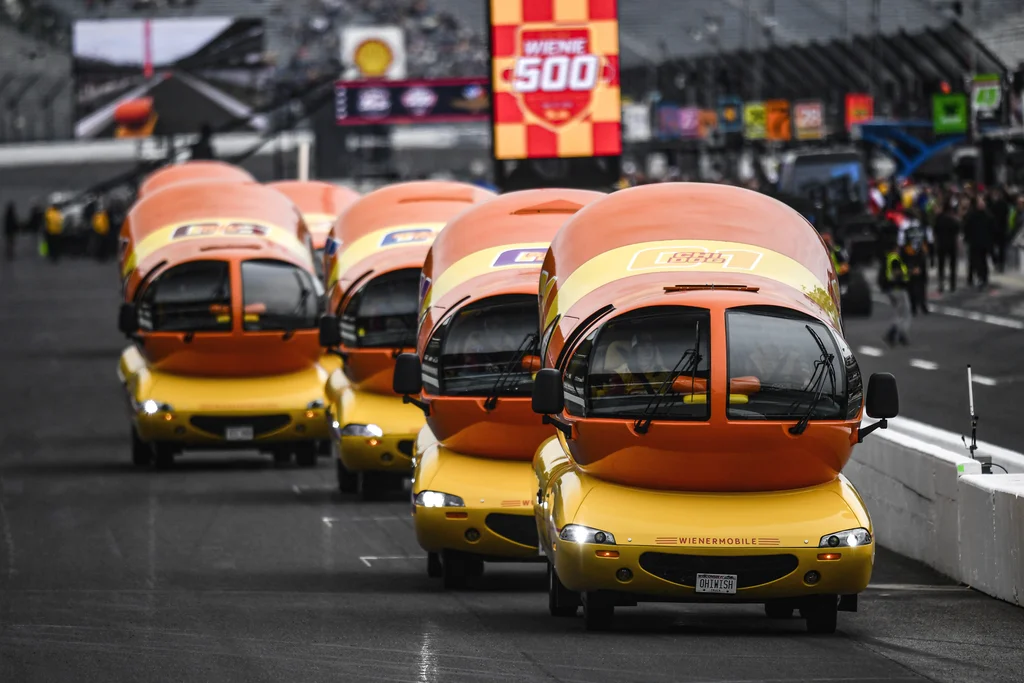
Despite notching nearly 100 years on the road, the Wienermobile somehow feels more relevant now than ever before. Over the past several years, it’s been consistently requested by tens of thousands of consumers hoping to feature it at their events. And, since 2025, it has directly boosted Oscar Mayer’s sales through the Wienie 500, which sees all six Wienermobiles race each other at the Indianapolis Motor Speedway.
As social media turns digital marketing into an oversaturated hellscape, more brands are vying to catch consumers’ attention through IRL activations like pop-ups and events, hoping to score both in-person impressions and a healthy amount of user-generated content and press coverage. The Wienermobile presages any of those efforts, yet it manages to achieve the same goals—with the bonus of decades of consumer affinity elevating it from a marketing stunt to a true cultural icon.
I spoke with Kraft Heinz executives, including Todd Kaplan, Kraft Heinz North America CMO, and Molle Twing, senior experiential marketing manager for the Wienermobile program (a former Hotdogger who’s now known as the “Top Dog”), to understand how the Wienermobile’s design has changed over time, the recipe that makes it such a uniquely enduring marketing asset, and how the brand is setting it up for another 90 years on the road.
How the Wienermobile got its wheels
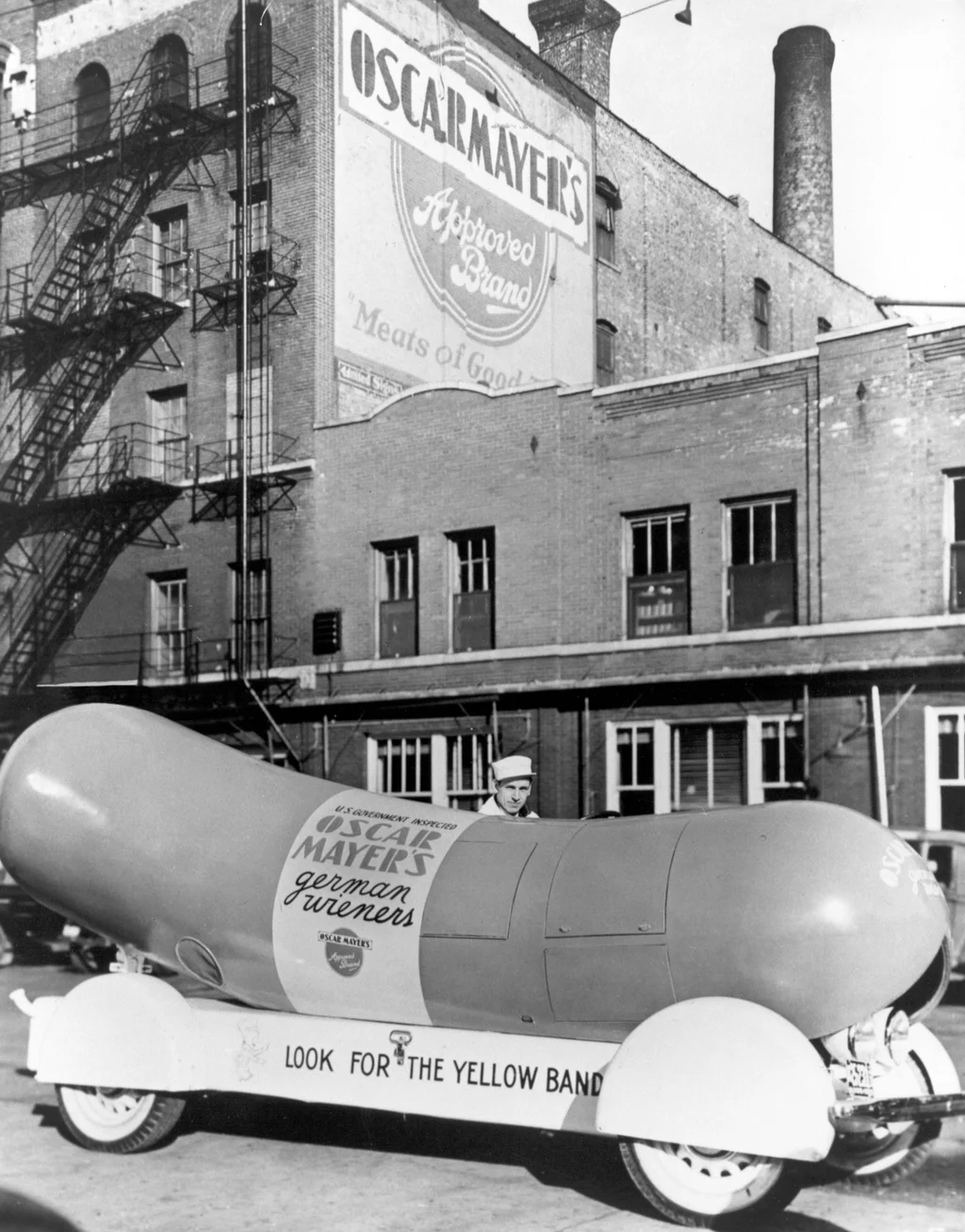
The year was 1936, and Oscar Mayer was a midsize meatpacking company with locations in Madison, Wisconsin, and on the north side of Chicago. The U.S. was in the thick of the Great Depression, a time when meat, especially quality meat, was considered a luxury. Carl Mayer, the nephew of Oscar Mayer’s namesake founder, had an idea.
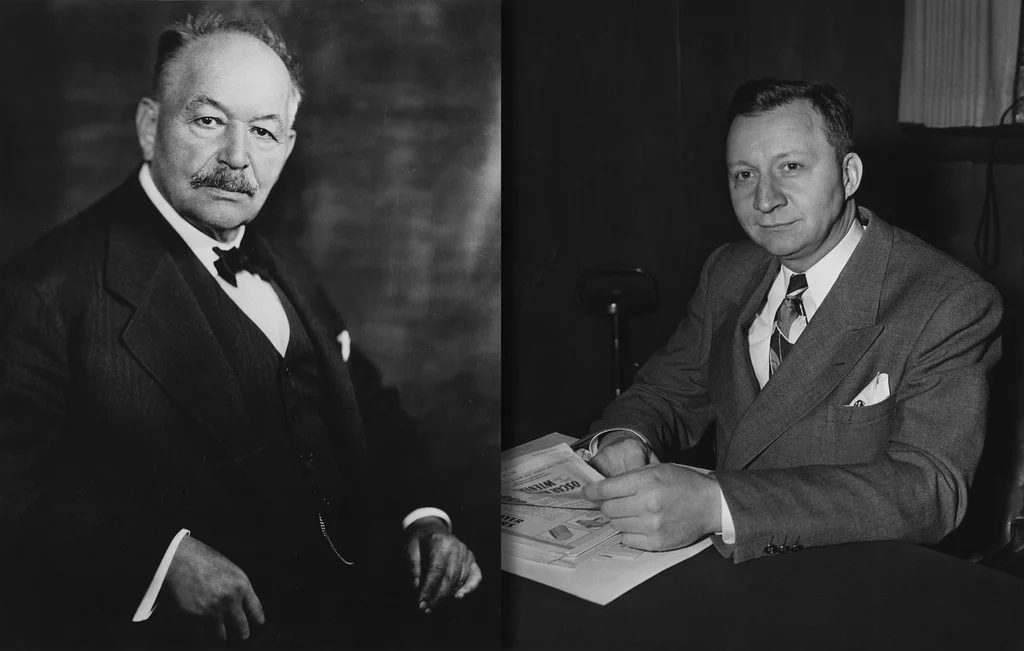
“He went straight to his uncle and was like, ‘Hey, I’ve got this quirky idea to create this 13-foot metal hot dog to make people smile,’” Twing says. “It was a time when people needed it most. It was a little bit of a dark day in the country, and the idea was, ‘How can we bring a little joy and make people know that Oscar Mayer stands for something much more than just good-quality, trusted meats?’”
Somehow, Oscar was convinced to pursue Carl’s wild idea. The first Wienermobile was produced by General Body Co. of Chicago. It featured text enticing viewers to “Look for the yellow band,” referencing the company’s iconic packaging design, and advertising “Oscar Mayer’s German Wieners.” Open cockpits were situated at the center and rear of the car to let the driver and passengers get some fresh air. According to an official company history, in those days the vehicle was often seen around the streets of Chicago.
Twing says not much is known about the very early days of the Wienermobile program—except, of course, that it was an obvious success. “The fact that we were able to continue on that great legacy of the Wienermobile, not just for a decade, not just for two decades, but nine decades, has something to be said about the success that it saw in those early days,” she says.
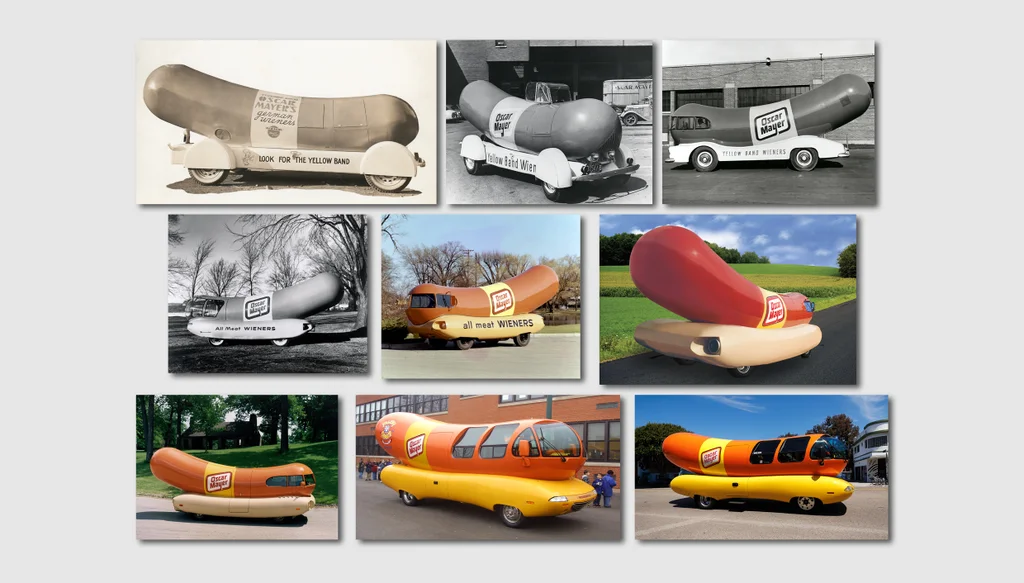
A crash course in Wienermobile design history
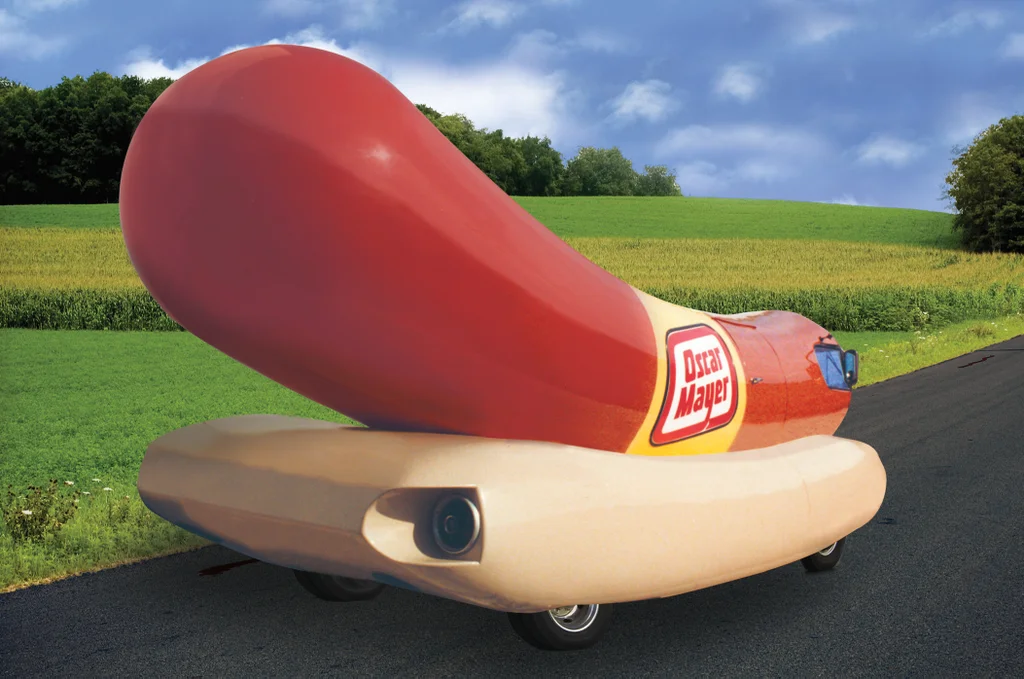
Over the years, the Wienermobile has seen roughly 17 different design iterations, not including small tweaks to existing vehicles.
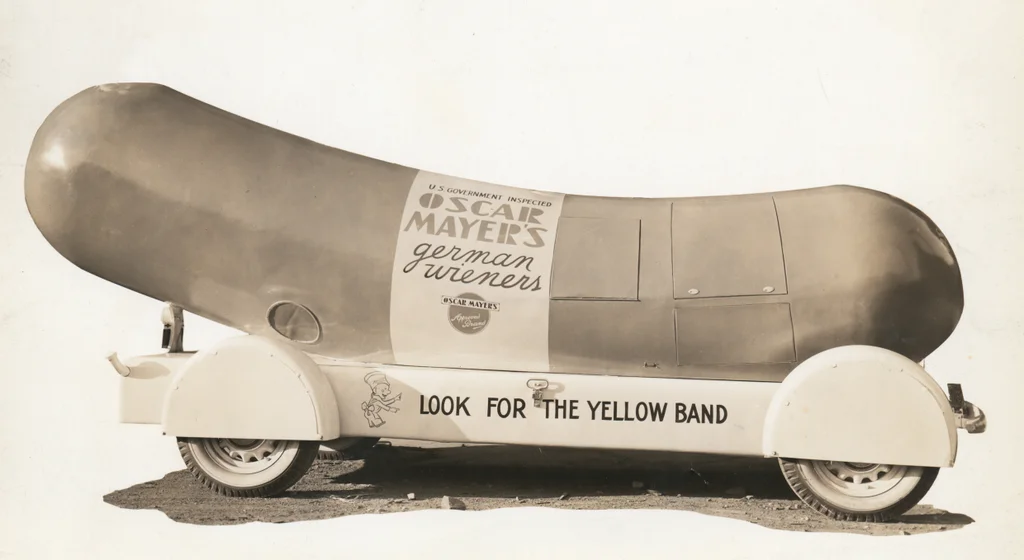
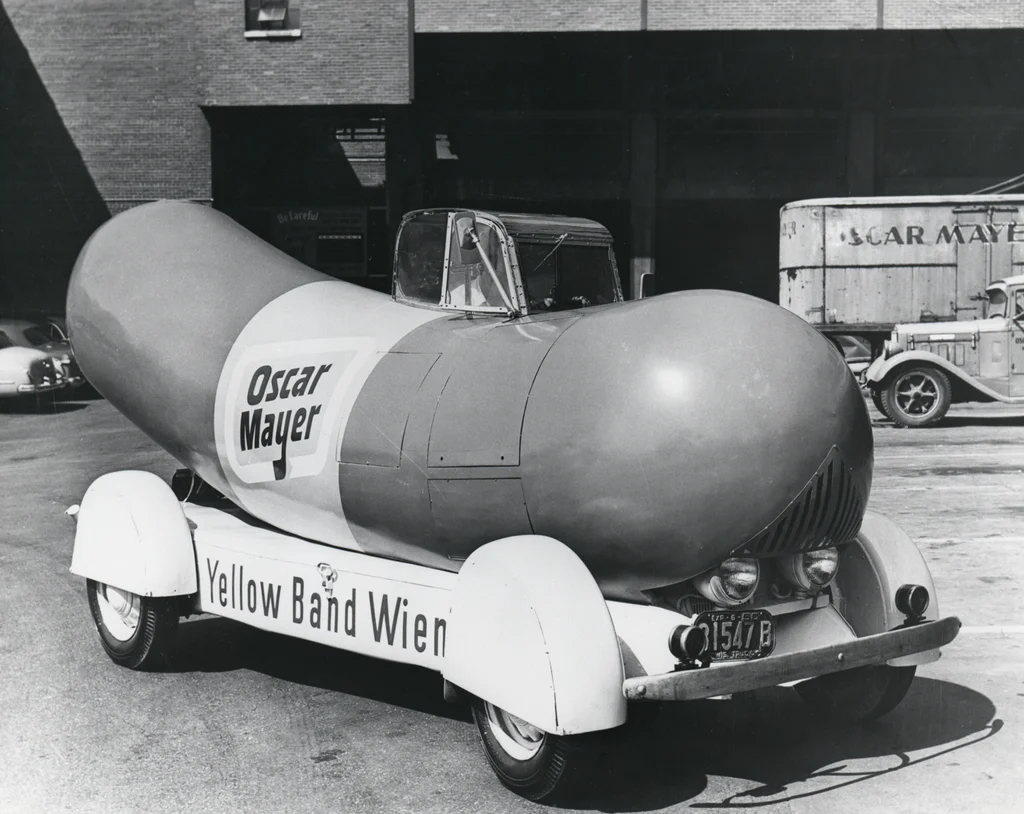
In 1940, a glass enclosure was added to the top of the original vehicle to protect the driver during an era when the Wienermobile was traveling farther distances through the Midwest and to the East Coast. The program was discontinued during World War II, when gas rationing made touring infeasible, but it returned in 1952.
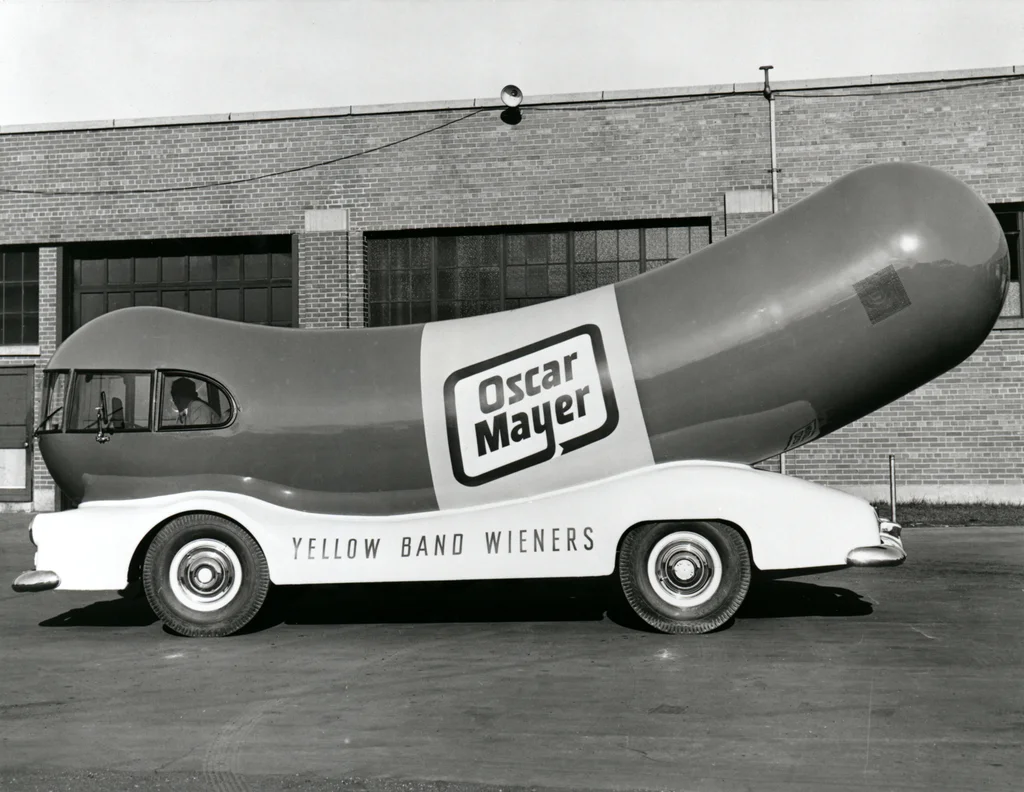
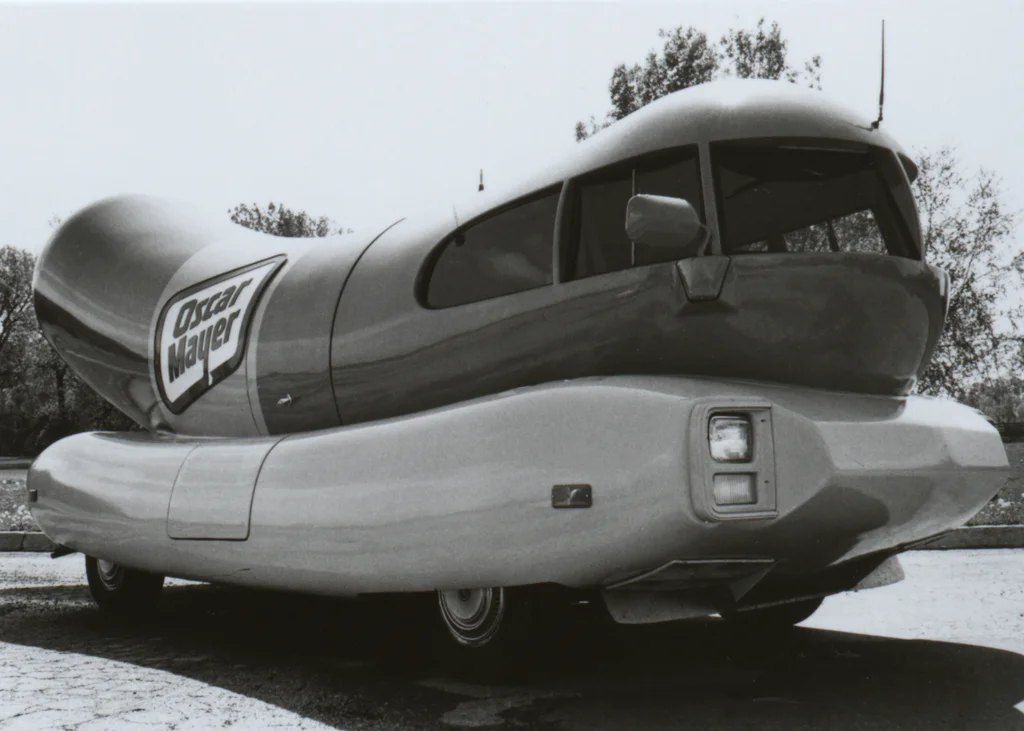
That year, the company debuted five new Wienermobiles designed by the Gerstenslager Co. of Wooster, Ohio. Each was 22 feet long, set on a Dodge chassis, and included a sound system, sunroof, and driver’s cab enclosed in the front of the dog. This version of the car would set the precedent for all Wienermobiles to come.
In 1958, industrial designer Brooks Stevens, who also created Miller beer’s first logo, put his own spin on the Wienermobile. His take was the first to include buns on its Willys Jeep chassis, as well as a bubble-nosed, glass-encased front. Other versions of the vehicle have included a 1988 fleet with microwaves and fridges; a 2008 mini Wienermobile; and a 2011 special-edition Wienermobile food truck.
Within the past 90 years, the Wienermobile program has almost been discontinued several times, including its World War II hiatus, and in 1977, when Oscar Mayer was refocusing investment on the growing opportunity for TV advertising. But Nine years later, in 1986, the company decided to test the waters with a 50th anniversary tour.
“It had so much success, from what I’ve read,” Twing says. “They had letters and pictures and everybody reached out to try to get a chance to see the Wienermobile. They were like, ‘There’s something here. We need to bring this back.’”
Since that triumphant return, the program has remained an annual investment for Oscar Mayer. In 1988, the company introduced its “Hotdogger” brand ambassador program, which allows anyone to apply to drive the Wienermobile; attend “High Dog High,” where they learn the brand’s history; and hit the road for a one-year term.
“More people have been to space than have actually gotten behind the wheel of the Wienermobile,” Twing says. “There’s been just shy of 500 people who have ever been through this program. It’s very, very selective. We get thousands and thousands of applications every year just for the 12 few spots that we have. It’s because it’s an American icon—everyone wants an experience with the Wienermobile.”
How the OG brand stunt became an American icon
The next time you’re at a family gathering, try asking everyone in attendance what they remember about the Wienermobile. Chances are, you’ll hear at least a few different stories—and that, in the briefest of terms, is Oscar Mayer’s secret sauce, the envy of marketers everywhere.
Over the past several years, in-person brand activations have surged in popularity. As digital marketing becomes increasingly crowded with outlandish brand collabs and limited-time releases, brands are turning to IRL activations to stand out. Concepts like the Tesla diner, Uniqlo’s first in-store café, Miu Miu’s book club, and Airbnb’s roll-out of famous home re-creations are just a few examples of brands trying to get their boots on the ground and spark a wave of user-generated content.
These ideas are creative in their own ways, but inevitably they come across as clear bids for attention. At best, stunts like these can feel aspirational but fleeting; at worst, like a cash grab. The Wienermobile’s advantage is its baked-in, generational goodwill. By virtue of traveling the U.S. for the past nine decades with a clear focus on making connections with individuals, the Wienermobile has transcended from stunt to cultural symbol.
As a reporter who covers marketing, I am perhaps more immune to the wild world of stunt marketing than the average person. Still, stepping into Oscar Mayer’s iconic Wienermobile felt like meeting a celebrity in real life.
Kaplan says that awe-inducing power is a rare asset. He spent almost two decades in lead marketing roles at PepsiCo before taking the lead at Kraft Heinz in 2024. Throughout that time, he says, he watched as every brand searched “for distinctive assets” to help build a story around their product. Oscar Mayer has the unique ability to lean on a symbol with built-in customer affinity. And, unlike plenty of other activations, the Wienermobile isn’t trying to sell you anything directly.
“The thread that makes it work is authenticity,” Kaplan says. “Any brand can say, ‘Let’s create a mascot from scratch. Let’s build a fleet of vehicles.’ Red Bull has sampling vehicles, and a lot of people are doing grassroots things. But this is almost the OG of grassroots marketing. It’s not trying to be anything more than it is: It’s a hot dog on wheels from Oscar Mayer.”
In Wienie racing, “It’s all about stamina”
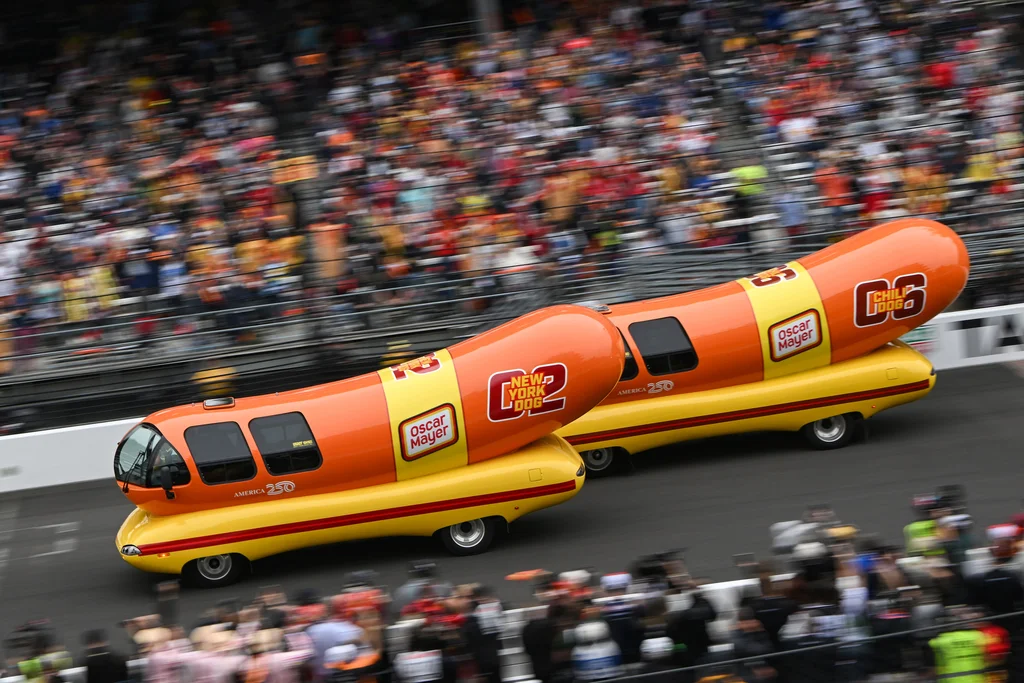
On May 22, six giant franks on wheels sat waiting to tear their way around the Indianapolis Motor Speedway. Via an official broadcast, one announcer reminded the audience, “You gotta remember, a quick start can sometimes be frowned upon in a race this long, 10 miles. It’s all about stamina when you’re talking Wienie racing.”
So began this year’s Wienie 500, an event that sees all six Wienermobiles compete in a two-lap race for Hotdogger bragging rights. Inaugurated last year, the Wienie 500 has been a major success for Oscar Mayer, with around 8 million fans watching the race via live recordings in 2025 and 2026.
Over the past several years, the Oscar Mayer team has invested considerable thought into how to continue evolving the Wienermobile for modern audiences. In 2017, it sent two Wienermobiles to the Statue of Liberty; in 2018 it introduced a hot-dog-delivering hero who handed out meat from a (real) jetpack; and, just this January, the program got its own Instagram account to chronicle the Hotdoggers’ travels across the nation, notching some 32,000 followers thus far.
Yet none of these efforts have come close to the sheer spectacle of the Wienie 500. The wiener-pun-laden debut of the race in 2025 netted immediate results for Oscar Mayer: The brand sold 500,000 more hot dogs over Memorial Day weekend tied to the event compared to the year prior. In 2026, it topped that record with an additional 75,000 franks sold.
Perhaps more important, the Wienie 500 has already turned into a cultural moment, even for those who don’t follow auto racing. On Reddit, fans discuss how the Wienie 500 got them into the sport; on Draft Kings they bet on which Wienermobile will take the crown; and on TikTok they post inspiring edits of the event.
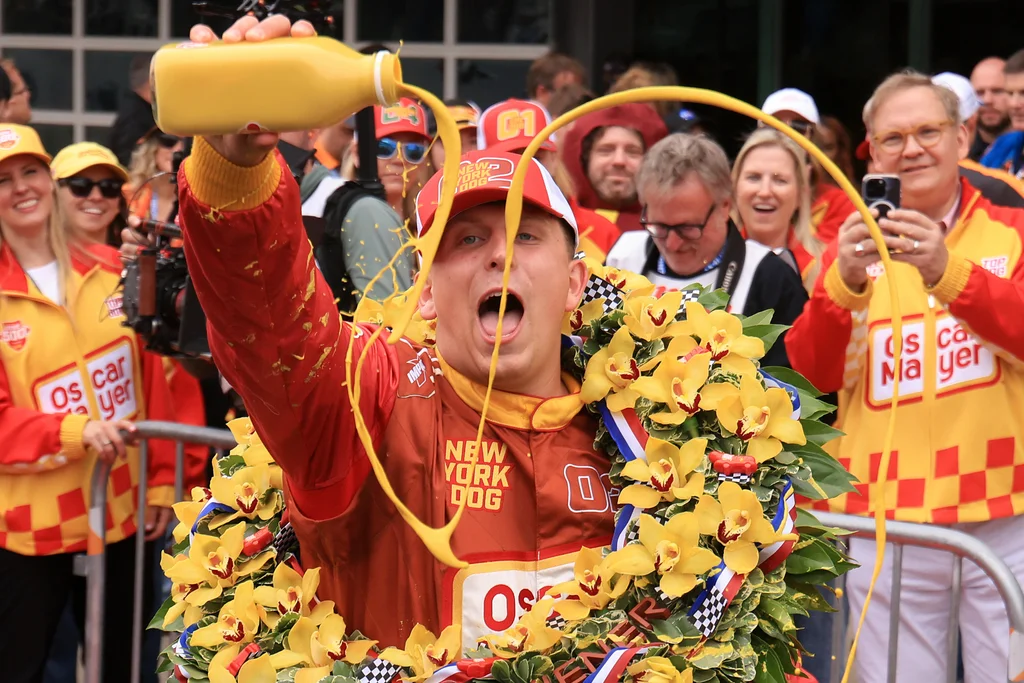
Kaplan says he expects the Wienie 500 to continue to be an annual tentpole moment for the brand going forward. Still, both he and Twing agree that the Wienermobile’s core goal will always be to prioritize one-on-one interactions with fans—and that means dedicating most of the Hotdoggers’ time and effort to being on the road. Every year, Kaplan says, the team receives more than 10,000 requests to feature the Wienermobile at events like weddings and prom celebrations.
Twing says the moments that made the most impact during her time as a Hotdogger arose when she least expected them. She recalls one particular instance, when she and a fellow Hotdogger met a 9-year-old at the grocery store who, after recently moving to the neighborhood, was preparing for his birthday party.
“The mom was so nervous,” Twing remembers. She’s thinking, I don’t know if anyone’s going to show up to his birthday. And my partner and I were like, ‘Hey, I think we’ve got to go make some magic with this little guy.’ After our event that day, we headed over to his house. Nobody showed up to his birthday party, but the Wienermobile was there. And he couldn’t stop hugging us. The mom was crying. It created this emotional connection.”
As Grill Master Maile and Lindsey Links shuttled me around my Chicago neighborhood, I saw dozens of small moments like that one: dads approaching the vehicle with kids in tow asking for a picture; a family running with their dog to catch up; and folks on the street cracking a grin as we drove by.
“It really teaches you to take life with a smile on your face all the time, because it’s never as serious as it seems,” Carballo says. “And seeing a 27-foot-long hot dog vehicle is certainly proof of that.”