Today, a new glossy magazine called 72 hits the news stands. On the cover, you’ll find Julia Roberts gazing intensely at the camera, wearing a black button-down shirt and jacket designed by Phoebe Philo along with chunky diamond-encrusted jewelry. Inside, she’s interviewed by George Clooney, but you’ll also find stories about luminaries across fashion and entertainment, from Stella McCartney and Jonathan Anderson to Oprah Winfrey and Adwoa Aboah.
72, a quarterly fashion magazine, is the flagship product of a new media and entertainment company called EE72. It is cofounded by Edward Enninful, the former editor-in-chief of British Vogue, along with his sister, Akua Enninful, a talent agent. (The company’s name combines Edward’s initials and the year of his birth.) After more than two decades running some of the best-known fashion titles in the world, Enninful is ready to strike out on his own.
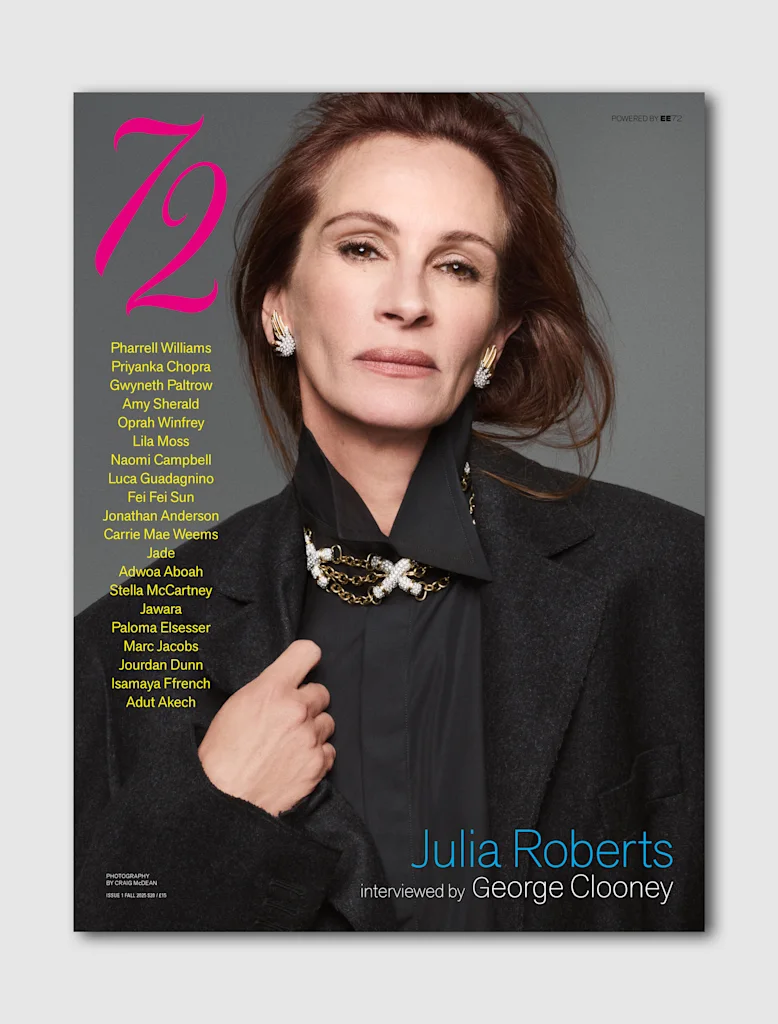
“When you are on someone else’s masthead, you have to please your bosses and advertisers,” he says. “I was ready for total creative freedom.”
Launching a new magazine in this moment is a bold move. The media industry has been on the decline for more than a decade, as people shift their attention toward streaming services and TikTok, and advertisers cut their spending on magazines and newspapers. Last year, 15,000 media jobs were cut in the United States, as places like the Washington Post and Vox Media had layoffs.
But Enninful is confident in his ability to create a profitable media business, despite these headwinds. After all, he’s done so before. In 2011, he took over W magazine when the publication was struggling and increased ad pages by 16%. Between 2017 and 2023, as editor-in-chief of British Vogue, he drove up both digital traffic and print circulation. “From the time I was in my twenties, I was always offered magazines that needed to be turned around,” he recalls. “Then I realized that turning things around is my superpower.”
New Business Models
Enninful started his career at a time when magazines were still thriving. He was scouted as a model in London as a teenager, going on to model for Arena and i-D, before pivoting to styling fashion shoots. He was eventually named fashion editor of i-D.
Until the internet and social media took off 20 years ago, magazines were a lucrative business because brands would pay top dollar to have their ads seen by large audiences. But 15 years ago, Enninful began to see the uphill battles the media industry was facing. In 2011, when he became style director at W, and then in 2017, when he became the editor in chief of British Vogue, advertising was beginning to decline.
To ensure the success of his magazines, Enninful had to think creatively about working with advertisers. Rather than just selling them banner ads or print pages, he’s been focused on finding other ways to collaborate. “The advertising system needed to be disrupted, and I’ve been doing this my whole career,” he says.
He’s bringing this same approach to 72. For the first issue, there isn’t a single page of advertising. Instead, he creates bespoke partnerships with each brand that involves things like in-person events, podcasts, videos, and even products. For instance, for the magazine’s launch party, 72 partnered with Moncler and Google Shopping, enabling these brands to get in front of some of the most influential people in fashion. “We offer our clients holistic packages that are tailored to their needs.” he says.
While Enninful is the chief creative officer of the company, he has hired a team of experts to run various parts of the business. Simone Oliver (formerly of BET and Refinery29) is the head of content, Sarah Harris (formerly of British Vogue) is the editorial director for both the magazine and website, and Lee Swillingham and Stuart Spalding (founders of the creative agency Suburbia) are co-creative directors of the magazine.
EE72 will also have another revenue stream in the form of a consulting wing that works directly with brands to advise them on how to be relevant in this cultural environment. “This takes the pressure off the magazine,” he says. “For the magazine, we can just focus on creating really excellent journalism and beautiful art rather than the needs of the advertisers.”
More Diversity
But to succeed as a magazine, you need more than just strong advertising revenue. You also need a fresh and relevant point of view. Over the course of the last two decades, Enninful—whose family moved from Ghana to London when he was a child—has done this by bringing diversity to the notoriously exclusive fashion industry.
Throughout his career, he’s focused on highlighting the importance of inclusivity. In 2017, after President Trump was elected the first time, Enninful brought together 80 prominent members of the fashion industry to create a video called, “I Am An Immigrant.” In 2019, he used the September issue of British Vogue to spotlight 15 female trailblazers including Greta Thunberg. (The issue was guest-edited by Meghan Markle.)
Enninful says he will bring much of the same approach to 72. In many ways, the magazine will be reminiscent of other high-end fashion magazines on the market, including Vogue. We’ll see top designers’ latest collections and read interviews with cultural icons. There will be lavish photo spreads by top photographers. But Enninful will continue to focus on bringing in underrepresented voices and perspectives.
He believes it is particularly important to do this now because “diversity, equity, and inclusion” are under attack not just in the United States, but around the world. Enninful believes that promoting diversity isn’t just a moral issue: It’s good for business. “When you feature diverse people on the cover of the magazine, you attract more people into the eco-system that had previously been ignored,” he says. “Throughout my career, I’ve seen that this is great for business.”
But for all his experience in the magazine business, Enninful believes there’s still a lot to learn because the industry keeps changing. He says one of the most exciting things about starting a brand-new media company is that he has the freedom to experiment. He plans to run the magazine like a startup, instead of being bound to the traditions and systems of legacy media companies. “There’s a reason we didn’t buy an existing magazine title,” he says. “We didn’t want to be stuck with a legacy brand. We wanted something new, young, and agile. We can learn from mistakes, move quickly, and adapt.”
And ultimately, he believes that readers are also looking for something new right now. “Many people are exhausted by what they’re seeing in the media,” he says. “I think it’s a great time to be starting something new.”
Related Posts


It’s 2026 in the South Pacific. Here’s how this major city kicked off the new year
Auckland rang in 2026 with a downtown fireworks display launched…

Coco Gauff, 21, just won the French Open. She says her parents have her back in very different ways.
Coco Gauff celebrated her French Open win with her parents,…