On 10 wooded acres outside of Tallahassee, Florida, a curved, wood-paneled home juts out of the natural landscape like a ship that’s been permanently grounded on land. It’s the only residence designed by renowned architect Frank Lloyd Wright in the whole state, and it’s currently on the market for $2.1 million.
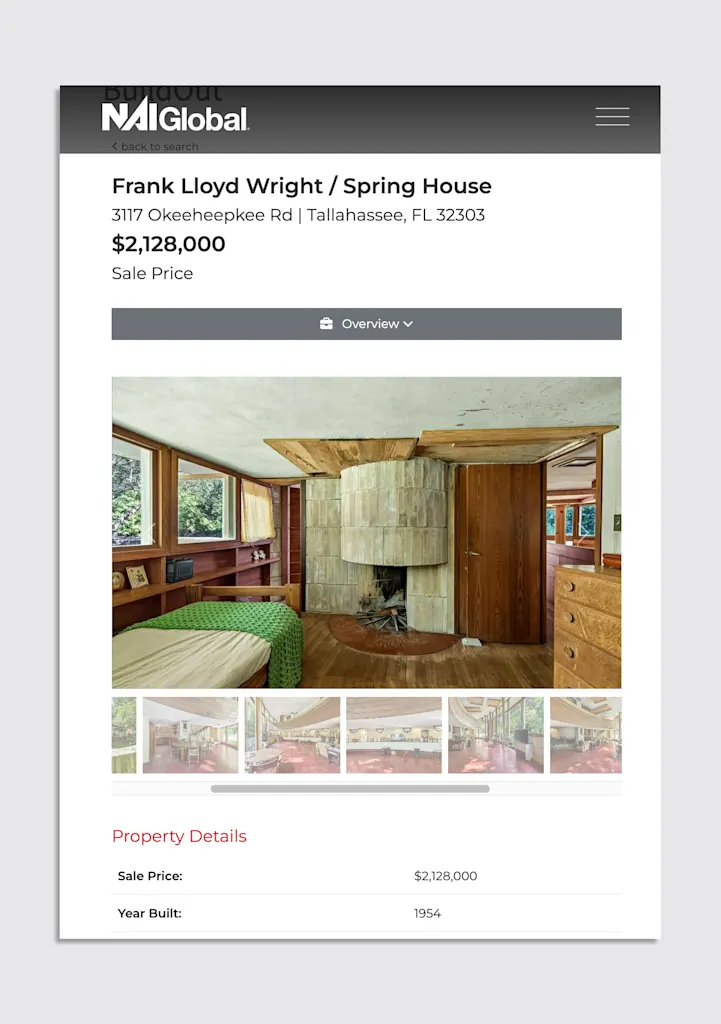
Nicknamed the Spring House after a nearby natural water feature, the home was completed in 1954 as a commission for husband and wife George and Clifton Lewis. According to the Spring House Institute (the organization responsible for the property’s preservation), the Lewises asked Wright to design a space for them with the stipulation that they had “a lot of children and not much money.”
The resulting 2,000-square-foot structure is an example of how Wright’s experimentation with complex curved geometries shaped the tail end of his career—a fascination that’s also apparent in his design for New York City’s iconic Guggenheim Museum.

What the Spring House has in common with the Guggenheim
For most Americans, the name Frank Lloyd Wright probably calls to mind a structure dominated by artfully arranged parallel lines and hard angles—the kind of geometry exemplified by some of Wright’s most iconic buildings, like the Fallingwater home in Pennsylvania or the Ennis House in Southern California.
However, in his later years, Wright became more interested in understanding how carefully conceived curves could change the utility of a space.
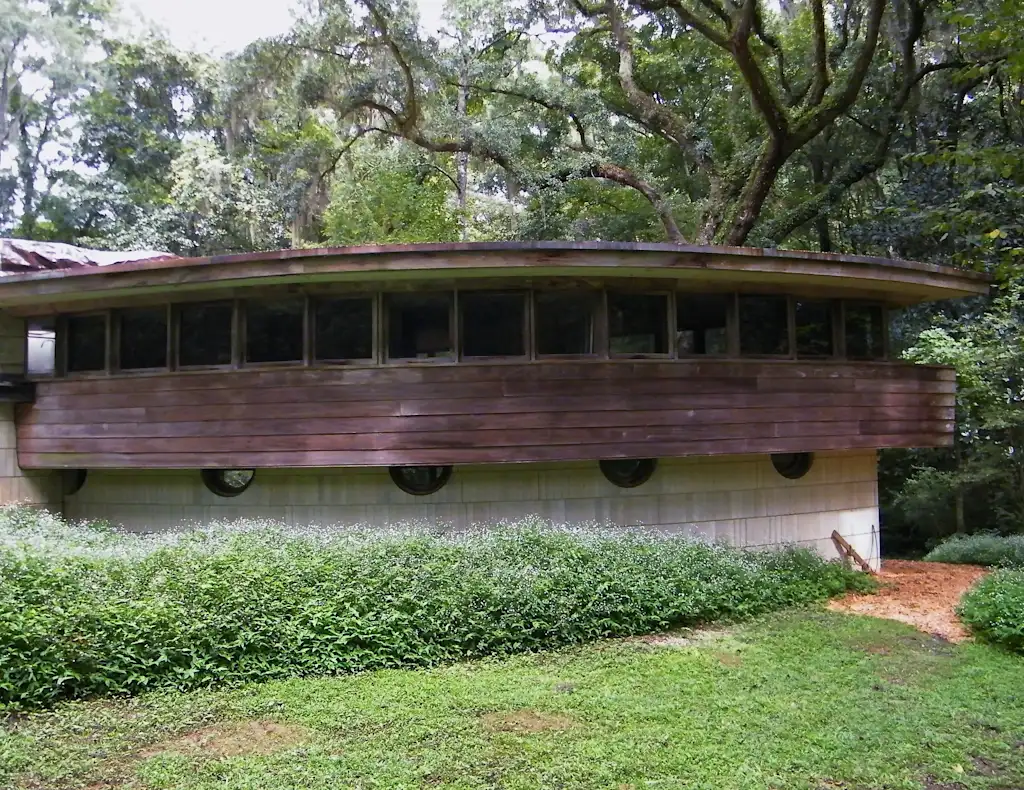
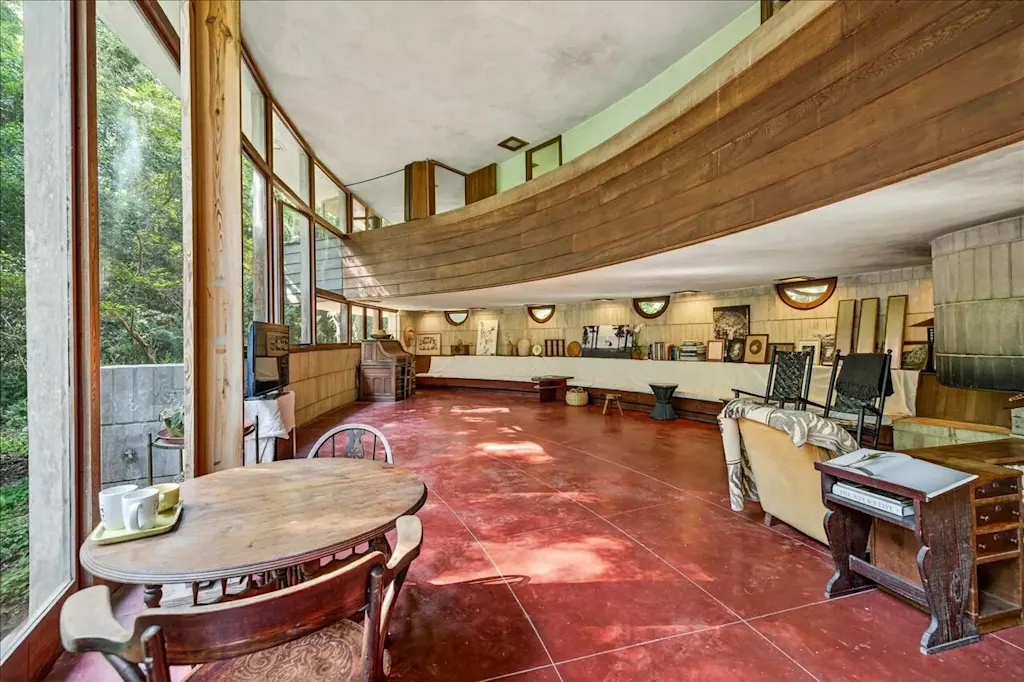
This curve-based approach, termed Wright’s “hemicycle style,” involved designing semicircular floor plans behind large curved glass walls to allow the building to receive the full arc of the sun during the day. In the Spring House, that’s most evident through the home’s back wall, which features a sweeping semicircle that looks out into the back yard and is almost entirely paneled in glass.
Per the Spring House Institute, the Spring House is one of just 11 hemicycle houses designed by Wright, and one of only two hemicycle houses with its “unusual boat-like shape,” derived from the intersection of two arcs.
John Waters, preservation program director at the Frank Lloyd Wright Building Conservancy, says he believes the Spring House is a reinterpretation of an earlier design known as the Herbert and Katherine Jacobs Second House, which similarly employed a curved exterior to let in maximum light.
“There are a number of aspects of the Spring House, like the way its second story is suspended from the roof, that are similar to the second Jacobs house,” Waters says. “But there are also some really interesting tweaks. Either end of the interior balcony gracefully extends out beyond the glazed wall to exterior balconies on either side. I think it’s just a very elegant design in that way.”
Waters notes that Wright used similar design principles to simultaneously create the Guggenheim Museum, recognizable for its interior of concentric white circles, as well as the David and Gladys Wright House, which features a circular spiral design.
“It’s probably a chicken-and-egg situation in terms of which design was leading the others, but they are all sort of conceptualized at the same time,” Waters says.
Related Posts
I lived in Europe for 7 years before returning to the US. Here are 3 things I did right and 3 I wish I’d done differently.
I did some things right and wrong when I moved…

Domino’s tasty new tagline is a jingle and logo rolled into one
For its first brand refresh in 13 years, Domino’s updated…
Here’s what smart people are saying about Jack Dorsey slashing Block’s workforce
Jack Dorsey's Block cut roughly 4,000 jobs. Uncredited/AP Jack Dorsey…