In the summer of 2009, the NFL was bracing for war. The owners had walked away from a collective bargaining deal they had signed just two years earlier, demanding pay cuts, slashed pensions, and two extra games for free. They had stockpiled a $4 billion lockout fund and were ready to shut the game down for a year if that is what it took.
On the other side stood a union reeling from the sudden death of its legendary leader, Gene Upshaw. Into that void stepped an “outsider”—a trial lawyer from Washington, D.C., named DeMaurice Smith—whom ESPN called the man with “the toughest job in sports.” The players had less than $300 million, a string of failed strikes behind them, and the very real prospect of being steamrolled. On top of everything, the players desperately needed to end the owners’ unilateral right under the old deal to add as many games to the regular season as they wished.
But this time, the fight would not be linear. The new leader pushed his players to battle on every front—public opinion, Congress, and most of all, in the one place owners thought they couldn’t be touched: their money. Out of that fight came one of the most unlikely weapons in sports labor history—an insurance policy against a lockout.
It was the first, and only, of its kind. And if the players could pull it off, it might just prevent them from being at the mercy of thirty-one billionaires who saw an opportunity for the greatest power and money grab in the history of professional sports.
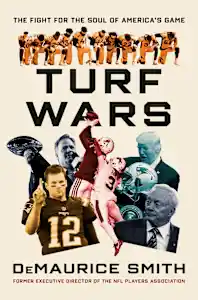
Excerpted from Smith’s book, “Turf Wars: The Fight for the Soul of America’s Game,” this is the story of how how that deal went down.
AN ACE IN THE HOLE
With negotiations tabled, I did what I do when I’m overwhelmed: I escape, and I drink.
An old law partner buddy, David Barrett, and I went to Palm Springs, California, and pounded cocktails.
Owners had been openly bragging about their $4 billion rainy-day fund—enough to survive a months-long pause—for years, even before the dust had settled following the Great Recession. Banks weren’t in a position to lend so much money, and after meeting so many owners, I couldn’t imagine that some of those overgrown man-babies had the discipline to save roughly $130 million apiece.
“Would the TV networks give it to them?” Dave asked. “The league has leverage,” he continued, “because of how much the networks want the broadcast rights.”
The day after Dave and I hit the bars, I authorized the hiring of a former network executive to advise us on television contracts. I lobbed what felt like a stupid question to the former executive: Could there be a clause in a broadcast rights contract that would pay owners even if games weren’t played?
Every contract, this executive explained, includes language about “make goods.” Say you run a doughnut shop and advertise it on Google. If, for instance, Alphabet’s servers get hacked and all of its sites go dark, this is the clause that requires Google to make good on the agreement and publish the ad later.
Using similar logic, networks could agree to a deal in which they paid a certain amount of money in the event that games weren’t played, in exchange for a discount on future payments.
If our theory was correct, it was as if the league had taken out an insurance policy from the networks. If they had, it would have been for less money—a potential violation of the league’s obligations to players under the collective bargaining agreement.
All of this got me thinking that it sure would be amazing if there were such a thing as lockout insurance. It was a disaster we’d known was coming, and it wasn’t as if we were causing the lockout. In fact, our players were trying like hell to avoid missing work, so the risk wasn’t even ours to transfer. Still, I wondered, could there be such an insurance policy? It was a question worth asking.
I got permission to pursue this as a potential nuclear option in our arsenal. Its ultimate value wasn’t the payout. It was the leverage it would create. Because if the policy did pay out, our side could withstand a work stoppage for far longer than the owners believed. Their $4 billion had to cover keeping stadiums and team facilities online, administrative staffs paid, and front-end costs guaranteed. Factoring in players’ salaries, this amount suggested they were prepared to miss half the 2011 season as they waited on players to cave.
But if we sprang this insurance policy on owners at the right time, I explained, owners would realize their eight-game strategy was doomed. The insurance payout was $850 million, set to be distributed after two missed regular-season games. It was enough for players to sit out the entire year, and while it might not pay for their full salary, bonuses, and benefits, it was enough to pay each player $200,000 per week—enough that players wouldn’t beg me to sign whatever proposal the league put forth.
Now, here was the tricky part: The premium would cost $47 million. Players murmured, knowing the union had only $200 million in its coffers. It was a huge gamble. I believed that the insurance payout would be enough to protect our men and give them financial security for an entire missed season. For now, we had to keep it quiet. Secrecy was our most important component. We had an ace in the hole, and I had known for months who I wanted to deal the cards
‘Maybe it’s time we all put our guns away’
My phone rang. It was Robert Kraft, the owner of the New England Patriots.
He asked I was up for one more meeting.
“Look,” he said, “this isn’t a time to be hiding stuff. If you guys have more resources, we need to be transparent with each other.”
“Let’s just say I took steps to protect our players,” I said. “Nobody is going to crumble early.”
In my legal career, I had worked for men like these. Gone against them. They’re not the type to congratulate you on a successful gambit and just accept defeat with a warm handshake. These guys are used to winning, and on the rare occasions they don’t win, their response is to change the rules and punish the opposing side for making them sweat.
As we waited outside the meeting room, I mostly felt dread. My brain had produced three possible scenarios, two of them bad. Owners could storm out or call our bluff, effectively a challenge to see who broke first. Players are taught to feel comfort in certainty, so either of those possibilities would break us. The third was that Kraft realized that a civil war was good for no one, that the NFL’s business model was impervious to inflation, elections, and geopolitical conflict, invincible to almost everything except greed.
The door finally opened, and we were invited into an initial meeting with just a few participants. On our side, NFL Players Association President Kevin Mawae picked Domonique Foxworth, Jeff Saturday, and me. I made eye contact with everyone in the holding room, more than fifty guys, and tried to convey confidence and conceal my anxiety. There’s no such thing as a “fearless” leader, and if there were, I can’t imagine following them. Any conflict requires self-awareness and the acknowledgment that all of your planning, strategizing, and overthinking could fail. Against some of the most powerful and dangerous men in the world, I was well aware of the odds.
We returned to the conference room door, and I lowered the handle. There sat NFL commissioner Roger Goodell, Carolina Panthers owner Jerry Richardson, the Coboys’ owner Jerry Jones, and Kraft at a round table. To me, every group is a jury, and I try to read their shoulders and eyes. Richardson was fuming; Jones calmer than ice water. We took our seats, and Kraft began the meeting.
In the same tone of voice I used for closing arguments in a murder trial, I told everyone about the insurance policy and its details. I paused, allowing the information to sink in. Nobody said a word.
“I’m sure you thought there would be a resolution by week four,” I said, “because players would collapse. But we’re content to sit out the entire season.”
I’m not sure I’ve ever seen a hatred in someone’s eyes like that of Jerry Richardson. Roger turned bright red, the vein in his neck pulsing. Kraft remained silent. Jerry Jones seemed to realize that, in a single sentence, we had destabilized years of planning and maneuvering by the league.
“So let’s just wait a minute,” he said. “Maybe it’s time that we all put our guns away.”
Kraft and Richardson looked at him.
“We can just sliiiide ’em back into the holster,” Jones continued.
The moment of truth
In a negotiation, this is what’s called the deal point—the moment of truth. Jones recognized it before anyone else, acknowledging that owners were cornered. There would be no player collapse, and there’d be no eight- or ten-game season.
“Why haven’t I been told about this?” Roger said. “De, you have to understand that I’ve set up some things to protect the owners. Things I haven’t even told them about.”
That’s when I knew. It was checkmate.
Ah, Puddin’, I remember thinking. I got you, didn’t I?
Kraft took a long breath and said that we’d given the league some things to discuss. He looked at me and issued the faintest smile, an acknowledgment, finally, that I might actually be worthy of respect.
From the book TURF WARS by DeMaurice Smith © 2025 by DeMaurice Smith. Published on August 5, 2025, by Random House, an imprint and division of Penguin Random House LLC. All rights reserved.
Related Posts

How Trump’s anti-DEI policies are hurting Black workers
When the government shutdown came to an end last month,…

‘Him’ director Justin Tipping explains the movie’s gory ending, and how it was almost even more terrifying
Tyriq Withers in "Him." Universal Warning: Major spoilers ahead for…