The tiny easy chair Mikael Axelsson is holding in his hands—a dollhouse-size combination of bent wire, hand-carved foam, and hot glue—has been a white whale for the Ikea designer since he first modeled it back in 2014. The concept was simple, or at least he thought it would be: Build a frame of metal, fill it with a balloon-like cushion, and reinvent novelty 1990s blow-up furniture into a modern home furnishing.
But after trying to take the Barbie-size model he’d built and expand it into a full-scale piece of inflatable furniture, he had two major problems. First, he could never quite figure out how to make an inflatable cushion that didn’t feel like an exercise ball. Second, he couldn’t convince his bosses that inflatable furniture wouldn’t be the total failure it was when the company first tried it in the late 1990s.
“It’s been standing on my shelf since then,” he says.
A little over two years ago, Axelsson pulled the model off the shelf at his desk in the design department at Ikea of Sweden, the global retailer’s headquarters in the small town of Älmhult, Sweden. Axelsson and the roughly 20 other designers on staff had been called to participate in an experimental design sprint in late 2023. They had two days to come up with boundary-pushing concepts for the newest edition of Ikea’s PS collection, a recurring furniture-centric product drop of Scandinavian designs that will launch this May.
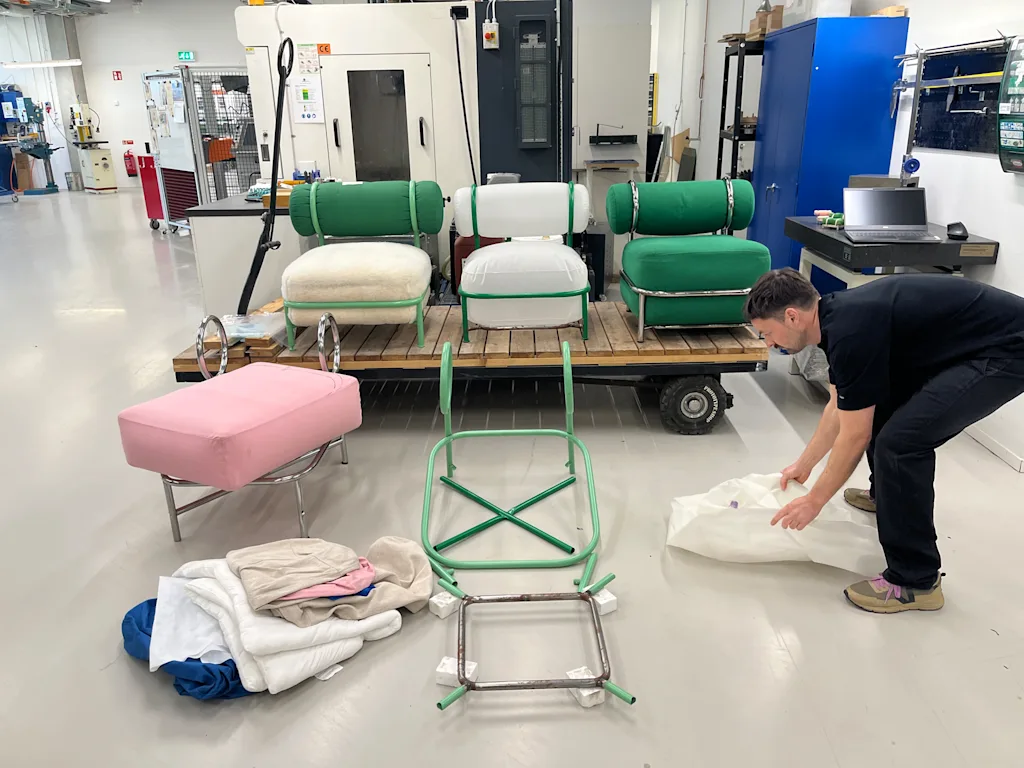
Axelsson saw the chance to revive his inflatable easy chair. This time, in the spirit of throwing everything at the wall, he got the go-ahead to at least explore the idea. He immediately started welding. He ended up building about 20 different versions of the chair, with varying tubular chrome frame configurations and bulbous hand-sealed inflation chambers. Several of these iterations were on display when I walked into Ikea’s headquarters in early April.
I was there to visit Ikea’s secretive prototype lab—the place where conceptual designs get mocked up, refined, refined again, and eventually optimized for the large-scale production that will flatpack and distribute them to Ikea’s estimated 915 million annual in-store customers. Ikea invited me as the first journalist to see the space, the creative heart of the company, which pumps out 1,500 to 2,000 new products every year for markets all over the planet.
To see how the space works, and to understand why it’s so important to Ikea’s $52 billion in retail sales in fiscal 2025, Fast Company has been given an exclusive look inside the prototype shop. Products being prototyped there are often two to three years away from making it to the shelves of one of Ikea’s 500-plus stores, and some experimental design ideas being tested there may never materialize.
“You are basically in the future here,” says Johan Ejdemo, Ikea’s global design manager.
The prototype shop is where that future gets gut checked. From top-level feasibility to aesthetic refinement to the minutiae of assembly fittings and stitch choices, products get built and rebuilt in the prototype shop to continually test whether they’re meeting the Ikea standards for functionality and affordability.
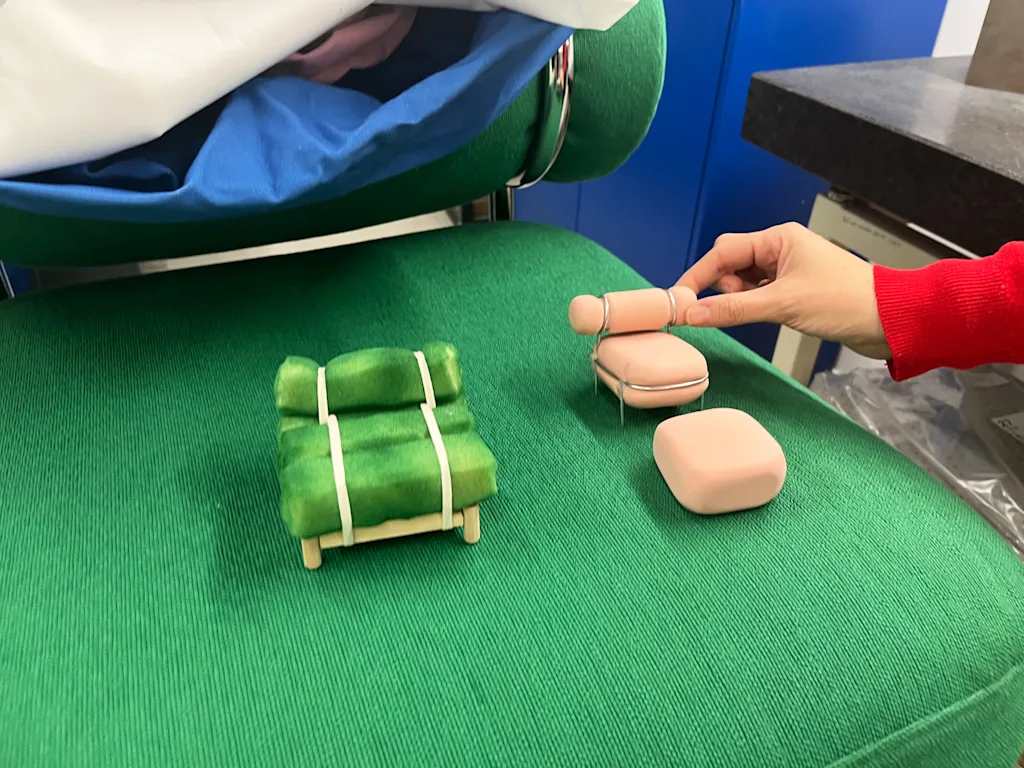
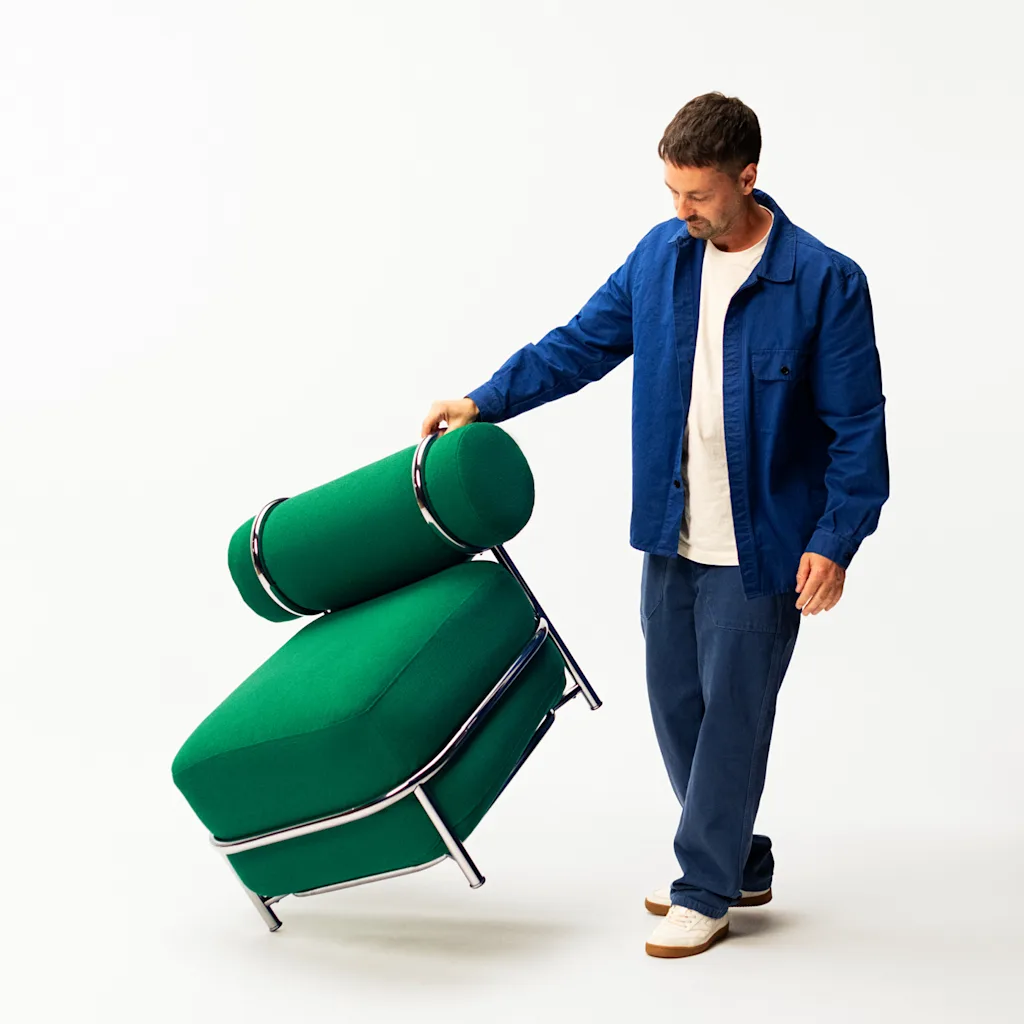
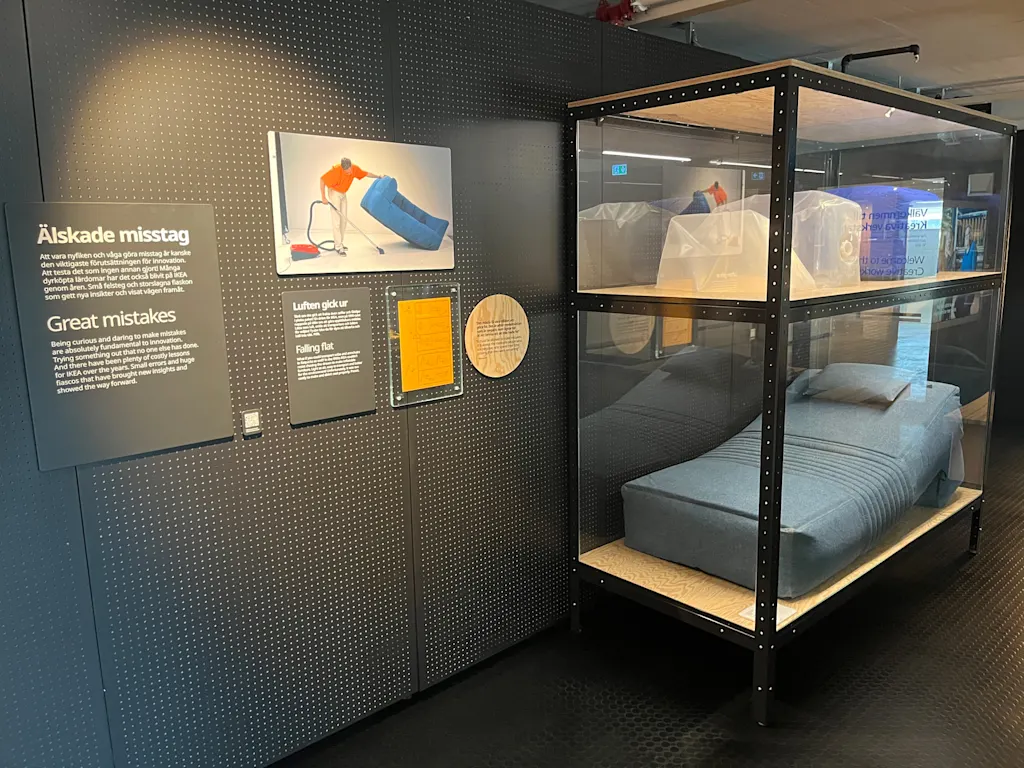
Axelsson’s design went through that exact distillation process, with the added benefit of the concept kicking around in his brain for more than a decade. Settling into the green cushion of a near-final version of the inflatable easy chair that will finally hit stores in May, priced at $199.99, Axelsson cradles that first tiny model he made back in 2014. The two chairs look remarkably similar. Scattered around him are the rough mockups and failed tests that it took to make that leap, a leap that happens for thousands of items on sale in Ikea stores and sitting in homes around the world.
“It would be really hard without this space to make good products, if not impossible,” Axelsson says.
A culture of testing
Prototyping has been part of Ikea’s DNA since it first started making its own furniture, but today the act of prototyping products is as much a design approach as a business strategy. Ikea is considered the largest furniture company in the world, with an estimated 5.7% market share in home furnishings. It’s continuing a long trend of expansion—66 new Ikea stores opened in fiscal 2025, and its largest retail franchisee, Ingka Group, expects to open 20 by the end of fiscal 2026.
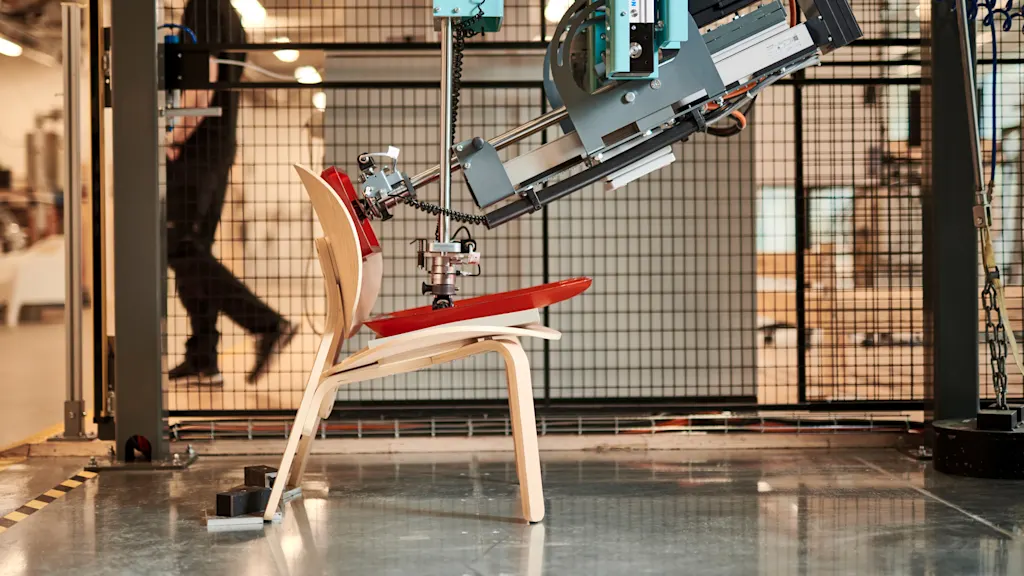
The nearly 2,000 products the company releases every year are produced at such a vast scale and with such tight profit margins that Ikea has cemented itself as a low-cost leader across a wide range of product types. Offering new and better products every year, with the aspiration of making them at as high a quality as costs will bear, has become the core business model. And the prototyping lab is key to its success.
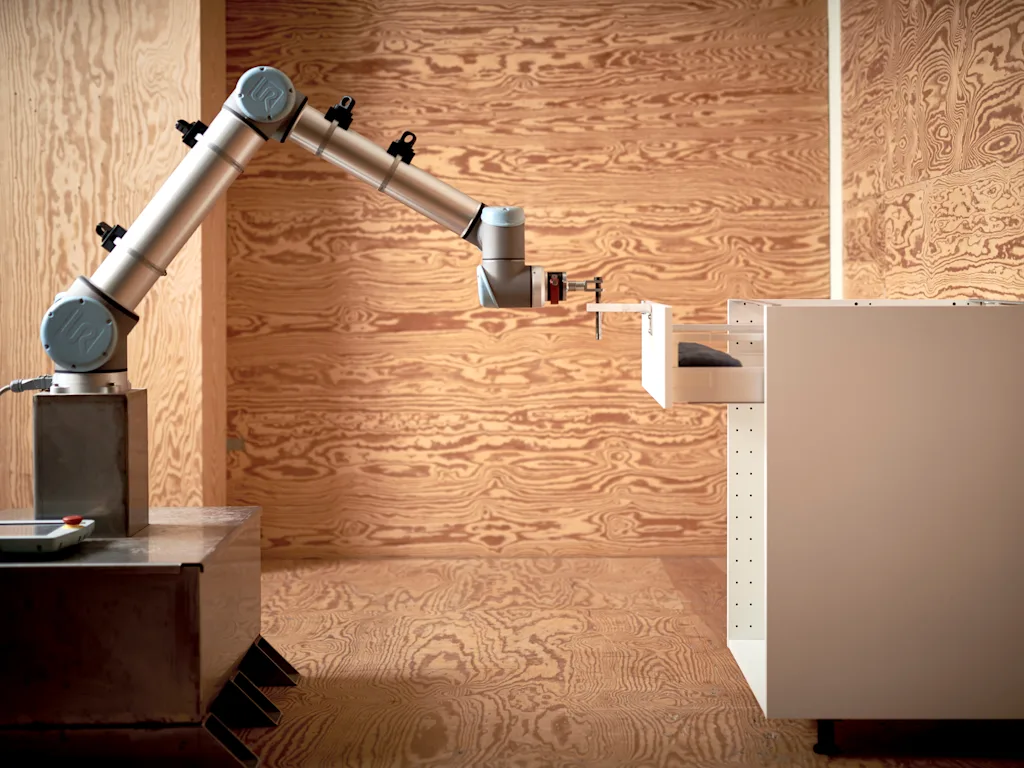
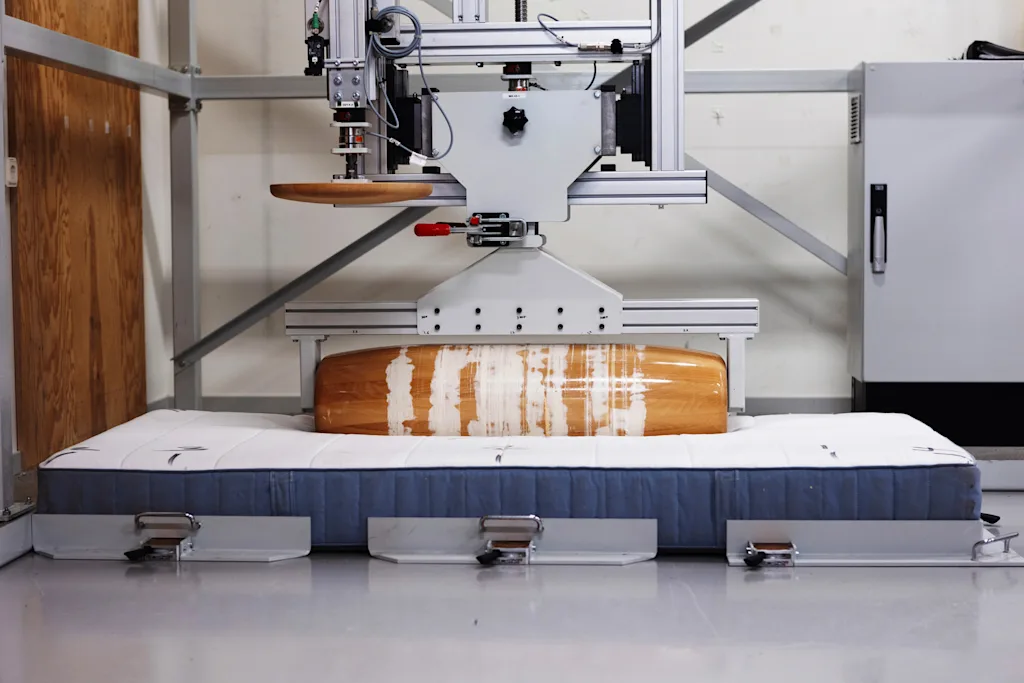
The secured doors of Ikea’s prototyping shop open up to reveal a calm (but clearly mad) scientist’s laboratory. There are five main rooms separated by a central corridor, and each is stuffed with racks of materials and enormous tools that represent the wide range of products Ikea has on offer.
It’s high school shop class in hyperspeed: One area prints large panels of images for a textile, another is coated in sawdust, another blasts a CNC water jet cutter through a piece of sheet metal, and yet another fumes with the scent of freshly sprayed paint. Hospital white walls and smooth concrete floors contrast with the chaotic sounds of a screaming table saw, a zapping arc welder, and classic rock pouring out of a boombox.
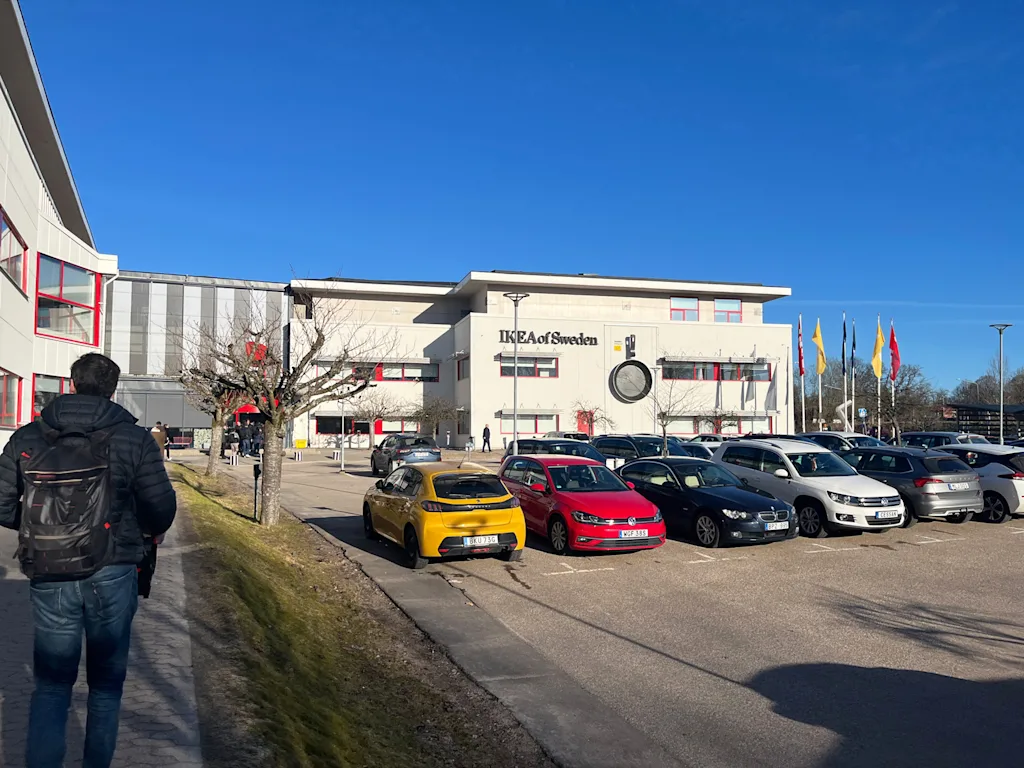
The prototype shop opened in fall 2025 as part of an expansion of Ikea’s headquarters, which is situated in the quaint southern Swedish town where founder Ingvar Kamprad launched Ikea as a mail order business in the 1940s. The new building adds 183,000 square feet to the complex, and the prototype shop sits centrally between the design department and the cafeteria, with separate spaces for the textile and comfort department, the metal shop, the wood shop, painting and surface treatment, and 3D printing. The shop finishes more than 3,400 prototype projects per year.
Henrik Holmberg is the prototype shop’s manager, running a team of 14 specialists who work directly with Ikea’s designers and product developers. He started out in the prototype shop 25 years ago and notes with pride that the shop has existed since Ikea first ventured away from its roots as a mail order catalog and started producing its own furniture, back in 1955.
Over the decades, the role of the prototyping shop has evolved from proving out new furniture designs to actively engaging in the design process itself. Designers, product developers, engineers, and marketers are regularly streaming into the shop to check on products in the works or tap into the expertise of the craftspeople there to help bring an idea to physical form. The opening of this new prototyping facility has made this interdisciplinary approach into the status quo.
“Now we are integrated,” Holmberg says. “We are actually in the center of the house.”
On any given day there are upwards of 60 different products being prototyped or refined. Project-specific rolling carts are scattered throughout the shop, filled with the raw elements of shelves, lamps, and bathroom accessories.
The breadth of activity and the sheer amount of stuff is overwhelming. This is a short list of happenings in the prototype shop on the day I visited:
—Textile experts compare two stitching treatments on the edges of a low price sofa’s cushions.
—A piece of pipe is run through a CNC-controlled bending machine to become a curlicue.
—A lumpy floor chair has its organic shape modeled in 3D software typically used by the fashion industry to print out the patterns a seamstress uses for upholstery.
—A test label is wrapped around what looks to be a chocolate bar.
“But don’t bite it because it’s just a piece of wood,” Holmberg says, holding the bar. “Here you can’t trust anything because we are faking so much.”
Quick mock-ups like this are the blood of the prototype shop, fueling the creative process and accelerating the sometimes brutal evaluations that determine whether an idea should move forward or die young. “We do many iterations sometimes to ensure that we don’t spend too much time on the wrong thing too early,” Holmberg says.
In addition to new products, the prototype shop is also regularly reevaluating old products. Sometimes this is for safety reasons, as regulations evolve and the company tries to eliminate tip-over risks in products like chairs and dressers. “That is apparently not safe anymore,” Edjemo says, pointing to a plastic children’s chair that’s one of the company’s best sellers. The revision underway angles the legs a bit farther out, making it more stable.
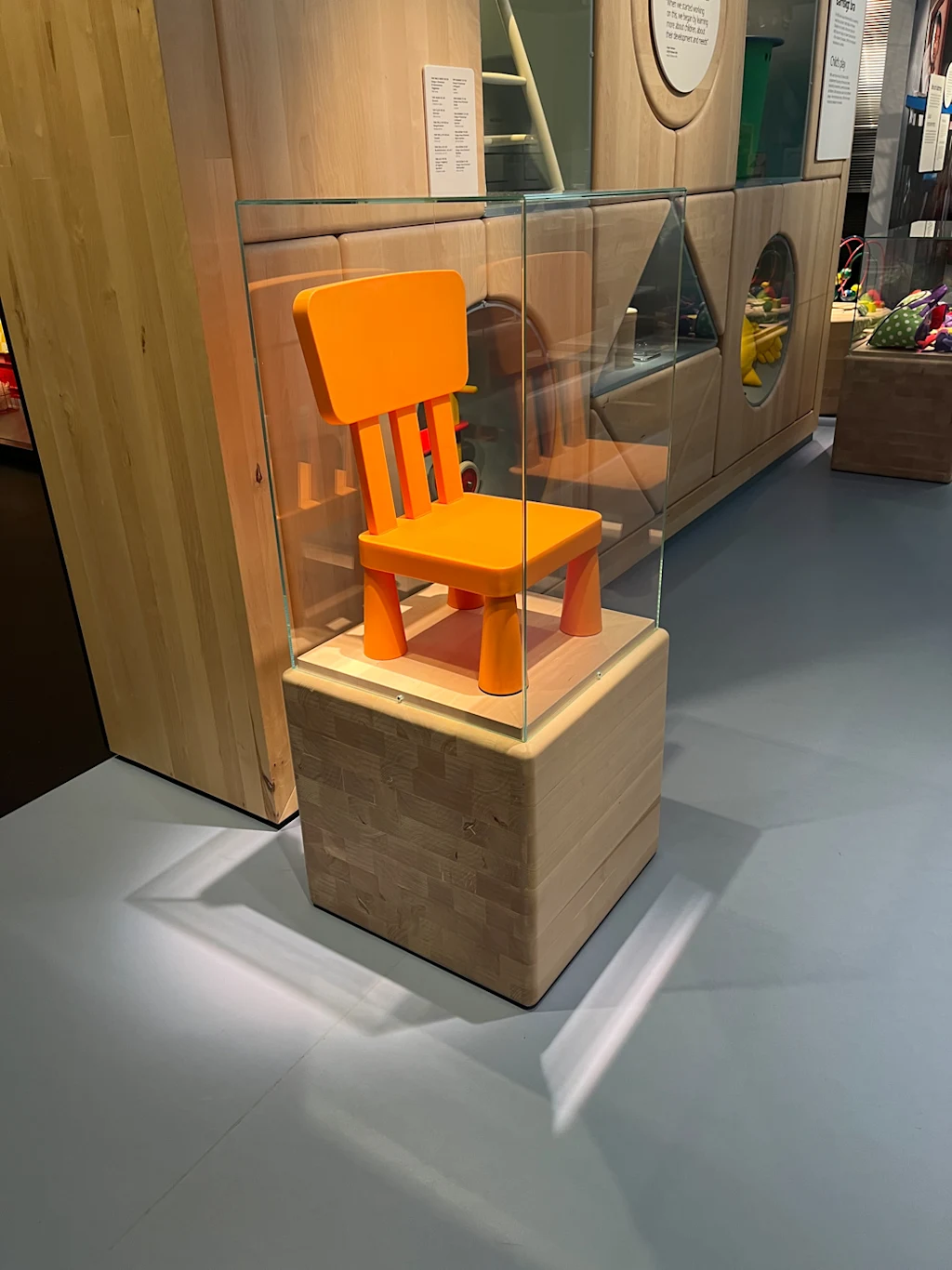
“It takes a lot of energy, but you have to do it and it’s not always beneficial for the design,” he adds. “The regulations are changing all the time.”
Sometimes a product comes back to see whether a more sustainable material could be used in its construction, or to improve its recyclability. “Circularity is influencing everything in design today,” Ejdemo says.
All this means there’s very little downtime in the prototype shop. But the process isn’t rushed. In fact, Holmberg stresses the importance of carefully searching for the best solution to whatever product is being designed or refined, drawing on his team’s decades of experience in blacksmithing or carpentry or sewing. “Everything about prototyping is to have the access to explore. We try one track, then another track, and if that doesn’t work we need a third track,” he says. “The main thing is to be flexible.”
Full circle prototyping
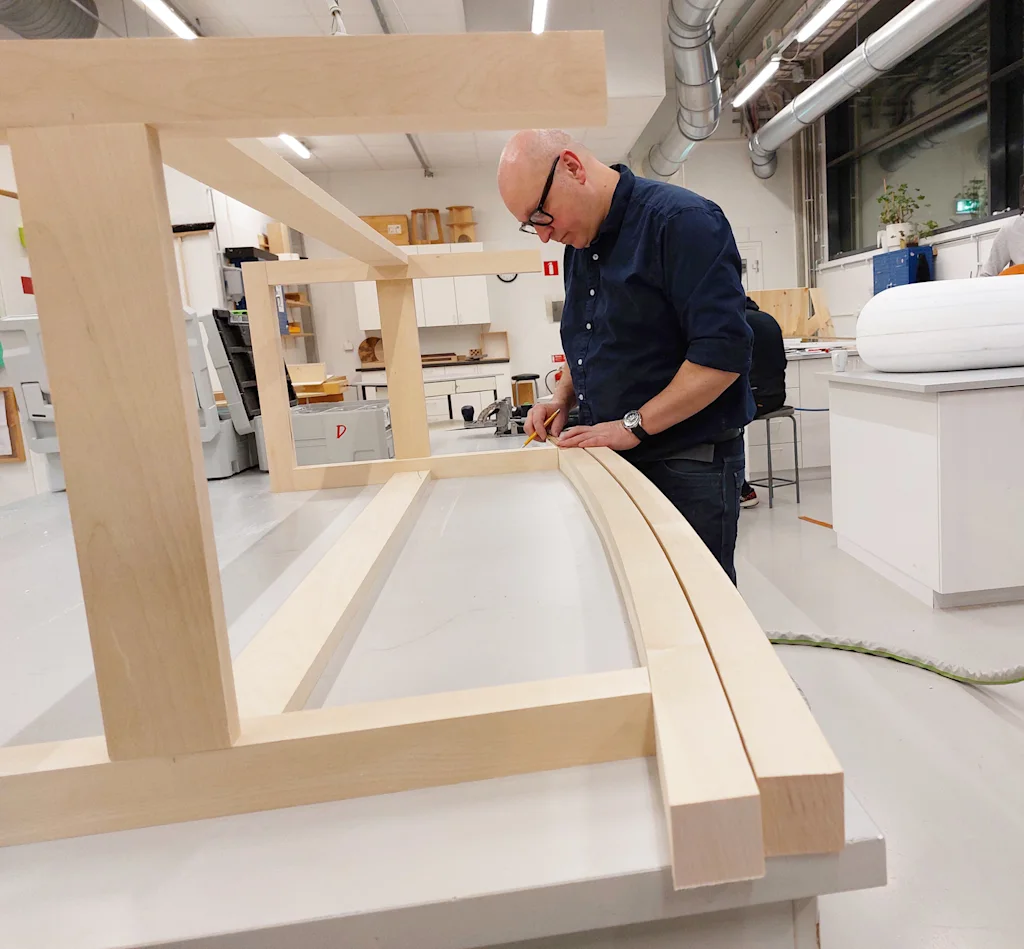
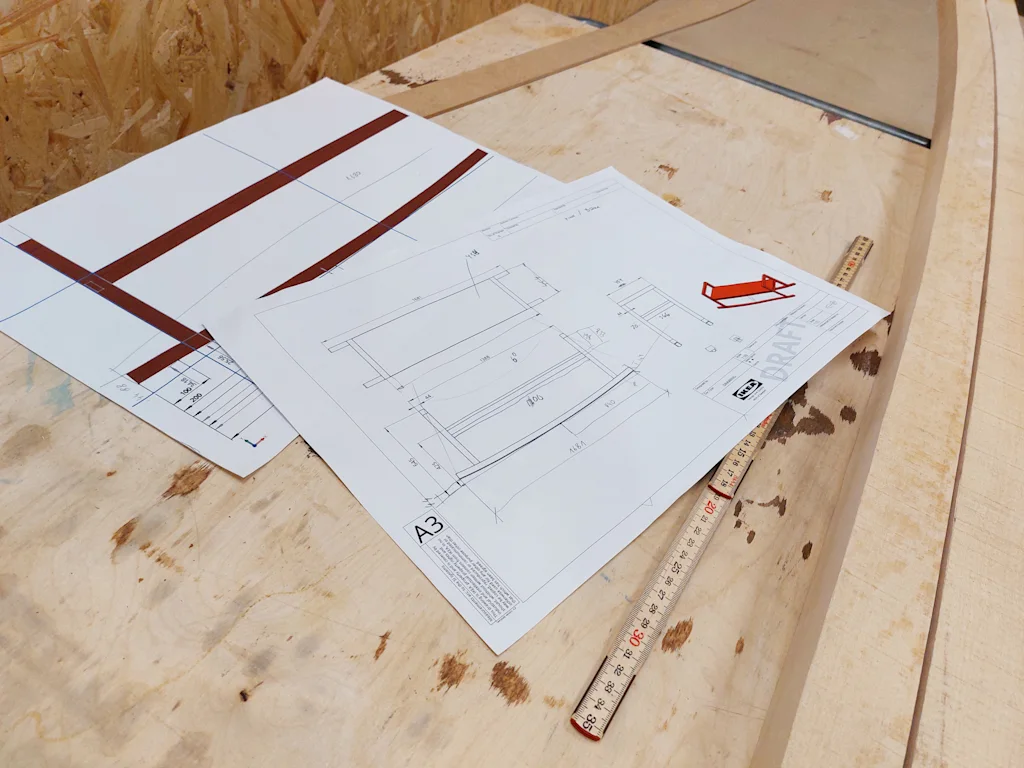
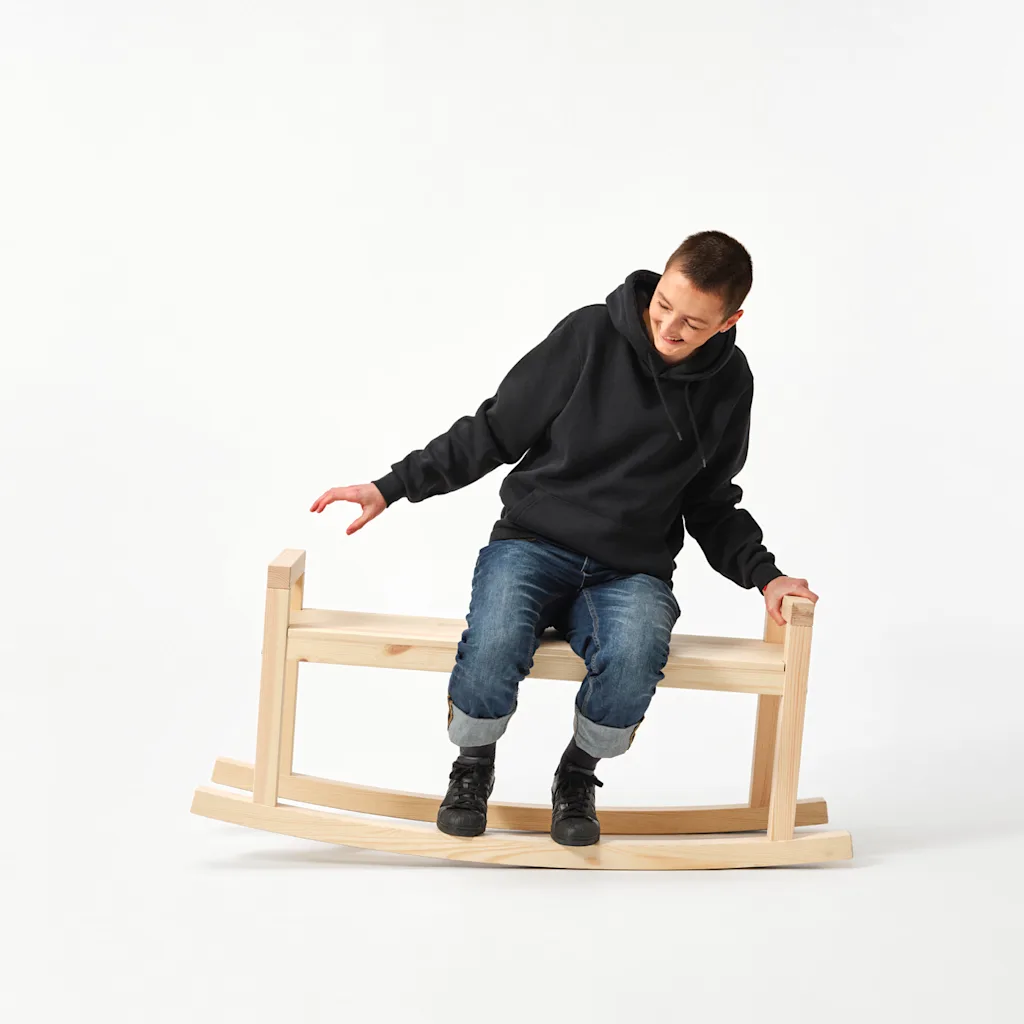
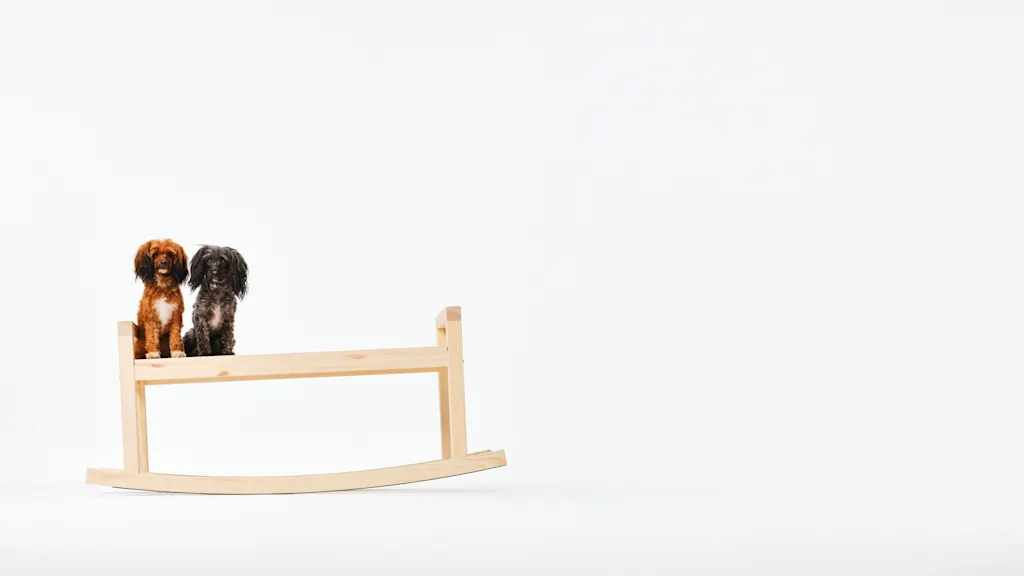
One of the most striking pieces in the new PS collection launching in May almost didn’t make it through the prototype phase. Back during the collection’s design sprint in late 2023, designer Marta Krupińska submitted a drawing showing a simple but odd wooden bench for three people. Instead of sitting flat on the ground, the bench’s design called for it to have arched runners under its front and back legs, making it wobble from side to side. Prototype engineer Fredrik Larsen rushed over to the bench drawings before any of his colleagues could. “I took the opportunity to grab it first,” Larsen says.
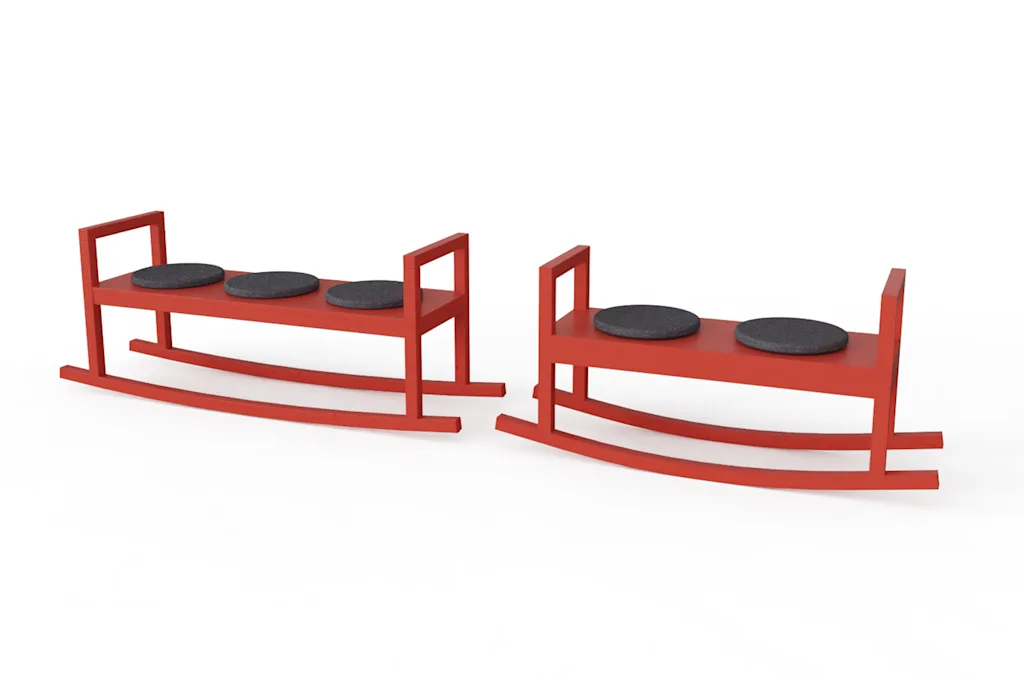
Krupińska says the idea for the rocking bench came from her inner child. “I like to do things against the rules, you know?” she says. After Larsen selected the bench to build, she couldn’t help but head straight into the prototyping shop with him. They immediately began to build the design together, at full scale. Rather than making a quick mockup, they decided to go straight to the pine that would be used for a commercial product. “We were reprimanded,” Krupińska says. “It didn’t land that well with my colleagues because they were doing very rough mockups in particle board and stuff like that.”
The gambit paid off. “When I saw this, I was just like, this is perfect,” says Maria O’Brian, the creative leader behind the PS collection. “You understand it’s a bench, but you also see the playfulness immediately.”
But the prototype had a problem. “The runners were deflecting like a flat tire,” Krupińska says. “We just sat on it and it was like ‘boom.’” She and Larsen went back to the prototyping shop.
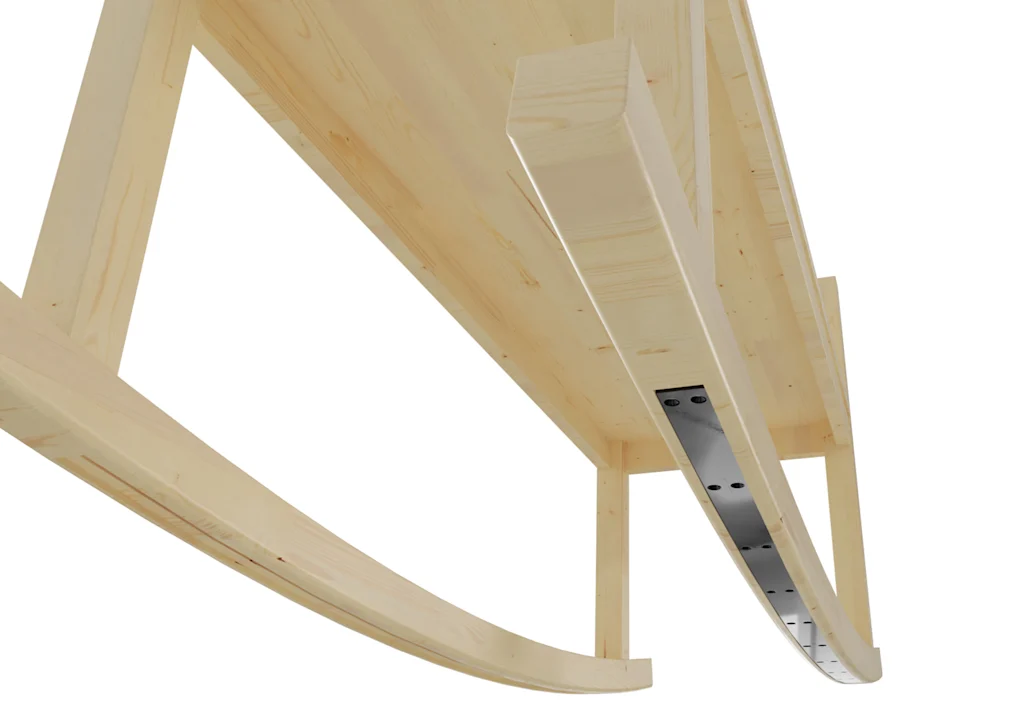
The bench, revised down to be a two-seater that could fit more easily into a smaller home, went through a few alterations to try to keep the arched runners from falling flat. They tried different woods, added an extra support bar, and they even reverted back to making a fast mockup out of particle board. Eventually they landed on a solution that involved cutting a channel on the bottom of the runners and lining them with a strip of metal. The runners held and the bench rocked.
“Then we got in trouble with Johan [Ejdemo]. Because Johan is an old carpenter,” Larsen says.
“Adding material is never the first strategy,” says Ejdemo, a former cabinet maker who’s been with Ikea for nearly 30 years. Conceding that the bench “was not my favorite,” he urged Larsen and Krupińska to find another solution that didn’t require adding metal or the bench was out of the collection.
In the months following the PS collection’s design sprint, Larsen and Krupińska had left their full-size prototypes sitting around the office. People kept stopping by to give them a try. “Every week I got a new video from Marta of people playing on it, and she was like, ‘See, they also like it,’” O’Brian says.
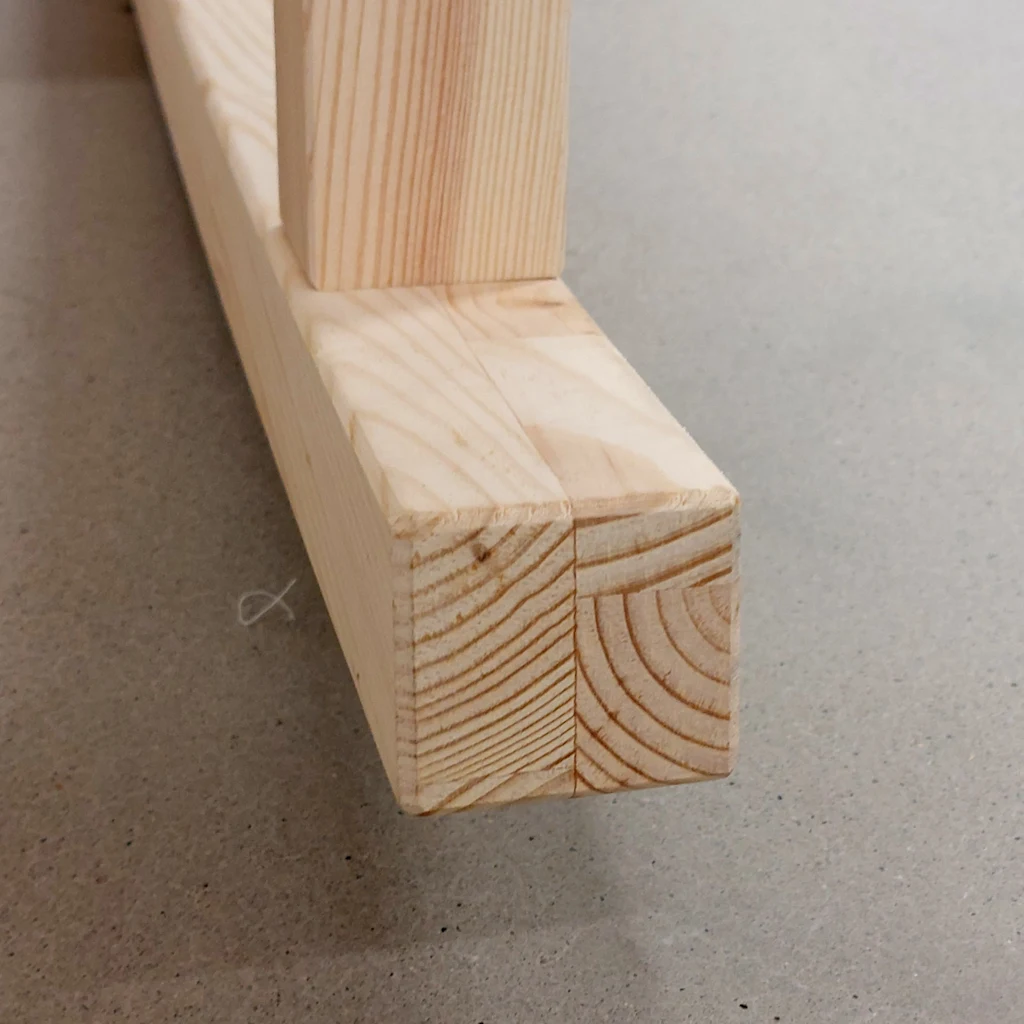
Having the prototypes out on display ended up leading to the solution Larsen and Krupińska needed. Another designer, thinking back on a recent project, suggested that they could gain more strength from the runners by slicing the wood lengthwise, reversing the grain and gluing them back together. “This was the breakthrough,” Larsen says. After four months of prototyping and problem solving, Larsen and Krupińska had a workable product. It will retail for $159.99 beginning in May.
The last prototype they made is sitting in the prototype shop on the day I visit. O’Brian, its early champion, and Ejdemo, its biggest critic, take a seat on it together and begin rocking. Neither can help but laugh.
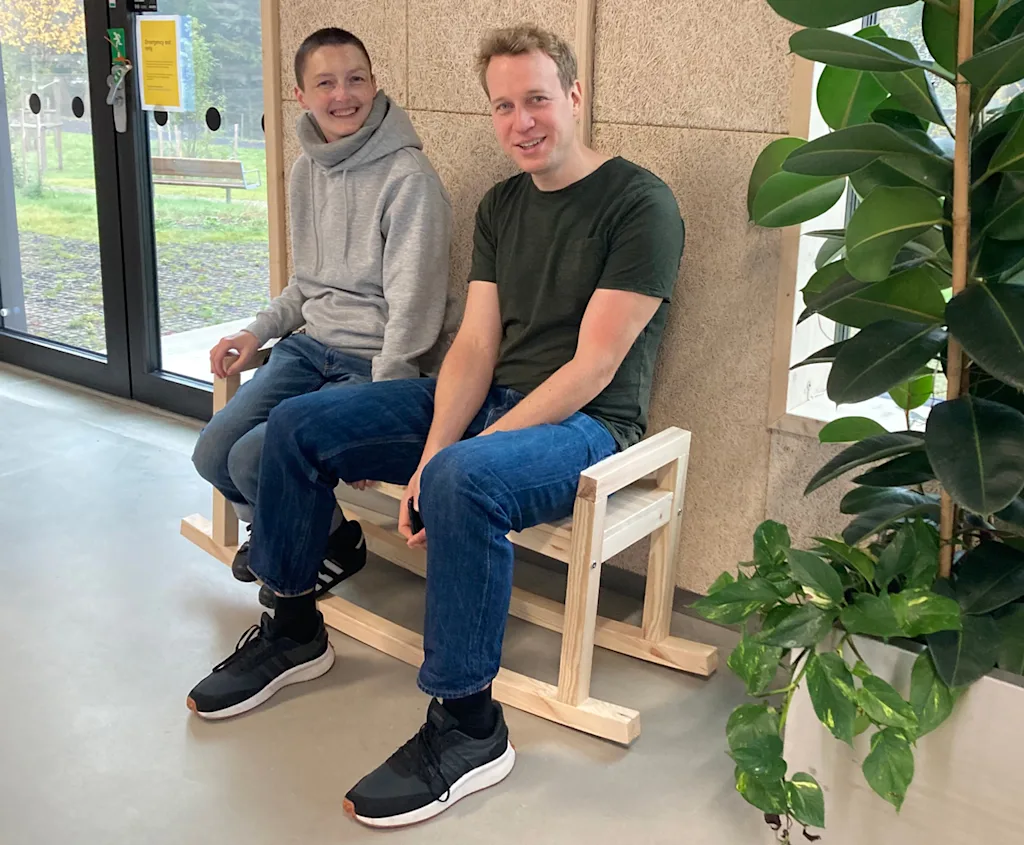
“This is a product that we think is something you’ll remember for a long time,” O’Brian says. “We’re really happy we made it, because it was a bumpy ride. You never know. In these projects you have a lot of darlings that fall away.”
“Building will give you the answers”
Through a set of secured doors, Edjemo and I walk out of the prototype shop down a short hallway to the design department. It’s an equally secretive part of the compound—no photos allowed—but also one that’s integrally connected with the rest of the vast business. It’s another short walk to various other departments that run the company, including marketing, finance, and the executives laser focused on shaving pennies off production costs and adding pennies to the bottom line. None is separate from the other.
“We’re based on the vision of creating better everyday life. It’s not just making a good-looking home. It goes a little bit deeper than that. We have a business idea connected to making that vision fly,” Ejdemo says. “Selling more products, we will be able to reinvest in how we make the products to offer them at prices so low that many can afford them.”
This wide range of products “allows Ikea to cater to a lot of different customer segments and taste levels,” says analyst Neil Saunders, managing director for retail at GlobalData. “The new launches keep the range fresh and interesting, and it allows Ikea to adapt to new trends in home design and styling.”
That’s why it’s in the company’s interest to put so much into its product development. Walking through Ikea’s design department, Ejdemo pauses to chat with a few team members about what they’re working on. One has a rolling bag filled with paints and brushes near her desk and a fresh water color for a new textile treatment. An intern has just gotten off the phone with a supplier exploring a new approach to ceramics. A market forecaster can’t say anything more than the fact that he’s currently figuring out what consumers will want from Ikea in 2030.
Ejdemo is also testing the waters for what’s to come. He’s placed a few prototype pieces out in the design department just to see if they get any attention. “They’re not part of anything right now,” he says. “But they might be.”
It’s not just experimentation, though. The output of the design department is heavily influenced by other parts of the company and a broader business strategy. “It’s very defined by the business, what they need, and what they’re going to do next, and they might have a gap in their offer,” Ejdemo says. “The priority of the job is the 1,500 to 2,000 products a year. They all start with design, and they all start with an understanding of the context around that product. Then you get guidance that it should sit in this style and be at this price level.”
Sometimes that means the designers are taking assignments and pumping out products because that’s what the company needs. Other times, the stars align and it suddenly makes sense to pitch a weird rocking bench or a mothballed inflatable chair. Having the ability to take those ideas and quickly turn them into physical prototypes creates a proof point, or at least a spark of interest that suggests what might sell. For Ejdemo and the designers at Ikea, designing a product means making it.
“I have learned throughout the years that sometimes it’s good to start with a quite crazy idea, because that gives you something. And then you understand to go in this direction or the other. But if you haven’t started to do these kinds of crazy versions, you will never find the next step,” says Ejdemo, still a carpenter at heart. “Starting building will give you the answers.”
Related Posts
Mamdani’s victory speech included a 4-word warning to Trump
34-year-old Democratic Socialist Zohran Mamdani won the New York City…

The 50 most expensive militaries in the world, ranked by defense budget
The US has the most expensive military in the world.…
How much the typical worker made last year at 16 top retailers, from Amazon to Walmart
Bloomberg/Getty Images Nearly two-thirds of US workers have held a…