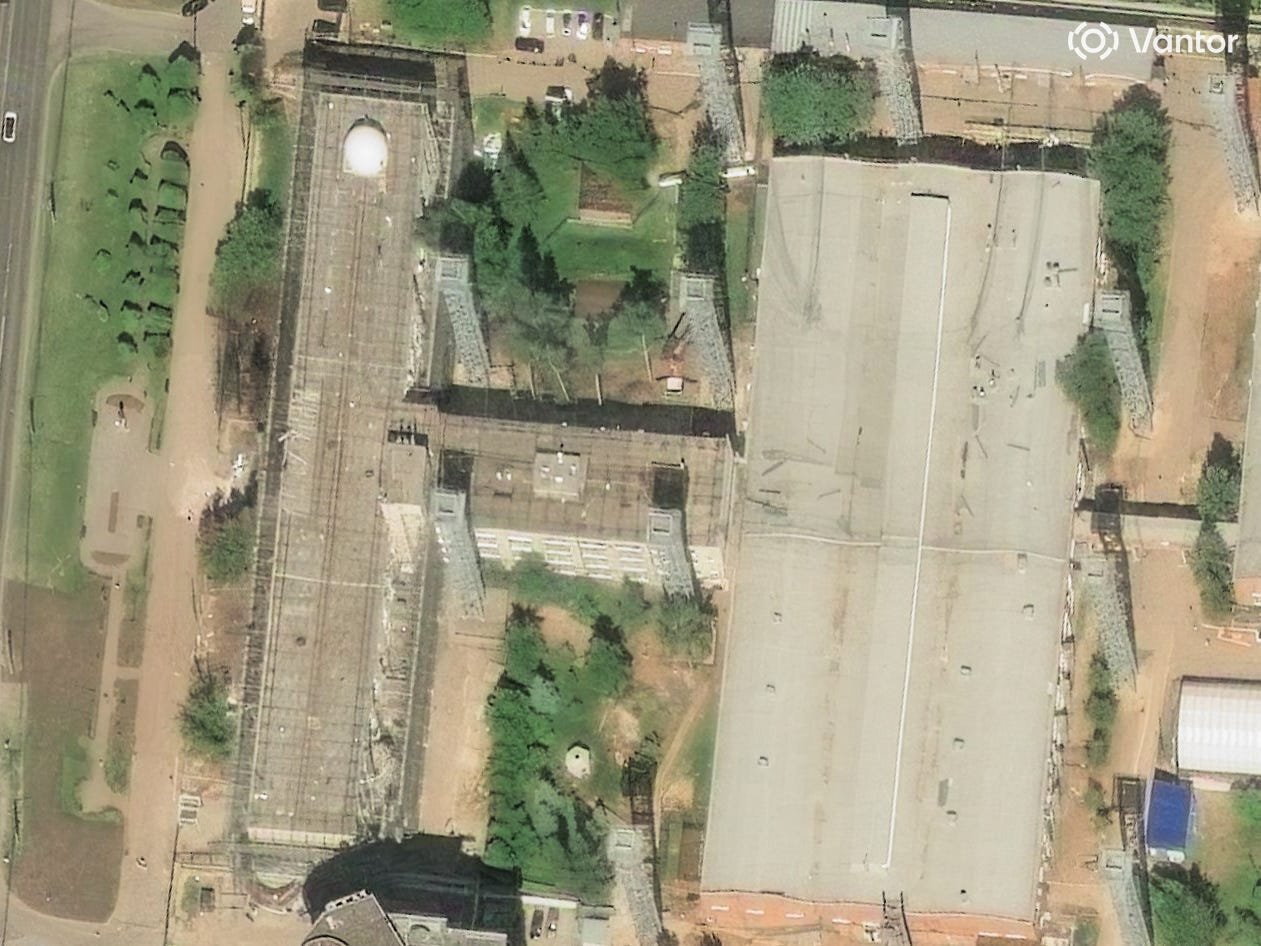
Satellite image ©2026 Vantor.
- Russia wrapped a building linked to weapons production in anti-drone cages, satellite imagery shows.
- This type of protection is common for vehicles on the battlefield, though unusual for buildings.
- Ukraine said it struck the building with cruise missiles this week.
Russia attempted to shield a weapons production facility with anti-drone cage armor. Ukraine came for it with its new cruise missiles.
A satellite image, collected by the US spatial intelligence firm Vantor in late May and shared with Business Insider, shows a cage surrounding part of the VNIIR Progress plant in Cheboksary, located more than 550 miles from the front lines in western Russia’s Chuvashia Republic.
Cage armor is common on the battlefield, often used to provide tanks and armored vehicles with added protection against drones. For infrastructure such as buildings and supply routes, anti-drone netting is becoming more widespread. Russia has used these nets to shield energy facilities, frequent targets for Ukrainian deep strikes.
Satellite image ©2026 Vantor.
It is, however, unusual to see cage armor wrapped around a building. Vantor said that the cage has been in place for at least a year. It’s unclear when it was installed, though.
On Wednesday, Ukraine launched a major attack on the plant, which produces electronic components for Russian munitions, hitting it with domestically produced FP-5 Flamingo cruise missiles.
It marked a rare disclosure of the use of the Flamingo, a 40-foot-long missile made by the Ukrainian company Fire Point, said to have a range of more than 1,800 miles and a 2,500-pound warhead.
Video footage captured at street level and shared on social media on Thursday showed significant damage to the caged building.
The Ukrainian military said that the VNIIR Progress plant is “one of the key manufacturers of navigation equipment for high-precision weapons of the Russian Federation,” responsible for making satellite navigation receivers and antennas for Shahed-type attack drones, Kalibr cruise missiles, Iskander ballistic missiles, and glide bombs.
Ukraine also targeted an oil refinery in Russia’s Samara region during the Wednesday attack.
Ukrainian President Volodymyr Zelenskyy said “we continue to apply Ukrainian long-range sanctions against Russian military facilities and the oil industry.”
Ukraine has launched several attacks on VNIIR Progress over the past year as part of an effort to cripple the supply chain of critical parts that end up in Russian weapons. It’s unclear to what extent the recent strike affected the plant’s operations.
Pierre Crom/Getty Images
Conflict analysts at the Institute for the Study of War, a US think tank, said the Wednesday strike — which follows an identical one in early May — “demonstrates Ukraine’s increasing ability to sustain and intensify long-range strikes against key Russian military facilities.”
The expansion of anti-drone cages and netting inside Russia underscores a growing concern about the efficacy of Ukrainian deep strikes targeting these facilities, strikes that may only get worse with the addition of new missiles into what has largely been a long-range drone operation.
Ukraine has been building up a proven arsenal of homemade missiles and drones for long-range strikes targeting weapons production factories, air bases, refineries, oil terminals, and other important sites inside Russia.