A summer night at Surf Lodge—Montauk, New York’s famed music venue and it-girl hotspot—looked like any other in July. Hundreds of Hamptons-goers were sipping drinks and dancing at the waterfront venue to blaring DJ sets, trying to catch the perfect Instagram shot.
But with Gen Z crowding the dance floor lately, the drinking scene has started to shift. Nights have been wrapping a little earlier, drinks are more slowly paced out, or even swapped out for nonalcoholic options.
“Gen Z is interesting because they still celebrate and they have fun. It’s just a new balance and a new way of approaching drinking,” says Jayma Cardoso, Surf Lodge’s owner and hospitality mogul, whose other ventures include New York City’s Goldbar and the Surf Lodge winter spinoff the Snow Lodge in Aspen.
With over 20 years in the business, Cardoso has seen nightlife evolve, constantly adapting and innovating to keep her venues relevant to new generations. And, despite headlines calling Gen Z the “sober generation,” new research shows they’re not ditching alcohol entirely.
As a Gen Z consumer myself, I find sweeping statements on whether my generation drinks or doesn’t often oversimplified or stuck in time. In fact, our drinking habits are more nuanced. My peers often choose to drink less, not abstain entirely. And yes—some even drink more than they should.
A recent study from IWSR, an alcohol market data company, found that alcohol participation levels have risen among the youngest legal-drinking-age consumers, with 70% of Gen Z in the United States saying they’d consumed alcohol in the last six months, compared to just 46% in 2023.
And while Gen Z’s drinking habits are finally catching up with those of previous generations, young drinkers are reshaping what drinking and socializing looks like.
Moderation is in, and so are new ways of socializing
“We’re not talking about a sober movement,” Cardoso says. “It’s that if they drink, they drink, but they choose wisely how to drink, and their intake of how much [of] it goes to their body.”
As Gen Z drinks more consciously, nonalcoholic beverage brands are tapping into the movement—appealing not just to the sober or sober-curious, but also to those looking to pace their alcohol intake.
“Instead of drinking alcohol continuously, what I saw were people were switching off,” says Ben Witte, CEO and founder of zero-proof functional beverage brand Recess. He launched the brand in 2018 as an alternative to managing stress and improving mental wellness, beyond what traditional drinks like alcohol could offer.
Back then, he noticed consumers having “in between drinks,” like a beer, to pace out hard liquor. Now available at various music venues and bars, including Surf Lodge, Recess serves as a zero-proof alternative to the ritual, positioning itself in the moderation market.
And still, some might opt out of drinking in favor of a new buzz.
“There are more options compared to other generations when they were that age. Cannabis is legal in many states across the country, so now it’s not always about just getting drunk,” says Darren Seifer, industry analyst for Circana. “There’s just a few more options that are available to Gen Zs that are chipping away at what they do when they’re out having fun.”
And the roads leading toward a buzz are already paved, with cannabis entering the beverage world. While not as widely available as functional beverages—drinks that include an added “function” such as stress relief from herbs—cannabis drinks are beginning to carve out a role in socializing.
“If you think about the thousands of years of human history, we socialize over beverages,” Jake Bullock, cofounder and CEO of Cann, a cannabis-infused drink company, says. He initially launched his brand as an alternative to alcohol to avoid hangovers, but wanted a way to retain the buzz.
“Not only are you doing the original goal of drinking less booze, but you’re now also getting another factor,” he says. “It is another experience that’s slightly changing with the way you perceive the world around you and is going to make you a little bit more social.”
Money talks—and so does health
While Gen Z has become the poster child of moderate drinking, the trend crosses the age gap, with older generations reducing their alcohol intake as well.
A recent Gallup report shows that the drinking rate in the U.S. has fallen to its lowest point in 90 years, with only 54% of adults saying they consume alcohol.
And while the decision to set alcohol aside varies, both rising costs in an uncertain economic climate and a wave of health consciousness are pushing people away from the bar.
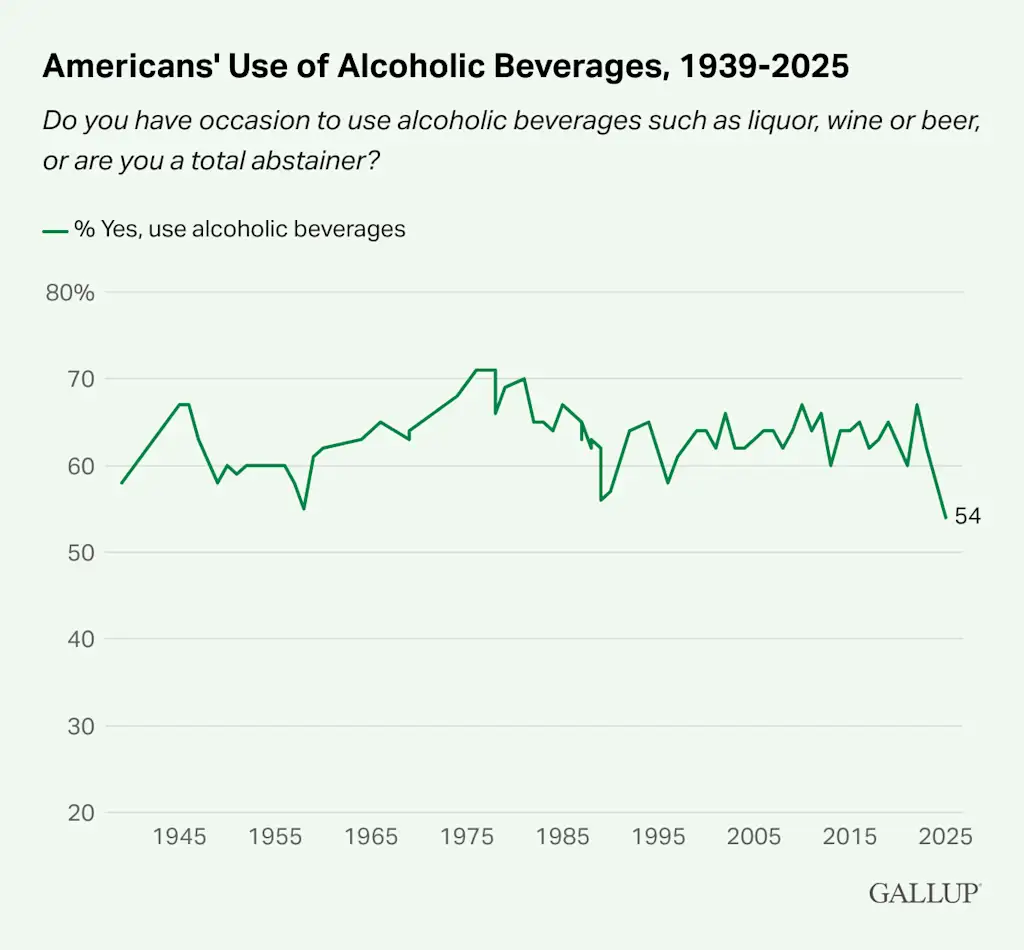
“The downward trend has accelerated,” Seifer says. “A lot of it is driven by pricing. And volume-wise, it’s been down in the last few years.”
In addition to pricing decisions—where consumers are opting to spend their money elsewhere—the popularity of health consciousness is also reshaping habits.
“Since the [Trump] administration came in in January and we heard about ‘Make America Healthy Again,’ there’s been an uptick in people saying they’re trying to avoid artificial colors, GMOs, artificial sweeteners. So there seems to be this renewed focus on purity these days,” Seifer says. “And when you think about what’s pure, it could be inferred that alcohol might not be a pure item.”
For instance, at Snow Lodge, Cardoso first introduced zero-proof cocktails due to wellness, a decision that has traveled to Surf Lodge, where consumers can now get a bucket of Recess over a bucket of beers.
“[Consumers] are looking at, ‘What are my options, and where am I going to spend my hard-working money?’” Cardoso adds. “Maybe it is, ‘I’m going to dance the night away, have the time of my life—but I’m also going to go home earlier so that I can do my wellness tomorrow.’”
So whether it’s for saving money or for waking up ready to go the next morning, moderation is trendier than ever, and Gen Z is leading the way.
Related Posts
How Doug McMillon went from unloading Walmart trucks as a teen to earning over $27 million as CEO
Walmart President and CEO Doug McMillon. Ethan Miller/Getty Images Walmart…

Thousands of Redditors are dreaming of one uncanny shopping mall
“I always dream of the same mall.” So begins a…

Cognizant’s CEO tells us his counterargument to the idea that AI will decimate entry-level white-collar jobs
Cognizant CEO Ravi Kumar said he has a counterargument to…