Want more housing market stories from Lance Lambert’s ResiClub in your inbox? Subscribe to the ResiClub newsletter.
Back in August 2023, I stated that two metro area housing markets I was watching closely—and believed still faced heightened downside risk despite eking out some gains in 2023—were Sevierville, TN (where, in July 2023, home prices were still +70% above December 2019 levels) and Naples, FL (where, in July 2023, home prices were still +72% above December 2019 levels). Unlike frothier markets like Austin, Boise, Punta Gorda, and Cape Coral, which had already slipped into correction mode by then, Sevierville (Sevier County, TN) and Naples (Collier County, FL) hadn’t yet seen a more material giveback.
Fast-forward to summer 2026, and my fundamental analysis was right: Both Sevierville (a big-time Airbnb and vacation housing market) and Naples (a big-time luxury/retirement second-home housing market) have subsequently passed through home price corrections, which have helped to blow off some froth and improve underlying fundamentals.
The reason metro area Chicago is in the chart below is because, since spring 2022, I’ve been using Chicago metro as a proxy for a low-risk post-boom market.
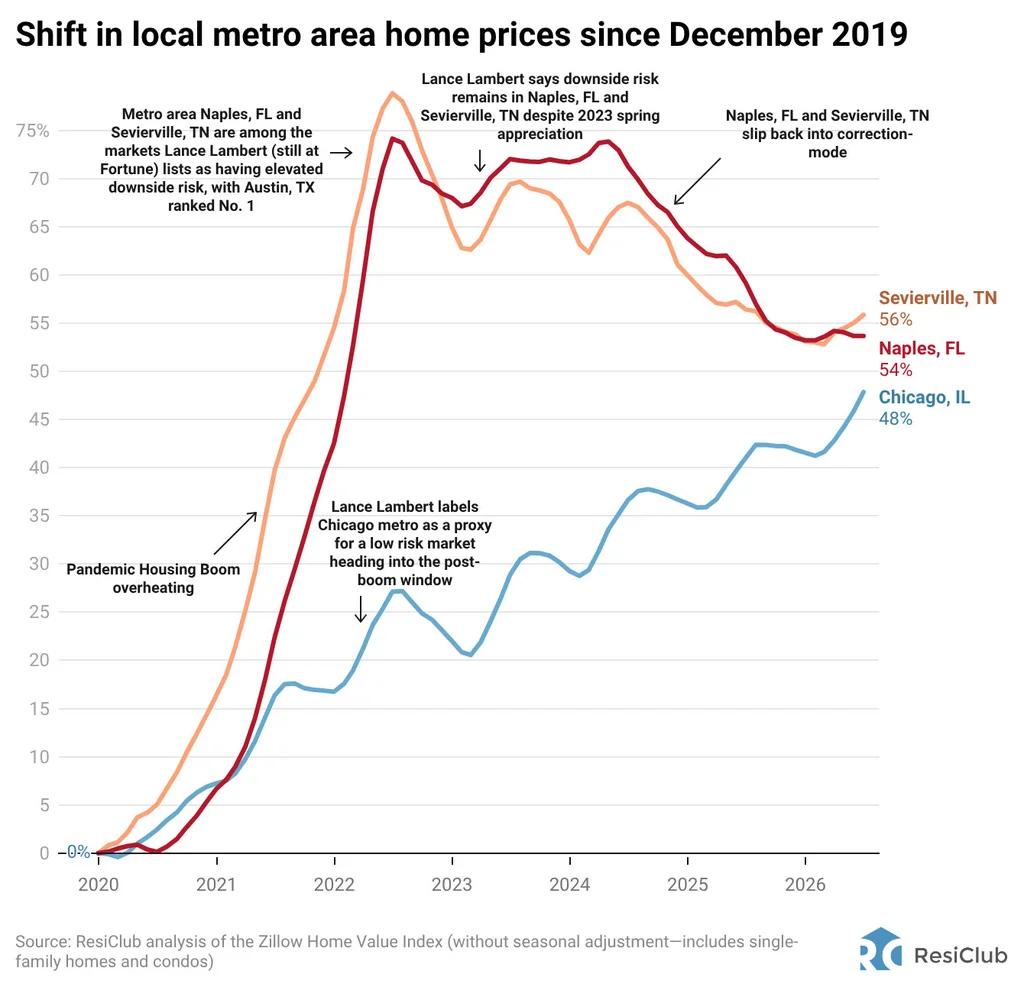
Southwest Florida’s particularly intense overheating during the Pandemic Housing Boom—including in Naples, FL metro (Collier County)—is the key reason for its post-boom downside pricing vulnerability. While U.S. home prices rose +42% between December 2019 and June 2022, Naples, FL metro home prices surged +74% over the same period—pushing it into the “significantly overvalued” threshold. Only, it takes a large enough shift in the supply-demand equilibrium for that vulnerability to manifest into falling prices.
Of course, over the past four years, 5 factors have come together to create a supply-demand equilibrium shift large enough to reveal some of that downside risk and push Naples, FL into a post-Pandemic Housing Boom correction.
- The Pandemic Housing Boom’s migration surge to Florida has fizzled out. Indeed, Naples, FL metro saw net domestic migration of -2,337 between July 2024 and July 2025, compared to +10,857 between July 2020 and July 2021. Without that larger influx of deep-pocketed buyers from up North, Naples home prices have had to rely more on local incomes.
- Surfside condo fallout. Following the Surfside condo collapse in June 2021, which killed 98 people, Florida passed new structural safety rules, requiring more inspections and additional funds for repairs to be set aside by the end of 2024. That has led to Florida HOAs issuing sky-high special assessments and monthly HOA fee increases to cover these costs. This has had a greater impact on older coastal Florida condo buildings.
- Hurricane Ian spurred a greater SWFL softening. Markets like Cape Coral and Punta Gorda, which were hard-hit by Hurricane Ian in September 2022, saw thousands of damaged homes, and the subsequent need for renovations. According to the National Oceanic and Atmospheric Administration, Hurricane Ian caused an estimated $112.9 billion worth of total damage, making Ian the third-costliest U.S. hurricane on record. That event helped create additional softening in SWFL. Naples was impacted too—with $989 million in damages in the city of Naples.
- Supply elasticity. Unlike many housing markets in the Northeast and Midwest, Southwest Florida (including Naples, FL metro) has a higher level of homebuilding, build-to-rent, multifamily construction. As that new supply entered the market in the post-Pandemic Housing Boom affordability-strained environment, builders used bigger affordability adjustments—such as mortgage rate buydowns and rental incentives—where needed to move it. That helped cool the Southwest Florida resale market further by drawing buyers who might have otherwise purchased existing homes toward new construction. As a result, this put additional upward pressure on Florida’s resale inventory after the Pandemic Housing Boom ended.
- Home insurance shocks. Over the past three years, the median annual U.S. home insurance premium has jumped around 30%, but Florida homeowners have been hit even harder. The surge in Florida home insurance rates is partly driven by rising replacement costs—home prices and construction costs soared during the boom—and partly by increased hurricane risks and insurance payouts. Florida’s sharp rise in insurance costs, combined with one of the biggest home price increases during the Pandemic Housing Boom, led to one of the biggest housing affordability deteriorations (2021-2024).
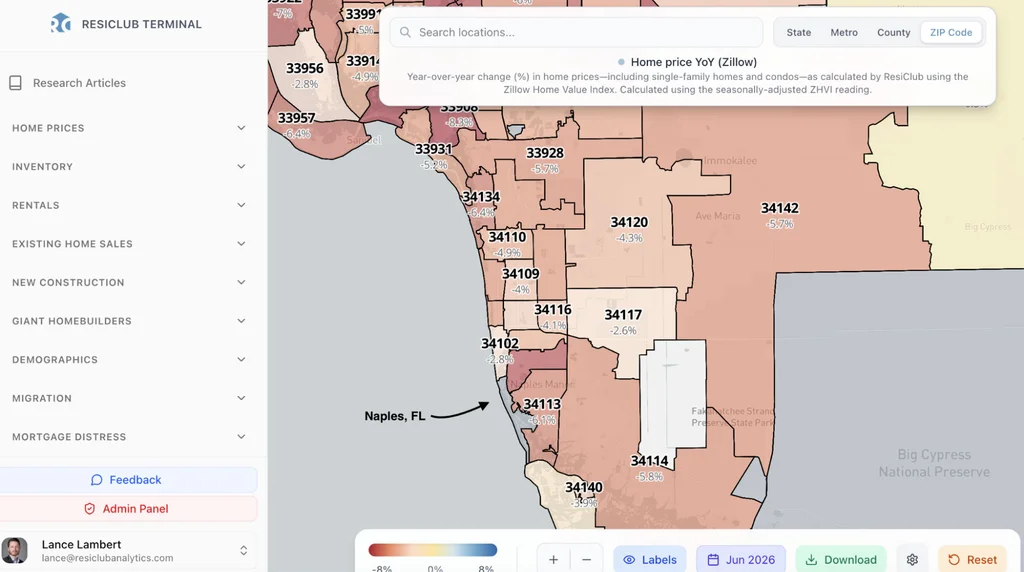
Through the end of June 2026, Naples, FL home prices—including single-family homes and condos—are down -11.8% from their 2022 peak. That’s a milder correction than what the Cape Coral–Fort Myers, FL, metro (-19.0% from its 2022 peak) and Punta Gorda, FL, metro (-24.8% from its 2022 peak) have experienced, but it’s far greater pricing weakness than most U.S. housing markets have experienced since the Pandemic Housing Boom ended. In the Naples, FL., metro, condos (-18.4% from their 2022 peak) have experienced a more material correction than single-family homes (-9.2% from their 2022 peak).
Looking ahead, the recent pricing giveback in the Naples, FL, metro has blown off much of the froth that built up during the Pandemic Housing Boom and has improved underlying fundamentals. Back in Q2 2022, Moody’s Analytics had the Naples, FL, metro as 54% “overvalued”—as of Q2 2026, Naples, FL metro is just 16% “overvalued” according to the Moody’s Analytics model. In theory, as froth recedes and “overvaluation” comes down, so does downside risk.
Additionally, after a large upward burst in 2022–2025, active inventory in the Naples, FL, metro is down -19% year-over-year. And while home prices are still down year-over-year, directionally, the declines are getting smaller in the market: Naples home prices were down -4.6% year-over-year between June 2025 and June 2026, compared with falling -7.0% year-over-year between June 2024 and June 2025.
The Sevierville, TN micro area is essentially the core Smoky Mountains tourism market (Sevier County) on the Tennessee side—including Pigeon Forge and Gatlinburg. And much of the pricing weakness is among homes that were red-hot for out-of-towners during the Pandemic Housing Boom. Look no further than this log cabin, which sold for $1.65 million in August 2023. By April 2025, the new owner had already tried to flip it back on the market for $1.85 million. After several price cuts, and temporarily delisting, the home on Tuesday saw its list price cut to $1.55 million—or -6.1% below its 2023 sale price.
Sevierville metro’s particularly intense overheating during the Pandemic Housing Boom is the key reason for its post-boom downside pricing vulnerability. While U.S. home prices rose +42% between December 2019 and June 2022, Sevierville, TN metro home prices surged +79% over the same period—pushing it into the “significantly overvalued” threshold. It just took a large enough shift in the supply-demand equilibrium for that vulnerability to manifest into falling prices. That shift came as strained demand and strained fundamentals coincided with Sevierville inventory spiking in 2024-2025.
Between July 2020 and July 2021, Sevier County saw net domestic migration surge up to +1,057—compared to +230 between July 2018 and July 2019. However, in the four years since, Sevier County has seen negative net domestic migration—losing -1,090 Americans.
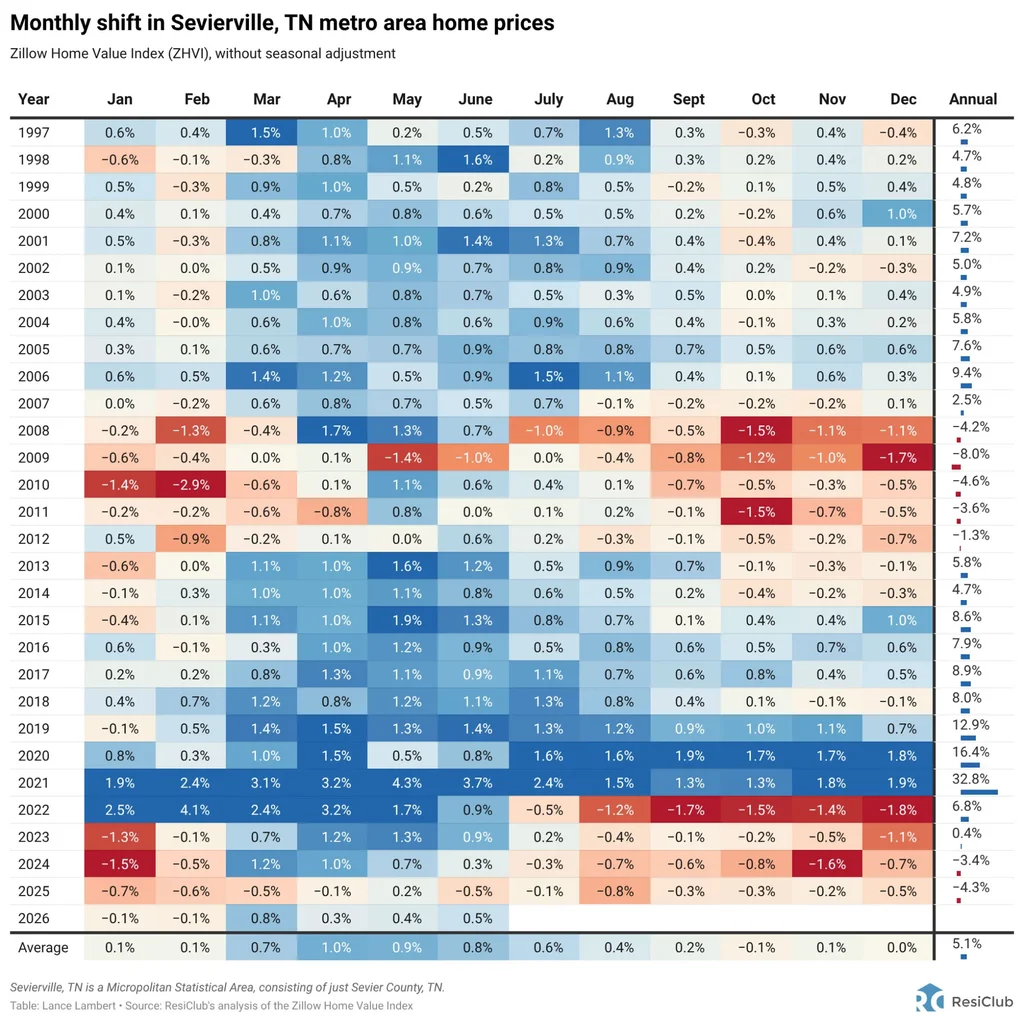
Looking ahead, the recent pricing giveback in the Sevierville, TN, metro has blown off much of the froth that built up during the Pandemic Housing Boom and has improved underlying fundamentals. In theory, as froth recedes and “overvaluation” comes down, downside risk also eases. Additionally, after a large upward burst in 2023-2025, active inventory in the Sevierville, TN, metro is now just up +2% year-over-year. And while home prices are still down year-over-year, directionally, the declines are getting smaller: Sevierville, TN home prices were down -1.3% year -over-year between June 2025 to June 2026, compared with -5.9% year-over-year between June 2024 to June 2026.
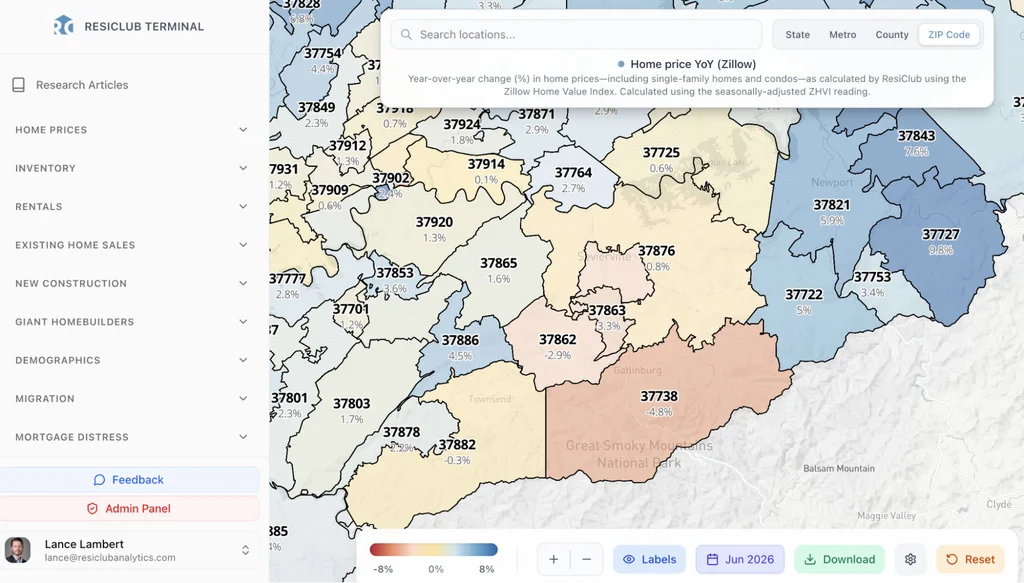
Through the end of June 2026, home prices in metro area Naples, FL are down -11.8% from its local 2022 peak, while home prices in the Sevierville, TN micro area are down -12.9% since its local 2022 price peak.
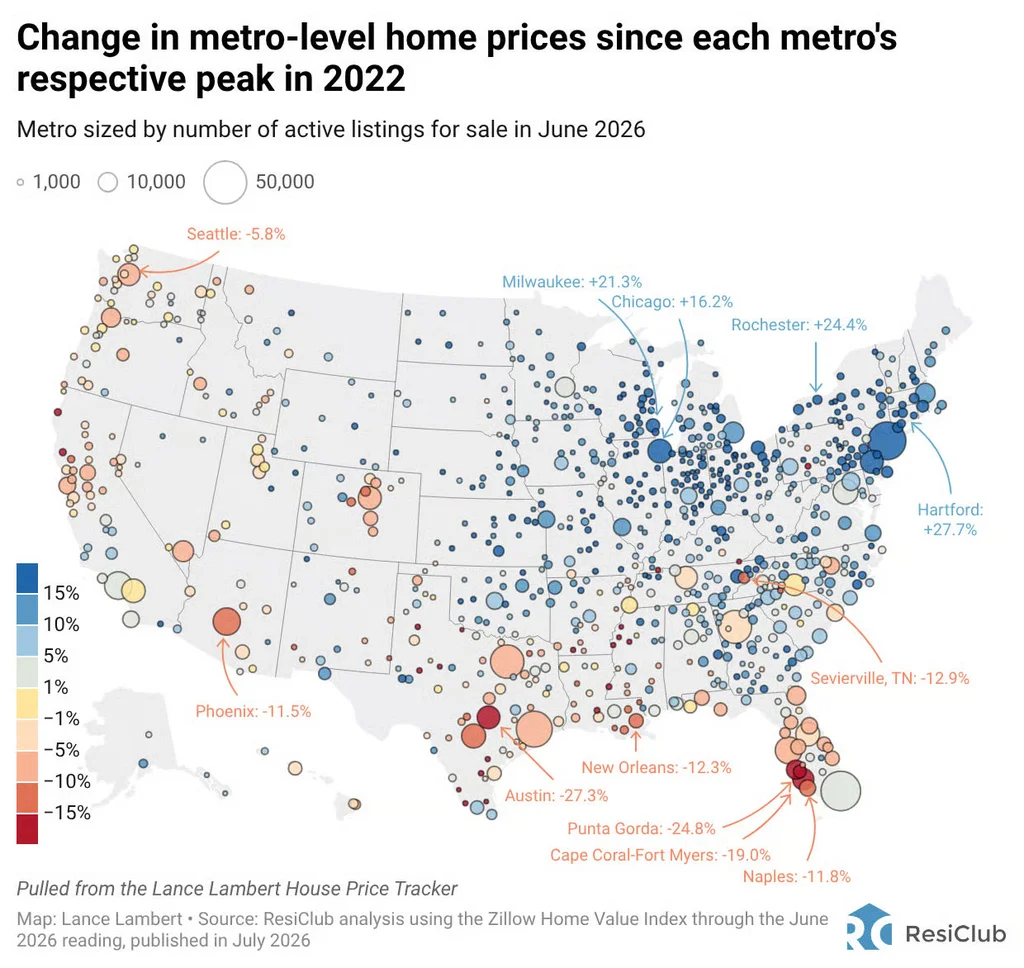
The big picture: As home prices in extremely overheated Pandemic Housing Boom markets like the metro areas of Naples, FL and Sevierville, TN pass through mild home price corrections, and incomes continue to rise, froth is getting blown off in those markets, and their downside risk is easing.
Bonus tables
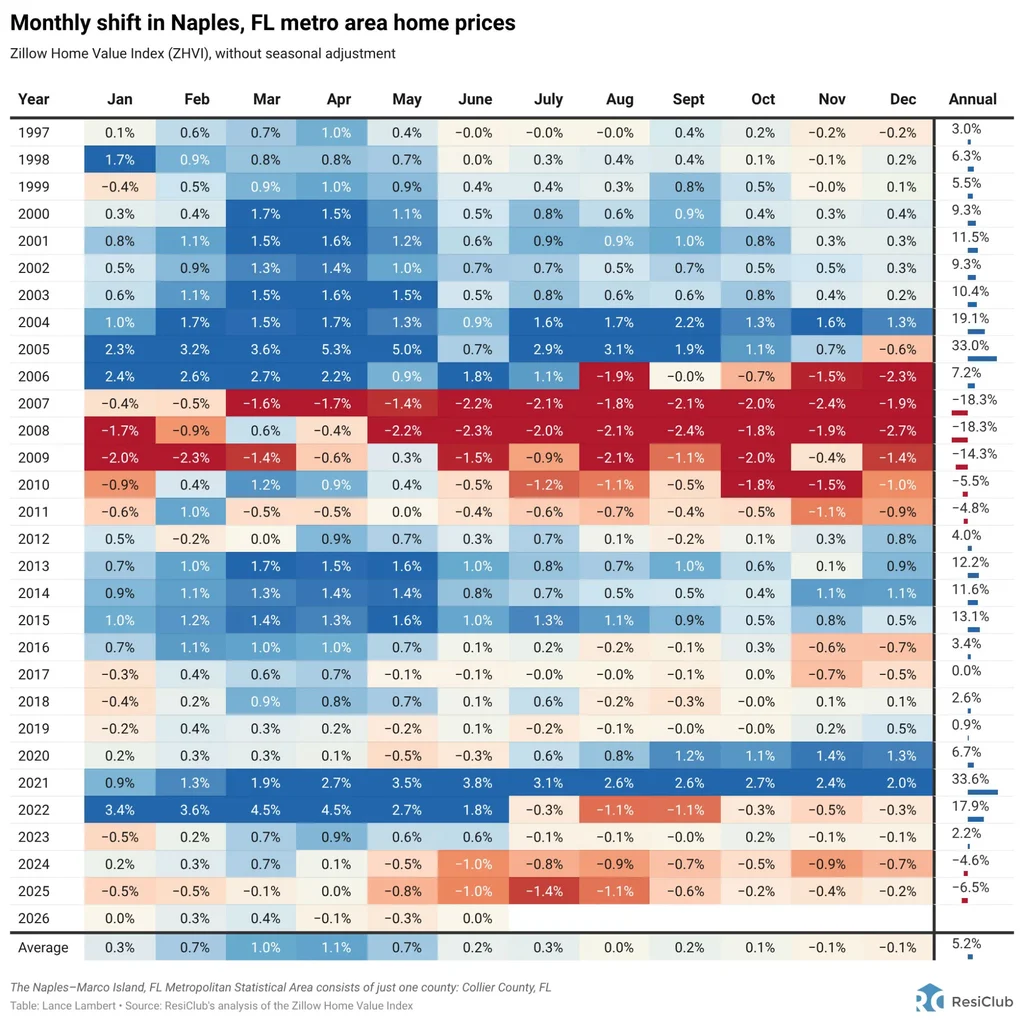
Month-over-month shift in Naples, FL metro area home prices (without seasonal adjustment):
Month-over-month shift in Sevierville, TN micro area home prices (without seasonal adjustment):