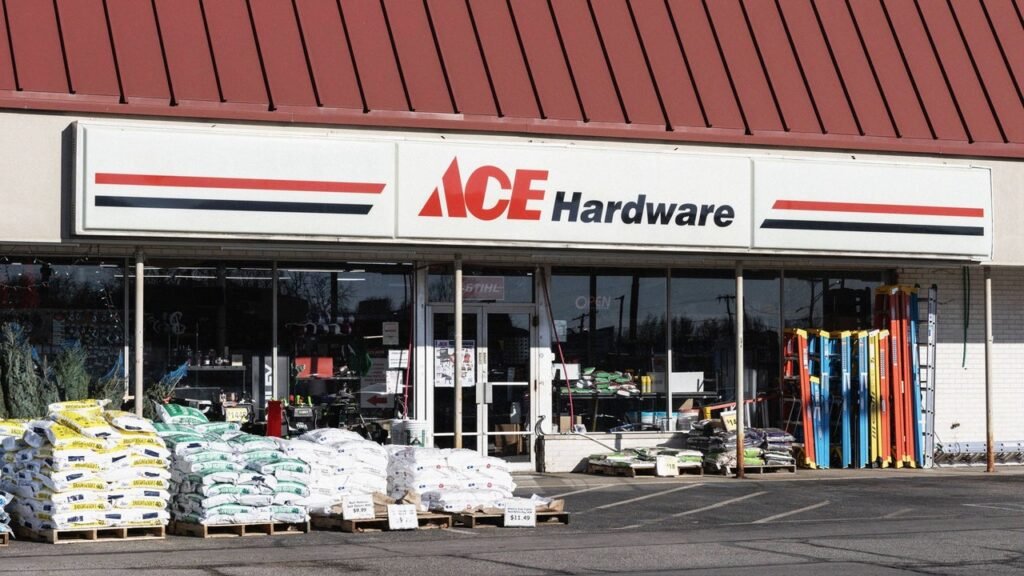
While Ace Hardware is celebrating record growth, some of its longest-standing stores are shutting their doors for good.
Like many traditional neighborhood hardware stores, Ace Hardware operates as a retailer-owned cooperative rather than a traditional franchise, meaning that each of its nearly 5,300 locations across all 50 states is independently owned and operated.
“Every Ace store is sized and stocked to best cater to the neighborhood that they serve,” Ace Hardware owner-operator Jeff Smith told Inc. “The stores have the flexibility to order from many sources, which helps to be more efficient, and keep up with customers’ ever-changing needs.”
Notably, many local owners lead with the name of their city, neighborhood, family, or a regional landmark before the official Ace Hardware name as a way to anchor themselves within the community. Others operate under long-standing local identities while still relying on the cooperative for back-end supply chains and inventory.
What business leaders can learn from Ace Hardware closures
Christina Lindley, the founder and CEO of VPRG Consulting, a firm focused on revenue, partnerships, and customer acquisition, told Inc. that Ace providing shared resources across purchasing, distribution, marketing, training, and technology spares owners from having to build the infrastructure on their own.
“Its Instacart partnership is a useful example of how national scale can support local stores,” she said. “A neighborhood business can reach customers through a platform they already use without building its own delivery marketplace.”
However, Lindley also noted the challenges that come with independence. Staffing, inventory, cash reserves, and succession planning all rest heavily on the individual operator.
Lindley cautioned against equating store openings with overall demand. She pointed to Ace’s second-quarter results, which showed same-store sales up 1.1% even as transactions among reporting U.S. stores fell 1.9%. The expansion is a positive sign, she said, but getting customers to keep coming back matters just as much.
This mixed picture plays out unevenly across Ace’s closures. Because each store is independently owned, the closures don’t stem from a single root cause.
For example, Woodside Ace Hardware in Winthrop, Massachusetts, shut its doors in August after 94 years in business. Owner Lauren Murphy, who took over the store from Paul Levy when he retired in 2021, had reportedly been struggling with health issues, leading to the closure.
Several locations have filed for Chapter 11 bankruptcy in recent months, including D&D Venture Group, operator of Chase Ace Hardware in Northern California, and Woodcrest Ace Hardware in Riverside, California.
Neither filing cited a specific reason, but the pressure aligns with a broader industry trend: Home Depot, Lowe’s, and Amazon now control roughly 56% to 57% of the home improvement market, squeezing independent operators and cooperatives.
Which Ace Hardware locations are closing in 2026?
Inc. confirmed the following closures in 2026:
Massachusetts
- 65 Main Street, Winthrop, MA 02152
Florida
- 202 Central Avenue NW, Jasper, FL 32052
- 105 Suwannee Avenue NW, Branford, FL 32008
Pennsylvania
- 631 Philadelphia Street, Indiana, PA 15701
Minnesota
- 212-214 Chestnut Street, Virginia, MN 55792
Mississippi
- 118 Highway 12 W, Suite 10, Starkville, MS 39759
Tennessee
- 5143 Quince Road, Memphis, TN 38117
California
- 201 W Bonita Avenue, San Dimas, CA 91773
Colorado
- 155 E Main Street, Aguilar, CO 81020
Texas
- 3044 Old Denton Road, Carrollton, TX 75007
Illinois
- 20 E Quincy Street, Westmont, IL 60559
Ace Hardware didn’t immediately respond to a request for comment.
—Amaya Nichole, News Writer
Get 1 Smart Business Story delivered straight to your inbox when you subscribe to Inc.’s free daily newsletter.
This article originally appeared on Fast Company’s sister website, Inc.com.
Inc. is the voice of the American entrepreneur. We inspire, inform, and document the most fascinating people in business: the risk-takers, the innovators, and the ultra-driven go-getters that represent the most dynamic force in the American economy.