Alaska Air Group
- Alaska Air Group announced new Premium Reserve seating on Alaska and Hawaiian Airlines flights.
- Perks will include reclining seats with leg and calf rests, 38 inches of pitch, and upgraded dining.
- It also announced upgraded business-class and lie-flat seats on some Boeing 737 Max 10s.
Alaska Air Group is the latest US air carrier to shore up its premium seating offerings — part of an industry-wide boom to cater to passengers who will pay more for premium perks.
On Tuesday, Alaska Air Group, which operates Alaska Airlines and Hawaiian Airlines, unveiled a new premium economy cabin called “Premium Reserve” and upgraded business-class suites. These will fly on mostly long-haul flights to Europe and Asia, and on select domestic routes.
Since acquiring Hawaiian for nearly $2 billion in 2024, Alaska has been pursuing its “Alaska Accelerate” plan to expand its premium offerings and international presence from its Seattle hub. The latest cabins are part of that strategy, making Alaska increasingly look like a major global carrier rather than the largely domestic airline it was once known as.
“We believe premium is more than a seat,” Ben Minicucci, CEO of Alaska Air Group, said in a statement. “It’s how guests feel from the moment they book their trip to the moment they arrive at the airport, to when they’re in the air with us.”
A new premium cabin and lie-flat seats on 737 Max 10s
Available to book on both airlines starting next summer, Alaska and Hawaiian’s new premium economy will feature wide reclining seats with leg and calf rests and a pitch — or the distance from one seat to the seat in front of it — of 38 inches,
It will also include a 16-inch, Bluetooth-capable screen, outlets and USB-C charging ports, and upgraded in-flight dining menus.
Alaska Air Group
Alaska already offers a premium-economy-like cabin called Premium Class, but the cabin type will be a first for Hawaiian.
Premium Reserve will be available on Alaska’s 787 and select 737 Max 10 aircraft, as well as Hawaiian’s A330 fleet, with flights beginning in 2028. Alaska doesn’t yet have the Max 10, which was nearing the finish line for certification after years of delays tied to safety and quality concerns. But CNBC reported on Monday that regulators have again delayed certification due to a newly discovered software issue.
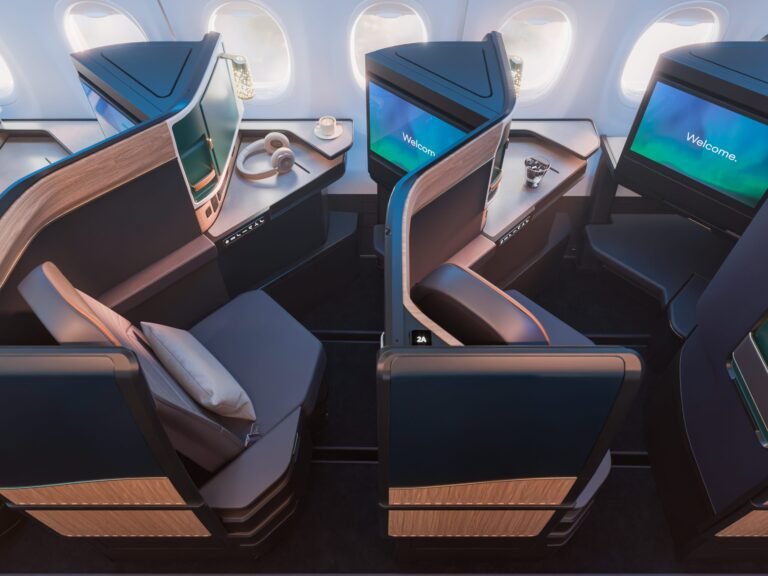
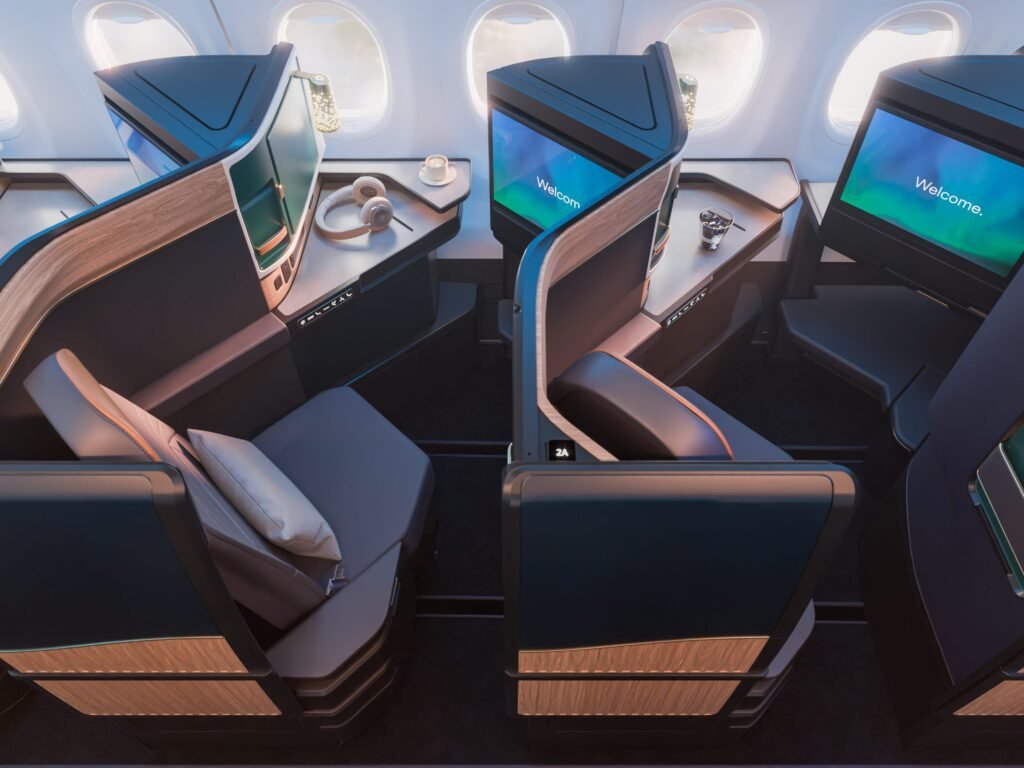
Beyond premium economy, lie-flat business class — called “Aurora Suites” on Alaska and “Leihōkū Suites” on Hawaiian to retain each airline’s distinct branding — has gotten a refresh.
Alaska Air Group
Hawaiian’s Leihōkū Suite, its 787 business-class product, serves select routes to Asia, Oceania, and North America. It will be added to the A330 and feature “hotel-quality bedding and enhanced onboard amenities.” Alaska’s Aurora Suites will be deployed on all 787 Dreamliners and include upgraded upholstery and materials. Both suites will have sliding doors, Bluetooth, big inflight screens, and access to airport lounges.
Aurora will also be installed on 737 Max 10 planes flying select transcontinental routes, joining the increasing number of airline narrowbody planes with lie-flat premium seats.
Alaska Air Group
These premium cabins won’t be cheap. A round-trip business-class flight from Seattle to Tokyo in mid-March is about $6,500 on Alaska; the same seat to London is about $5,300. Basic economy is about one-fifth of each of those business-class fares.
Alaska is also facing fierce competition. It’s up against legacy US carriers with already massive widebody fleets, extensive international networks, and well-established premium products.
Alaska knows it’s playing catch-up.
“I think where you’re seeing strength with the legacy carriers is in the premium space and in the international space,” Minicucci said in an April 2026 earnings call. “And if you look at our strategy under Alaska Accelerate, that’s exactly where we’re leaning into.”
Courting passengers who pay a premium
In post-COVID air travel, US airlines are moving away from packing as many people as possible into economy to increase revenue. Instead, they are pivoting toward customers who will spend more on premium travel experiences, such as airline lounges and higher-tier in-flight amenities.
A McKinsey analysis published in June found that on transatlantic wide-body flights, business-class cabins are earning almost as much as economy cabins, even though they carry far fewer passengers.
That premium demand has remained despite rising oil prices and soaring airfares amid the war in Iran, partly buoyed by continued spending from more affluent travelers.
“The folks who are more oriented towards purchasing into our premium cabins have been super resilient,” Minicucci said in a 2025 earnings call.
Alaska Air Group
United Airlines’ director of onboard products and partnerships, Peter Wolkowski, told Business Insider during the UK’s Farnborough Airshow in July that premium economy is its fastest-growing cabin on the company’s 787 fleet.
In 2025, Delta’s premium revenue increased 7% year-over-year, while its main cabin revenue decreased. On an earnings call in October 2025, then-Delta president Glen Hauenstein predicted that premium revenue was expected to exceed Main Cabin revenue by 2027.
“When you think about what’s different and what’s changed over the last 10 or 15 years, the premium products used to be loss leaders, and now they’re the highest-margin products,” he said.