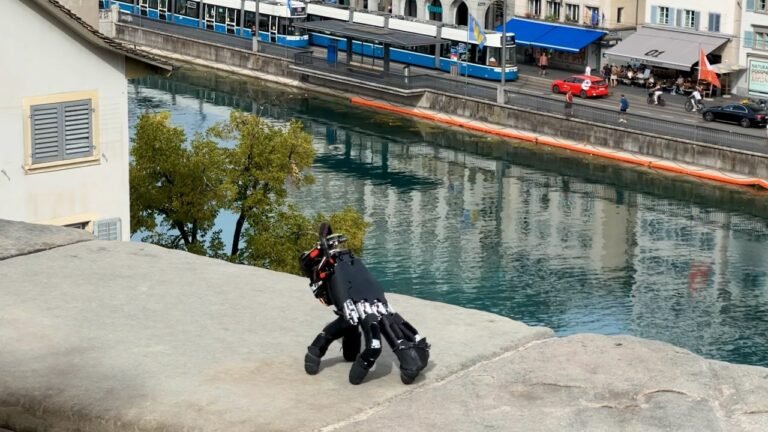
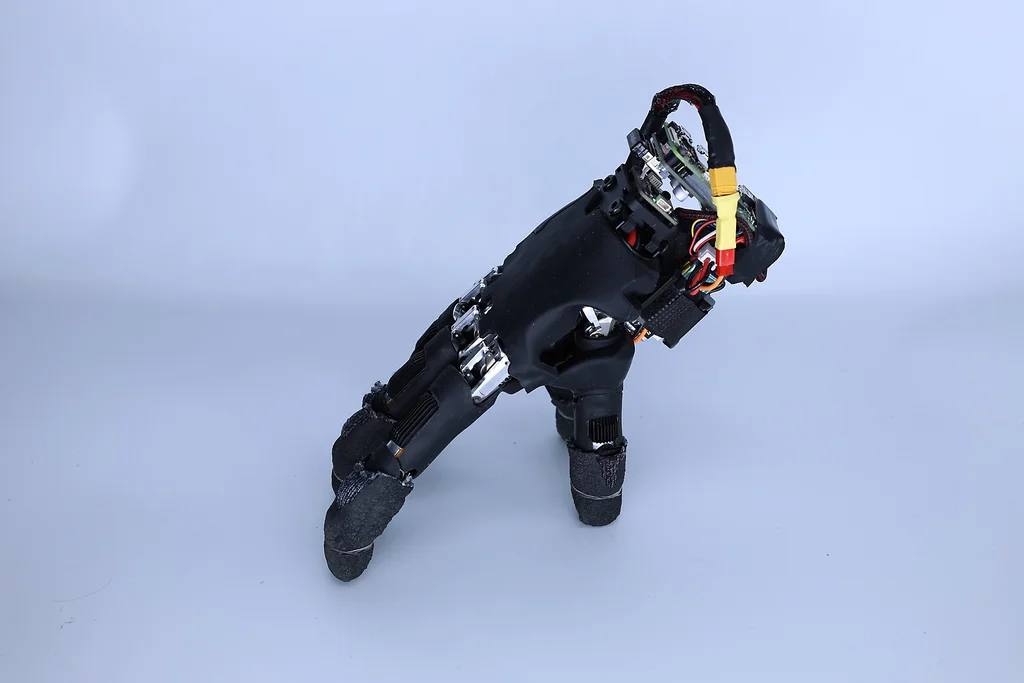
Robotic hands usually come bolted to the wrist of a mechanical arm, waiting for their humanoid owners to move them over to whatever knob or valve needs turning. However, at ETH Zürich’s Soft Robotics Lab, a group of roboticists decided to get rid of the body, designing a self-contained hand that crawls across surfaces, balances its own weight, and manipulates objects using only its five digits.
It may seem like an awesome-but-useless robotic recreation of Thing, The Addams Family’s famous disembodied butler. And while Amirhossein Kazemipour, a PhD candidate at the lab, tells me via email that Thing was part of the inspiration—“I love the Addams Family! :-)” he writes—the truth is that this walking hand can become a new key feature in the future of robotics. Enabling parts to function independently of a whole means more sophisticated operating capabilities.
Kazemipour is one of the three researchers behind the project, alongside Hehui Zheng and Robert Katzschmann, who recently wrote a paper detailing how their invention solves an enduring dilemma in robotics: creating a system that can move and dexterously interact with objects. When autonomous systems need to inspect equipment or flip switches inside cramped enclosures, their operators are typically forced to thread long, unwieldy mechanical booms through the gap or park bulky rovers right at the threshold.
“The idea is to give a hand some independence,” Kazemipour tells me. “Usually, an arm carries it to do the job. We wanted the same fingers to handle getting there, keeping the hand balanced, and interacting with things.” Plus, by training the digits to pull double duty as walking legs, the engineers at ETH Zürich—a Swiss public research university—bypassed the extra weight, complexity, and mechanical failure points of dedicated wheels or secondary limbs.
Teaching a humanoid hand to march like a scurrying spider, however, presents distinct kinematic hurdles.
Getting uneven physical joints to bend and carry their own weight was a geometric and mechanical headache, according to the paper. Standard legged platforms, like Boston Dynamics’s quadrupedal robot dog Spot, benefit from bilateral symmetry, meaning their left and right halves are mirrored pairs that share balanced dynamic loads across a level frame. But an anthropomorphic hand possesses no such geometry. It has an opposed thumb, four digits of noticeably different lengths, and a palm that naturally rests at a lopsided angle.
The researchers discovered that when they applied standard quadruped gait rewards—the scoring formulas that train four-legged robots how to step—to an off-the-shelf gripper, the fingers dragged their fingernails across the floor or splayed uncontrollably, struggling to stay upright on their soft fingertip pads.
AI to the rescue
To solve the anatomical riddle, the researchers devised an ingenious software that mathematically cancels out the palm’s resting slant so the hand always understands which way is flat, without restricting its natural motion.
Instead of forcing the fingers into an artificial, rigid stepping rhythm, the team trained an AI in a simulated physics engine using deep reinforcement learning, the digital trial-and-error process where virtual hands learn through millions of practice steps. Using mathematical guides, the system anchors each fingertip to a home position and allows the digits to take long forward strides while stopping the fingers from sprawling sideways or letting the chassis buckle.
An onboard neural network runs at a 50 Hz control rate, which means that it calculates motor adjustments 50 times every second. The hand’s built-in position controller immediately translates these digital nudges into physical joint angles, allowing the crawler to make split-second balance corrections.
When they tested the model, it worked. And yes, it behaved pretty much like the actual Thing from TV and the movies.
After they got it working, they managed to implement it all without an umbilical cord connected to an off-board computer. A cable would have defeated the purpose of developing a detachable, fully independent hand; the robot needed to run on its own.
To accomplish this, the team took an off-the-shelf robotic hand and mounted a custom 80 gram (3 oz.) backpack containing a Raspberry Pi Zero 2 W, a tiny single-board computer; an inertial measurement unit, or IMU, the kind of motion-and-tilt sensor found in a smartphone; and a small lithium-polymer battery. The solution ended up as an untethered, fully independent platform weighing just shy of 2 pounds.
Less Thing, more Iron Man
The team tested the hand across several physical experiments. In untethered trials, the hand crawled across 14 diverse indoor and outdoor terrains, marching smoothly across slick diamond plate, metal grates, dry concrete, artificial turf, and loose gravel. If it does tip over onto its side, an onboard fall-recovery mode uses the IMU feedback to right itself before returning to its default crawl stance.
In a self-supported manipulation test, the hand pressed arrow keys on a desktop keyboard, successfully executing 29 out of 32 key presses to guide characters through puzzles in the Sokoban video game. (And now I want to play chess against this Thing.)
Kazemipour tells me that creating a crawling hand was not just an exercise in quirky engineering. This apparent gimmick is a key development for future practical applications.
“Longer term, imagine a robot leaving its hand near a tight opening, letting it crawl inside to operate a control or move an object, then picking it up afterwards,” he says. That operational approach could assist emergency workers evaluating damaged buildings, technicians inspecting pipe networks, or automated factory stations where clearances are too narrow for standard articulated arms.
The broader implications point toward a decentralized, modular philosophy for robotic systems in the far future.
“That connects to a bigger vision I find exciting: robot parts that can handle more on their own,” Kazemipour points out. “A higher-level system could set goals while each part handles its own movement and sensing. With the right hardware, parts could detach when useful and reconnect when the job needs the whole body.”
The modular approach to robotics may prove greater than the traditional sum of the parts that we see in robots today. Rather than relying on rigid, monolithic humanoids whose entire utility is lost if a primary limb jams, future platforms could employ modular components that separate, explore confined voids, and reconnect when heavier payloads demand combined strength.
But that’s way ahead from where we are. For now, the lab is exploring onboard visual tracking to eliminate overhead localization cameras, along with automated mechanisms for docking.
“We haven’t demonstrated that full setup or automatic detachment and reattachment here,” Kazemipour tells me. “What we’ve shown is that a human-shaped hand, with its original uneven fingers and offset thumb, can learn to move and interact while supporting itself. It carries its own power and computer, so it’s a small step toward that broader idea.”
Even as an initial baseline, demonstrating that five fingers can propel, right, and stabilize an untethered gripper suggests that a future generation of robotic hands might not wait to be carried by a humanoid body into difficult workspaces. Think less Thing and more Iron Man’s armor’s hands moving and working on their own while Tony Stark dunks a glazed donut in a coffee cup.