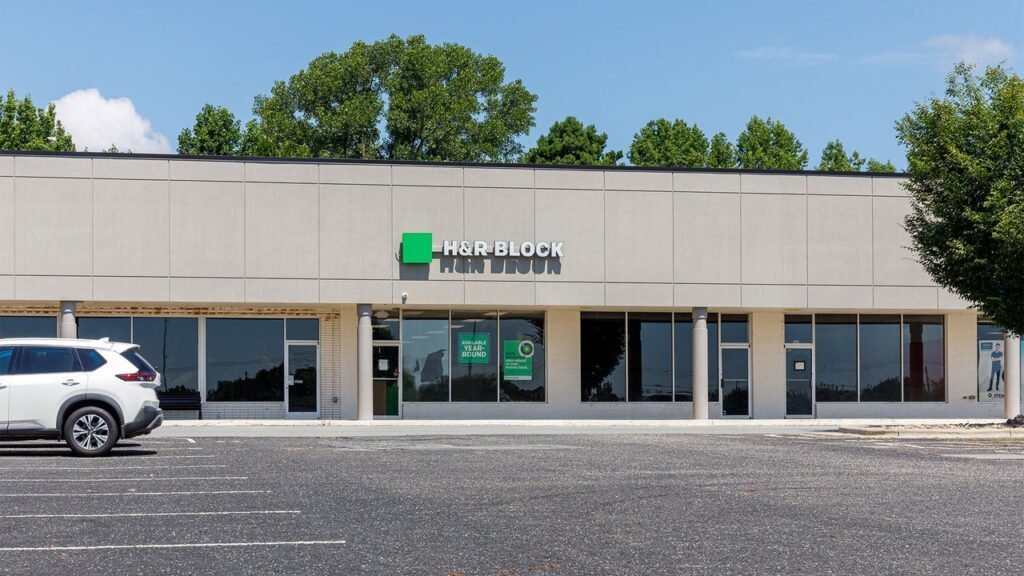
When Americans need to do their taxes, many go to H&R Block, which has thousands of locations across the country. But some may have noticed that H&R Block’s retail presence is not as robust as it used to be, as the company has notably closed tons of physical locations in recent years.
According to a recently issued franchise disclosure document, H&R Block had 1,816 franchised physical outlets as of the end of June. That’s down from 2,135 at the end of June 2024—a net decline of 319 franchised physical storefronts over the past two years.
It has also seen a net gain of company-owned stores at the same time—116 over the past two fiscal years—although not enough to make up for the decline. Overall, H&R Block reported 8,561 outlets at the end of fiscal 2026, a net decline of 203 over the two-year period.
Why the reduction? H&R Block says it’s mostly due to a change in strategy, which includes bringing franchised locations back under the company-owned umbrella.
“Like many aspects of our business, our retail footprint continues to evolve as part of H&R Block’s broader transformation strategy,” a spokesperson tells Fast Company. “Recent changes in our franchise portfolio reflect a normal shift in ownership mix, that includes reacquiring a number of franchise locations and integrating them into our company-owned operations.”
Changing preferences, changing tactics
As for what underlies the tweaked strategy, one potential reason is that more people are simply relying on online platforms (including H&R Block’s) to either do their taxes or utilize the company’s other services, which has led to less of a need for physical locations.
That may have been the catalyst when the company closed 400 U.S. offices back in 2018, amounting to 4% of its storefronts at the time.
More recently, the trend may be hastening by the availability of AI tools. Data published earlier this year from Adobe (which, notably, has tools to help people scan their tax documents potentially to prep their returns) found that year-over-year, U.S. workers were 136% more likely to use AI for tax filing for 2026 than they were in 2025.
H&R Block, too, has rolled out AI tax filing tools in recent years.
Still, while that may account for some of the shift in strategy, the data suggests that H&R Block is leaning away from the franchise model, at least to some degree. While its franchised stores have contracted, its company-owned store count has increased.
During fiscal year 2026 alone, 167 stores were reacquired by H&R Block from franchisees, as were 118 during fiscal year 2025, and 169 in fiscal year 2024, the disclosure document reveals.
Company leadership has also stated that reacquiring franchised locations is a part of a broader growth strategy.
During the company’s Q4 fiscal year 2026 earnings call in August, CFO Tiffany Mason noted that H&R Block will “continue to acquire franchise locations when opportunities arise at attractive EBITDA multiples.”
She added, in response to a question, that those acquisitions were “a core part of our long-term algorithm.”
The future: Fewer physical storefronts
By reacquiring franchised locations, H&R Block assumes its clients and potential revenue—it’s practically turnkey, allowing for more company-owned storefronts without actually having to open them.
It even has information available to franchisees or other tax business proprietors on its website as to how to start the conversation. Mason has said that the acquisitions present an opportunity for the company.
“In fiscal [20]26, we did 160 franchise buybacks. That compares to about 124 franchise buybacks in the previous year,” she said during the latest earnings call. “Those are opportunistic.”
There may be something to it, too. H&R Block’s stock (NYSE: HRB) has appreciated considerably while its physical footprint has shrunk. As of this writing, shares are up 113% over the last five years and roughly 24% year to date.
Accordingly, the company says its new strategy of fewer franchised locations is here to stay.
“Our focus remains on ensuring clients have convenient access to the expertise and services they need, whether through our retail offices, digital experiences, or a combination of both,” a company spokesperson says. “As we continue to invest in our future and transform our business, we will continue to assess opportunities to optimize our retail footprint.”