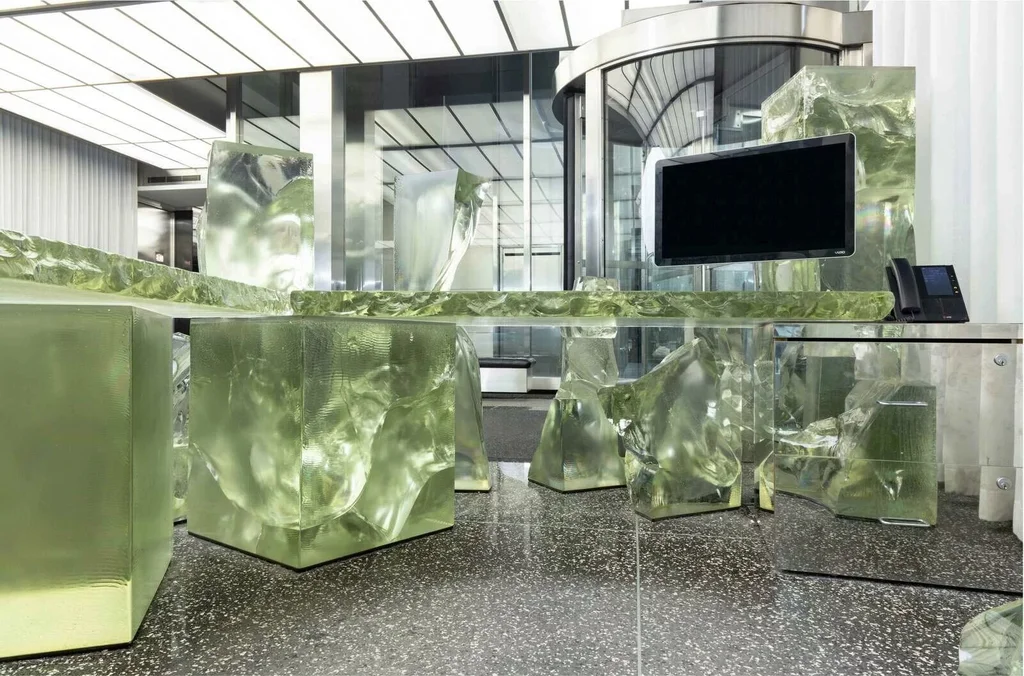
It’s a desk so big they called it “Icehenge.”
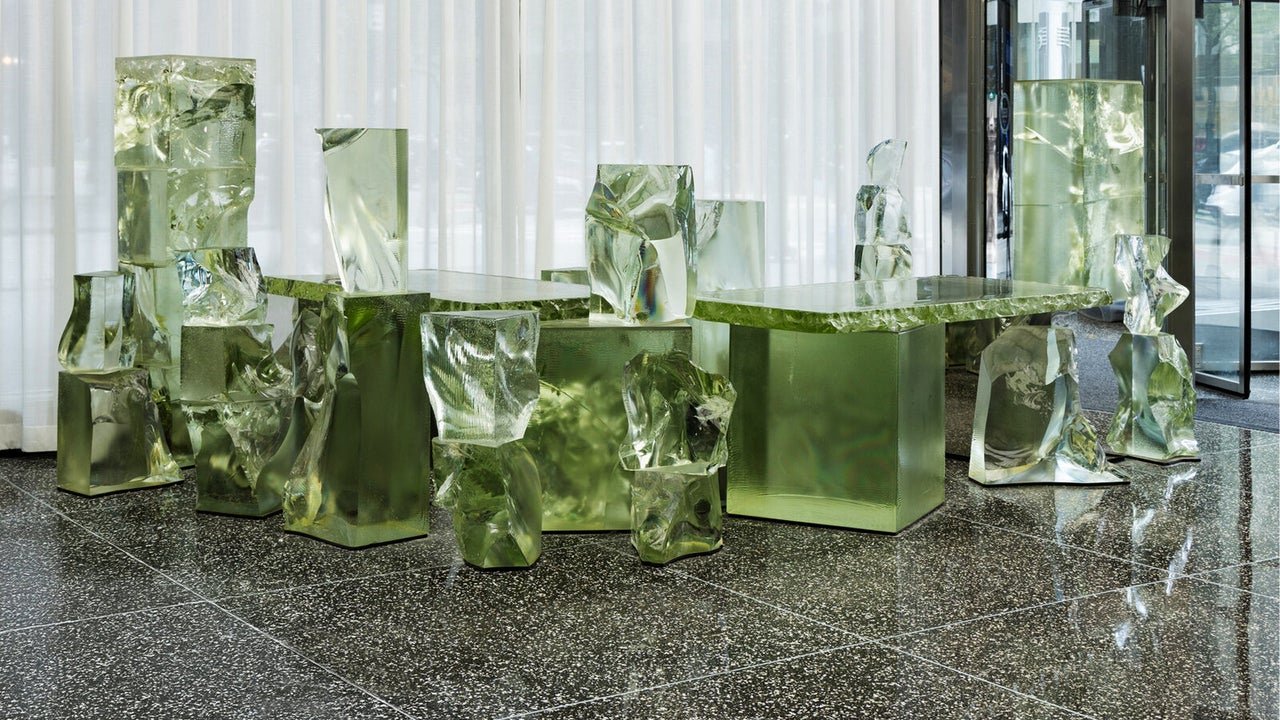
Weighing in at more than 7 tons—equivalent to an adult African elephant—the desk designed by architect Frank Gehry was inspired by the look of glass shards. It sold last week for $243,200, above estimates from the auction house Freeman’s. It also set a new record for a Gehry design object.
“We’re delighted with the result,” Roger Ward, Freeman’s VP and head of design, tells Fast Company. “Significant works by Frank Gehry rarely come to market, and this sale reflects the continued strength of demand for museum-quality design with exceptional provenance.”
Gehry, who died last year, was one of the single most prominent architects of the 20th and early 21st centuries. He designed whimsical, gravity-defying buildings like the Walt Disney Concert Hall in Los Angeles in 2003 and Weisman Art Museum in Minneapolis in 1993.
He was inspired to make the desk in 2012 after coming across a glass piece at another project, imagining stacks of angled blocks with the same aesthetic as a work of furniture.
Gehry ultimately designed “Icehenge” as a security desk for the lobby of Chicago’s Inland Steel Building, which he had an ownership stake in from 2005 to 2007. While the desk was used in the building like a normal office desk, with desktop computer monitors and a phone, it looks more like a sculptural take on a superhero’s lair.
Smooth, translucent green cubes and mirrored cabinets serve as legs that support two smooth desktop surfaces. Stacked, irregularly shaped forms resembling blocks of ice reach 6 feet tall at their highest, giving the desk’s form a sense of texture and refract light. This is no normal reception desk.
“It does look like an explosion in a glass factory, kind of,” Gehry told the Chicago Tribune after “Icehenge” debuted in 2013. “If you actually had an explosion at a glass factory, apart from everyone getting killed, it would be pretty exciting visually.”
It was one that especially stood out in a modern building lobby. For an architect as imaginative as Gehry, it’s little wonder he reimagined the monotonous shape of a desk instead as one of nature’s most monumental forms.