This article is republished with permission from Laser Wars, a newsletter about military laser weapons and other futuristic defense technology.
The threat of low-cost weaponized drones may grow more urgent by the day, but the United States’ nascent laser dome is slowly but surely expanding to meet it.
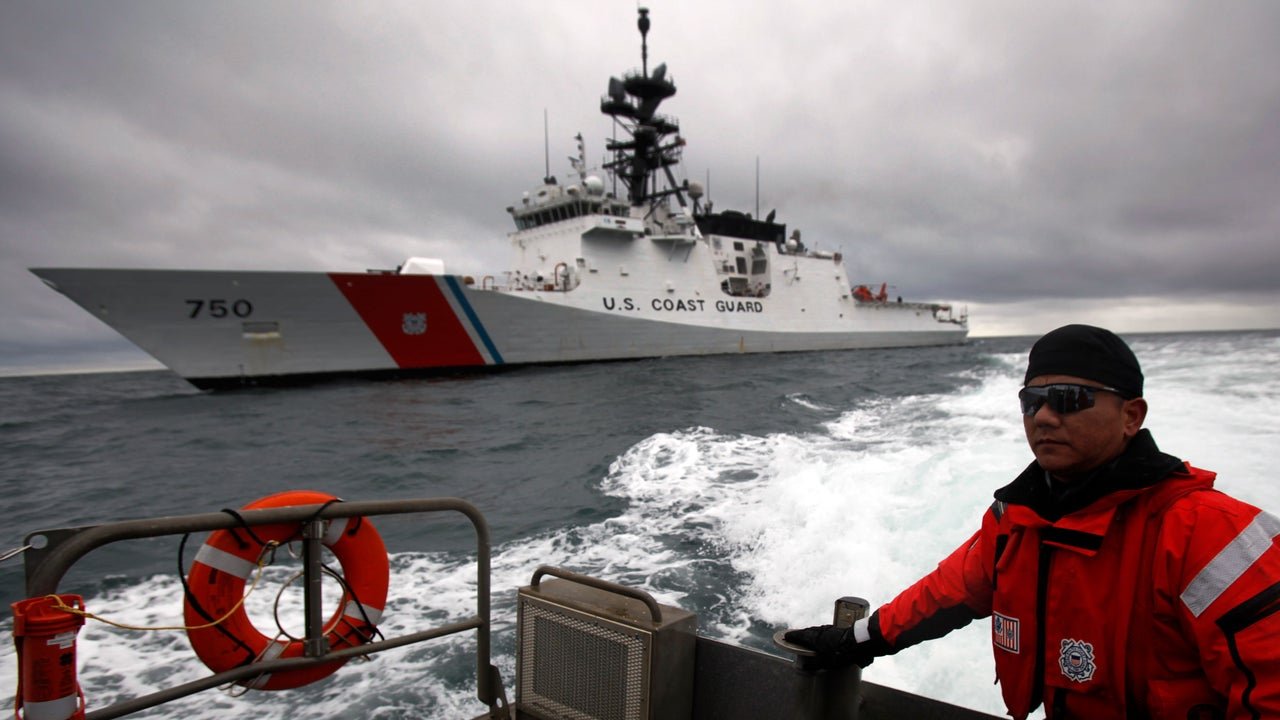
In a new request for information (RFI) published on July 20, the U.S. Coast Guard’s Research and Development Center stated that it is “interested” in high-energy laser weapons “or comparable laser technology” to protect cutters, small boats, and fixed sites like piers from both airborne drones and unmanned surface vessels. Importantly, potential weapons must do so amid punishing conditions at sea, namely “shock, vibration, sea spray, and airborne particulates, including smoke and fuel exhaust.”
The RFI makes the Coast Guard, which operates under the U.S. Department of Homeland Security, the newest uniformed entrant into a global laser weapon race that currently includes every U.S. military service (including the U.S. Space Force) and a growing fraternity of nations embracing directed energy weapons for drone defense at home. But somehow, the RFI wasn’t even the most interesting bit of directed energy news to emerge this week.
On July 21, defense contractor Kratos announced that it had received a $156 million contract to provide “mobile Counter-Unmanned Aircraft System (C-UAS) platforms” to the U.S. Department of Energy’s National Nuclear Security Administration (NNSA) Office of Secure Transportation (OST), the agency responsible for the safe and secure transport of nuclear weapons and materials, under its ‘Project Solar Shield.’ According to contracting documents, the agreement calls for the delivery of two prototypes and 25 full-production “On-The-Move (OTM) Counter-Unmanned Aircraft System (C-UAS) Special Operations Vehicle (SOV)” systems.
Kratos did not explicitly identify laser weapons as part of the vehicles’ “layered defense posture” in its announcement, and a company spokesperson declined to provide additional details when reached for comment. But an additional contracting document and a public statement from a company executive appear to indicate that its counter-drone solution potentially includes a directed energy component.
In February, Kratos announced that it had acquired Nomad Global Communication Solutions, which builds specialized vehicles like mobile command units and counter-drone platforms, the latter of which are marketed as capable of supporting directed energy capabilities. The next month, the NNSA published a notice of intent to sole source to Nomad GCS for the agency’s Counter-Unmanned Aircraft System (C-UAS), which included an associated document justifying NNSA’s decision to skip a full competition in favor of a Nomad GCS solution. The justification document is heavily redacted, but it appears to state that directed energy weapons (and, mofd specifically, laser weapons) and their associated size, weight, and power constraints were among the technical requirements considered during market research, and that “current commercial and government resources failed to produce any adequate alternative solutions” to Nomad GCS’s offering.
Kratos president and CEO Eric DeMarco subsequently announced that the company had received a contract for “a new directed energy weapons program” during an earnings call the following May.
“Over the past year, internally and tied in with an acquisition we have made—we try to go one plus one equals four—this is a counter-UAS system,” DeMarco said in an apparent allusion to the Nomad GCS acquisition. “It is mobile. We are the prime. It is several hundred million dollars. It is going to start ramping next year. It should be very big in 2028. This is an area where, now that we have won this one, it will open the door for us to win more.”
Taken together, the Coast Guard RFI and the NNSA contract represent a gradual broadening of the U.S. government’s domestic laser weapon push, one that’s no longer confined to U.S. military testing activities and U.S. Customs and Border Protection shootdowns at the southern border with Mexico. The Federal Aviation Administration and Pentagon’s landmark safety agreement on the domestic use of laser weapons in April laid the foundation for future domestic directed energy operations, and now federal agencies responsible for safeguarding critical infrastructure appear to be gradually exploring their potential applications.
The Coast Guard’s search for laser weapons comes amid a $150 million surge in funding for counter-drone capabilities in the year leading up to the FIFA World Cup and America 250 festivities this summer, part of what leaders characterized as “a whole new mission set” for the service. While that funding mostly went to acquiring equipment for the service’s own layered defense centered on using electro-optical/infrared sensors to detect and track incoming threats and electronic warfare capabilities like radio frequency jamming to neutralize them, the laser weapon RFI offers a hard kill option as a logical backstop. And beyond event security, the service’s role as the country’s premier maritime law enforcement agency (and the RFI’s explicit emphasis on fixed sites like piers) suggests an increasing focus on protecting ports, waterways, and other other maritime assets.
Additionally, the RFI treats on-the-move cutters and small boats as a separate engagement problem from fixed piers, and with good reason: a shipboard laser weapon has to maintain a steady beam on a target while its host platform pitches and rolls on the water compared to stationary dockside directed energy assets. The RFI’s explicit inclusion of uncrewed surface vessels alongside aerial drones is just as telling: after Houthi and Iranian drone boats targeted commercial vessels in the Red Sea and the Strait of Hormuz over the past year, and the U.S. Navy itself deployed its own drone boats against Iranian port facilities in July, the Coast Guard is clearly thinking about laser weapons as a way to stop explosive-laden hulls before they reach a critical logistics hub or populated thoroughfare.
With respect to the Coast Guard’s critical role in the U.S. homeland security ecosystem, the NNSA counter-drone contract is arguably the more consequential one even if Kratos never explicitly says the word “laser.” Protecting the convoys that transport nuclear weapons and special nuclear material is a different order of stakes than one shooting down suspected Mexican cartel drones at Fort Bliss, and the agency has been actively pursuing directed energy weapons as a potential solution for years, warning in 2024 that drone surveillance of top-secret sites has become “a persistent concern” that “no amount of signage or canine patrols along perimeter fences can prevent.” Project Solar Shield marks the agency’s first major push to extend that concern to open highways where nuclear convoys do not enjoy the luxury of a predictable and static threat environment.
This slow embrace of laser weapons comes with clear obstacles. Every new agency in that mix multiplies the same jurisdictional and engagement authority problems that led to February’s dual airspace shutdowns near the US-Mexico border, so far that America’s laser dome increasingly looks like a patchwork of capabilities rather than a unified federal doctrine. This approach has its strengths by allowing agencies to adopt new capabilities at the speed of the their unique operational challenges, but it also means the interagency coordination gaps that tripped up those border deployments earlier this year may end up reproduced across a growing set of government actors, each with their own rules of engagement.
Piers and highways are a far cry from the battlefields of Ukraine and the Middle East. But with the rise of drone warfare, anything under the same open sky is a potential target—and America’s laser dome is now being built one contracting notice at a time.
This article is republished with permission from Laser Wars, a newsletter about military laser weapons and other futuristic defense technology.