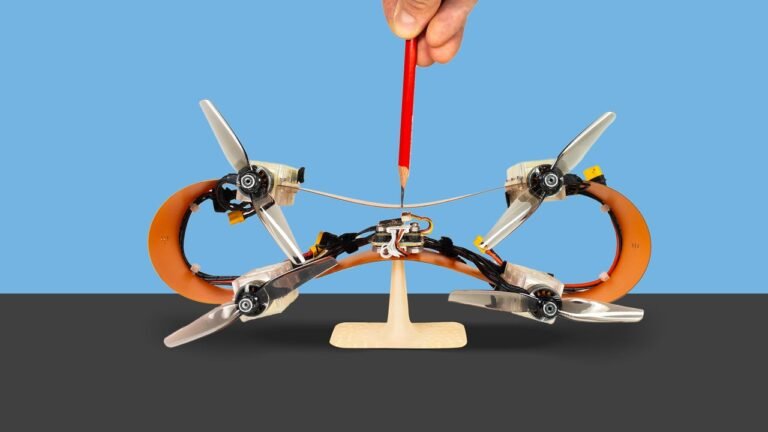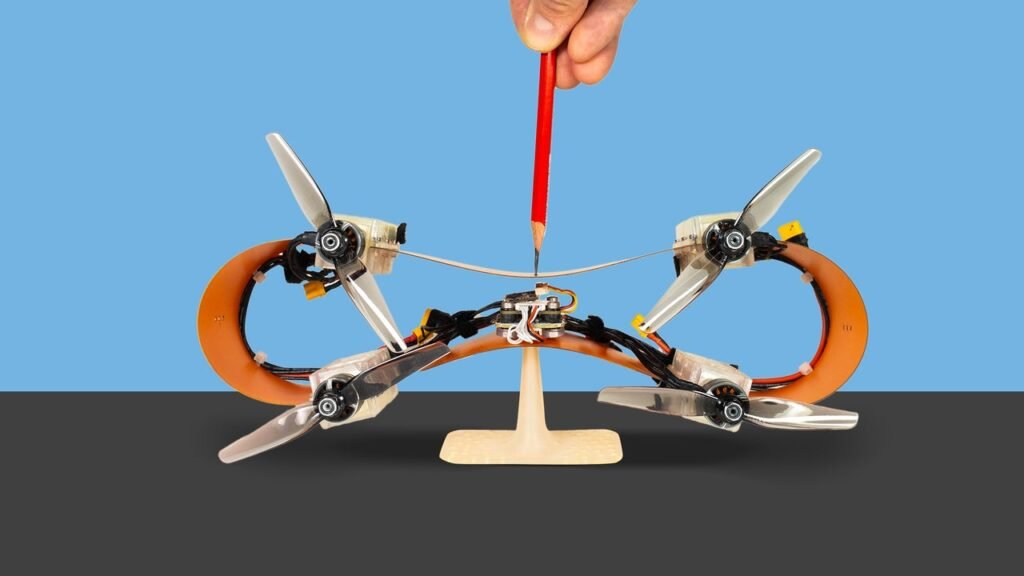
At first glance, FlexiQuad looks like a small drone. Just one more buzzing thingy doing its flying thing. Then you see it crashing against a tree. A regular drone would crash and fall to the ground, but this one bounces back from the tree trunk and happily keeps flying along.
The key to this trick is a hollow ring design crafted from flexible materials.
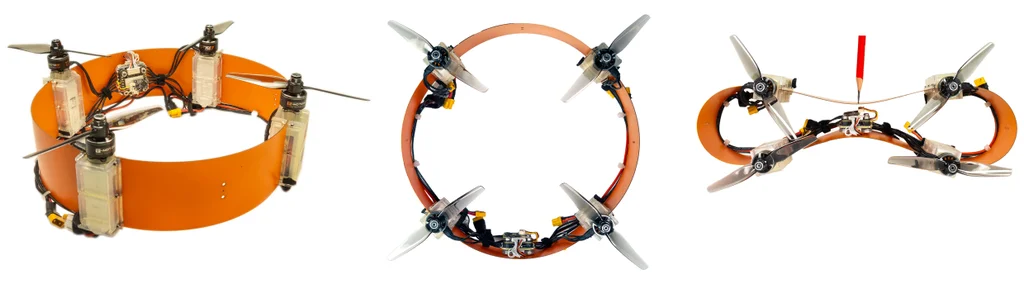
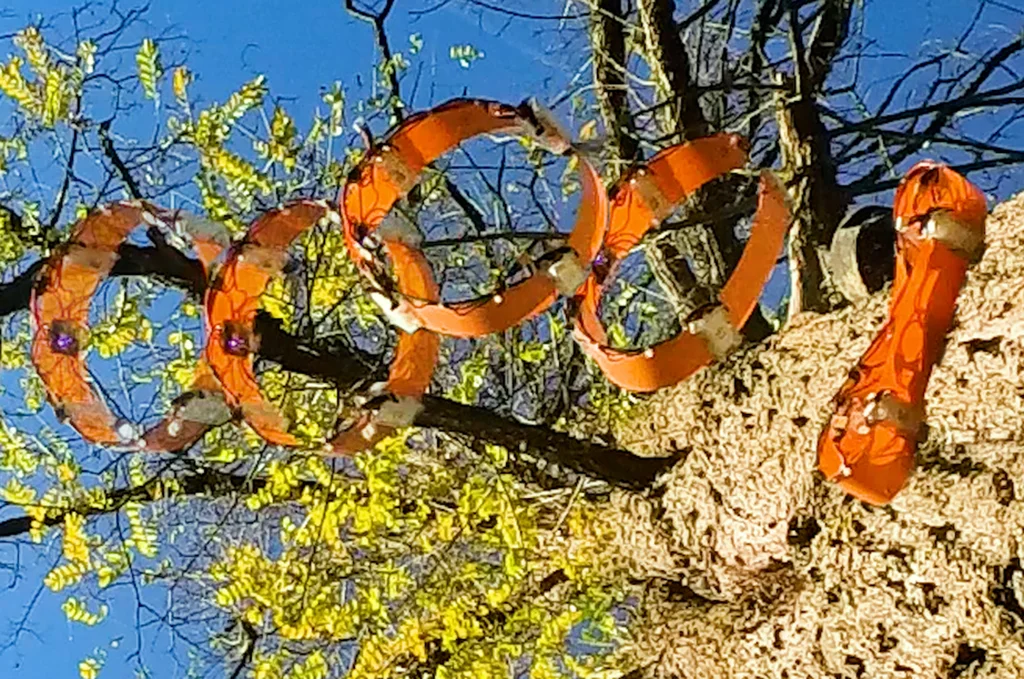
Today, almost every quadcopter uses four stiff arms bolted to a central body that holds its battery, brains, sensors, and sometimes other payloads. ETH Zürich researchers trashed that core and the arms, placing the rotors on a ring, with the batteries and the rest of the electronics spread evenly around the rim. The FlexiQuad’s middle is empty, like a vertically flat donut.
The ring is flexible. That’s its superpower. Hit a wall and it buckles, absorbing the force of the impact and bouncing back. As the structure stabilizes, it keeps itself in the air.
Developed by engineer Luca Girardi and Stefano Mintchev, a former professor at ETH Zürich’s Environmental Robotics Lab, the drone takes its design inspiration from how the wings of birds and insects bend in some directions but not others. “We were interested in how stiff their wings are and how they bend them—or don’t bend them—in different directions,” Girardi said in a statement.
Wings yield in some directions but can also hold rigid in others. Engineers call this “anisotropic stiffness,” the resistance of a material or a structure to deformation, which changes depending on the pushing force’s direction.
Girardi has worked on the idea for about five years. “At first, I was skeptical whether the drone would fly without the central reinforcement,” he said in the statement. “But I really liked the approach. Then we tried it—and it worked.”
“The key was to rethink where the weight sits, as well as where the structure bends,” Girardi tells me. “A heavy central body supported by flexible arms can introduce bending and oscillations.”
Turning the arms of a regular drone from hard to flexible would make the drone difficult to control. Soft arms will bend under the vertical force of the rotors. Even if they were hard enough to allow for takeoff, the wobbling would make it very difficult to control during flight. Once they moved the batteries next to the motors, Girardi explains, the central core of a traditional drone wasn’t needed. “The hollow center follows from that arrangement,” he says.
FlexiQuad’s donut can flex sideways, where the force of a collision will push. At the same time, it stays rigid vertically, which allows the propellers to lift the entire body without any wobbling or sagging.
Bouncing off the walls
The drone’s material flexibility was also key to the design. If it were too soft, the propellers would smack into each other during hard maneuvers as the ring deforms. Too stiff and you’re back to a breakable drone.
The researchers found the best flexibility range overlapped nicely with the stiffness of real wings, which works all the way from tiny insects to big birds. The approach works for drones weighing less than an ounce to up to about 6.6 pounds.
The other part of the design is the distributed mass. Birds and insects spread energy through their bodies instead of a central location. Hanging the weight of the batteries under the rotors gives overall stability to the design, according to the team’s preprint paper on arXiv, which hasn’t been peer reviewed yet. In simulations, an otherwise identical version with one central battery shook 13 times more at the rotors and 8 times more at the electronics during acceleration.
The result of the research is a 14-ounce prototype that is roughly a thousand times bendier than a conventional quadcopter. The drone tops 50 mph and accelerates at more than three times the force of gravity.
“Soft doesn’t automatically mean slow,” Girardi said in his statement. It can also tip into a sharp sideways dodge in the blink of an eye, which makes it as maneuverable as a regular drone.
According to Girardi and Mintchev’s research, the design is four times more collision resilient than that of a regular drone. When it folds to fit through a gap, the propellers overlap and thrust efficiency drops from 79% to 68%, but it keeps flying.
In tests, FlexiQuad took head-on hits at about 11 mph without sustaining damage. The designers also found another benefit to the flexible body: It can fold itself thin enough to slip through an opening 70% as wide as its normal width. In one test, it went through a 7-inch slot.
Its squeezing abilities can double as a grip, too. In another test, the drone hugged a soft first-aid pouch, carried it, and set it down. In another, it lifted a payload heavier than itself.
The drone’s flexibility allows for easy transport: You can open the ring and lay it flat in a medium-size suitcase. Putting it back together is simple thanks to its slide-in batteries and quick-release fasteners.
The FlexiQuad’s inventors say it will be inexpensive to make. The frame is four thin strips of fiberglass laminate (the cheap material circuit boards are made of), for a total raw cost of less than $15, not counting motors, electronics, and batteries.
Hoops in tight places
There are still (solvable) problems that need fixing. The drone has to learn to perceive its surroundings and navigate on its own. Also, after a hit, the bobbling of its body blurs camera images. The designers say they’ve have already used reinforcement learning to give the FlexiQuad an AI reflex that lets it steady itself after a crash with motion sensors, then resume flying without any pilot intervention. The frame’s bending itself might become a sense for the drone, too, they point out, the way insects feel their wings flex.
Yet the design is so simple and effective already that ETH has nominated the drone for the university’s own Spark Award for invention of the year. Girardi and Mintchev have also applied for a patent, which envisages the FlexiQuad flying into places where a drone can’t avoid touching things, citing everything from a ship’s cramped ballast tanks to collapsed buildings in search-and-rescue missions and dense forests where scientists take measurements.
FlexiQuad still has to turn into a commercial reality. Girardi tells me the team is commercializing it through a startup that, rather than selling only FlexiQuad, automates rapid drone design and ties it tightly to suppliers. The prototype sits at technology-readiness level 5 on NASA’s nine-step scale—meaning it’s been validated in realistic conditions—and is working toward level 6.
The team faces the usual barriers to take it to market, Girardi says, such as how to turn the prototype into a commercial product, scale manufacturing with a positive margin, and ensure customers will buy it at the resulting price. But the market potential is so big, it’s hard not to see the FlexiQuad arriving soon.
One instant application, which can be put to the test in the war in Ukraine to snatch kamikaze and rogue drones. Girardi tells me that they are about to start a field pilot program using a larger version with a net in its hollow center to catch unauthorized drones in civilian settings, “where you can’t afford kinetic interception—otherwise the debris risks [falling] onto people or sensitive infrastructure.”
Another application, thanks to its gripping abilities, could be search-and-rescue work, which the team is exploring with firefighters.
And of course, I can see one of these under every Christmas tree. An unbreakable flexible hoop that flies. You know, for kids.