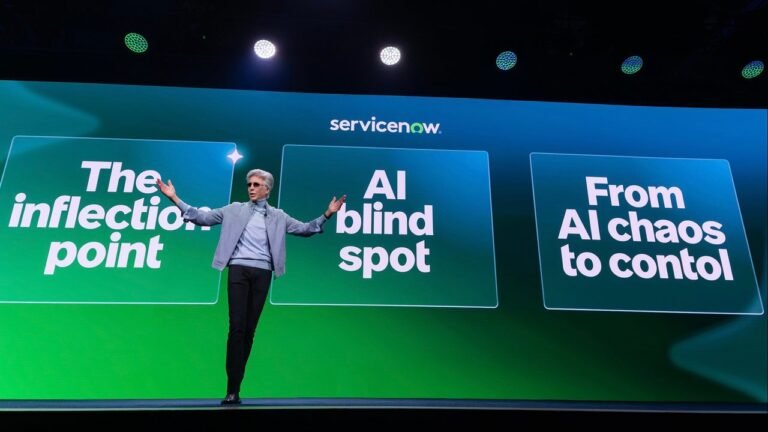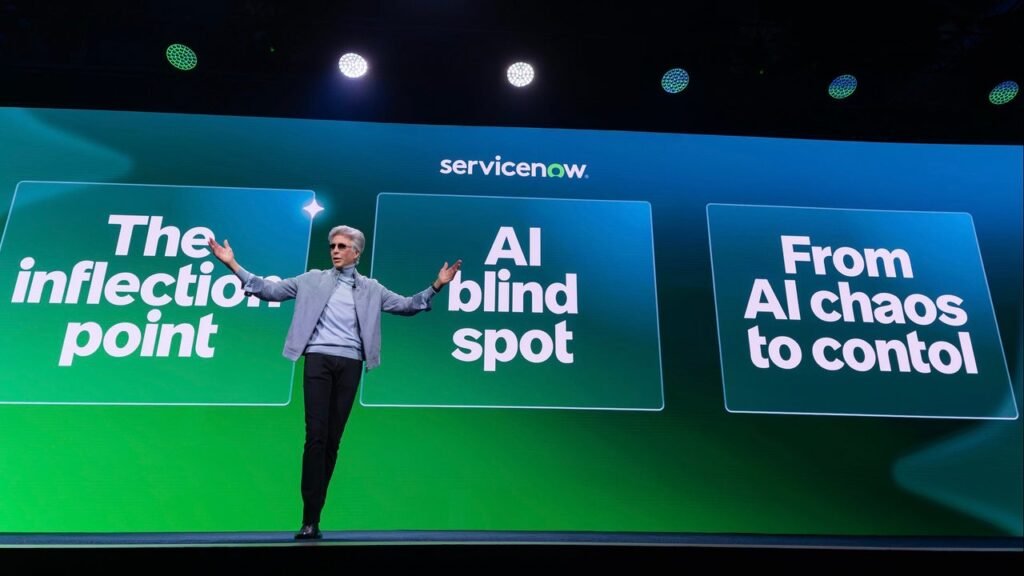
For two years, ServiceNow’s challengers have built businesses around frustrations with its software. Their pitch centers on two complaints: Implementations take too long, and employees increasingly expect help inside tools they already use rather than through a separate portal.
The IT service management startup Serval, which says it intends to replace ServiceNow, rode that argument to a $1 billion valuation last December, raising $75 million in a funding round led by Sequoia Capital. Anas Biad, a Sequoia partner, made a comparison ServiceNow would probably prefer not to hear. The last time the venture capital firm saw customer feedback that strong, he said, was when it backed ServiceNow itself 16 years earlier.
Marc Benioff, CEO of Salesforce, has also questioned how broadly ServiceNow can reach. He has pointed out that ServiceNow automates work for roughly 9,000 companies, while Slack—owned by Salesforce—already sits inside a million. That gives Salesforce a distribution advantage. It can introduce a service desk through an existing customer relationship, making the competition partly about who reaches the buyer first.
ServiceNow aims to address these complaints, and is introducing a product to do just that. Flow by ServiceNow is a conversational AI service desk that operates inside Slack and Microsoft Teams. Employees can ask for a password reset or application access in plain language, and ServiceNow says agentic artificial intelligence can handle the request or escalate it when needed. The product remains in controlled availability, but the company says it can be set up within a day with “no implementation project, CMDB [customer management database] migration or infrastructure required.” Through Flow, ServiceNow says it hopes to reach the “Fortune 500,000,” referring to a broad range of small and midsized companies.
“For too long, small and medium businesses had to choose between simplicity and scale. Flow gives them both,” Bill McDermott, ServiceNow’s chairman and CEO, tells Fast Company in an email exchange. “We created Flow to give the Fortune 500,000 the power of enterprise AI without the enterprise complexity—a conversational service desk delivering value from day one. Zero upfront expense. Pay only for what you consume.”
McDermott argues that ServiceNow’s experience handling enterprise workflows will distinguish Flow from easier-to-build competitors.
“Anyone can vibe code a conversation. Very few can engineer an outcome. Without orchestration, context, security and trust, you’re creating vibe slop that will flop,” he says. “Flow starts with the service desk. It can become the platform you run your business on.”
ServiceNow wants Flow to bring in customers that might not otherwise adopt its full platform, then expand those relationships as their needs grow. That raises a harder question: What happens if the simpler product proves sufficient even as those customers get bigger?
Built for a new generation of AI buyers
ServiceNow says Flow grew out of requests from leaner IT teams that wanted its automation capabilities without a full-scale implementation. Amit Zavery, ServiceNow’s president, CPO and COO, says those conversations revealed a buying preference its traditional enterprise sales model was not built for.
“They want to get started immediately, without going through any kind of configuration process. They want to start using a product, see where it goes, and pay as they go. That’s a consumption-oriented mindset,” Zavery tells Fast Company. “So we wanted to rethink that kind of work, as well as go-to-market and the way we deliver products.”
Zavery says he assembled a small team with experience in IT service management and AI development tools, then gave its members a founder-like mandate. “I said, you have no restrictions. It was like a well-funded startup, in a way,” he says.
ServiceNow says the team built Flow in three months. But the product also draws on years of knowledge about how IT departments handle employee problems, which requests can be automated and when a workflow needs to reach another system or person.
Keith Kirkpatrick, vice president of research at Futurum, a data and advisory company, sees Flow as part of a broader shift forcing established software vendors to package their expertise in products that are faster to adopt, easier to use, and simpler to buy.
“ServiceNow is also positioning this as a way for larger enterprises to quickly stand up an AI-first support operation, or extend existing support operations, with minimal hassle,” Kirkpatrick says. “I think incumbent software vendors will need to pivot to these types of more nimble offerings in order to fend off challenges from other vendors, as well as in-house development using AI tools.”
Can Flow outrun AI-native IT support rivals?
Serval says it automates more than half its customers’ IT tickets and some customers have replaced incumbent systems entirely. Serval’s cofounder and CEO, Jake Stauch, previously claimed that some ServiceNow customers have told him they deployed less than 10% of the ServiceNow AI products they purchased.
Salesforce combines conversational support with ownership of Slack itself. The company said more than 180 organizations had chosen Agentforce IT Service four months after general availability. Flow can meet employees in the same channel, but ServiceNow does not control that channel or its commercial terms.
Zavery, the ServiceNow president, argues that competitors cannot quickly reproduce ServiceNow’s operating knowledge.
“People sometimes underappreciate the importance of domain knowledge and expertise. AI has now made it much easier to write code, but simply being able to write the code is not what matters,” he says. “Knowing what to ask the system to write, and knowing whether what you are building actually makes sense, still requires you to understand what you are doing.”
Zavery says that distinction becomes more apparent once customers move beyond a demonstration and test how much of their actual workload the software can handle.
“I don’t think there is another company today that can do what we do, at the level we can do it,” he says. “The opportunity in front of us is immense because of the breadth of what we can ultimately deliver. We run 8 trillion transactions on ServiceNow on a yearly basis.”
Expanding beyond traditional customers
ServiceNow says Flow can turn recurring requests into automations that handle subsequent instances. Zavery uses repeated password resets as an example.
“It gives you the ability to simply say, ‘slash automate,’ and the system creates the entire automation for you,” he says. “Essentially, the next time that same request comes through, no human needs to interact with it on the back end.”
Even routine access requests, however, can involve sensitive information. ServiceNow says Flow includes guardrails intended to prevent AI agents from accessing systems or taking actions without authorization, while its separate AI Control Tower provides broader oversight of a company’s AI systems.
“Flow is not designed to manage your entire AI estate. That is where AI Control Tower comes in,” Zavery says. “But the guardrails and the broader scaffolding we have built into Flow are designed to prevent AI agents from accessing systems or taking actions they are not authorized to perform.”
Zavery did not specify what mechanisms Flow provides to reverse or contain a harmful agentic AI action after it has already been executed.
Flow sits alongside several other ServiceNow products with overlapping functions. The company spent $2.85 billion on Moveworks, another conversational entry point for employee requests, and already offers EmployeeWorks and Otto. Zavery says EmployeeWorks and Otto will continue serving larger enterprises.
The early customer examples show where ServiceNow thinks Flow may fit, but do less to establish that it has opened a new market. Serenity EHS already builds solutions on ServiceNow’s platform and is using Flow to reduce the time employees spend handling internal support requests. Likewise, the U.S. Navy’s Fleet Numerical Meteorology and Oceanography Center believes Flow could let employees build repeatable workflows directly inside Microsoft Teams.
ServiceNow expects Flow to cut ticket volume by 40% and let teams build automations in five minutes. The company has clarified that those figures are “expectations” while the product remains in controlled availability, meaning they have yet to be demonstrated at scale.
Flow could change ServiceNow’s enterprise economics
ServiceNow’s AI annual contract value exceeded $1 billion in the second quarter, while 658 customers each generated more than $5 million in annual contract value. Those figures underscore how much of its business remains tied to large enterprise accounts.
Flow introduces another way to buy. ServiceNow describes credit card sign-up for new customers and consumption-based use for existing customers whose plans include AI.
Futurum’s Kirkpatrick argues that ServiceNow will need flexibility as buyers gain alternatives. “A smaller company with basic support needs may be happy with an AI vendor, particularly if all they are trying to do is set up a basic support system,” he says.
Flow may therefore require ServiceNow to accept different customer economics. Winning smaller companies with lighter deployments and lower upfront commitments could mean smaller contracts, even if some expand over time. The question is whether ServiceNow can build that lower-commitment business without weakening the high-value enterprise model it already depends on.