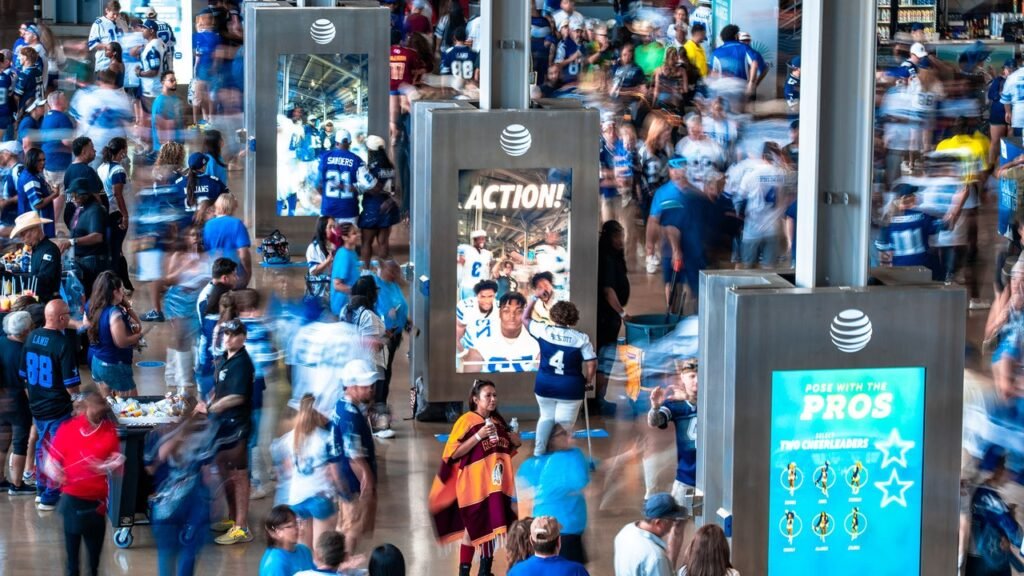
In a world where sports is dominant, major leagues and stadiums across the country are coming up with different ways for fans to stay connected and engaged during games.
To kick off the NFL season this year, AT&T recently extended its partnership with the Dallas Cowboys with a 30-year agreement running to 2055. But the company also rolled out new features at AT&T Stadium to make game day more interactive and personalized for fans.
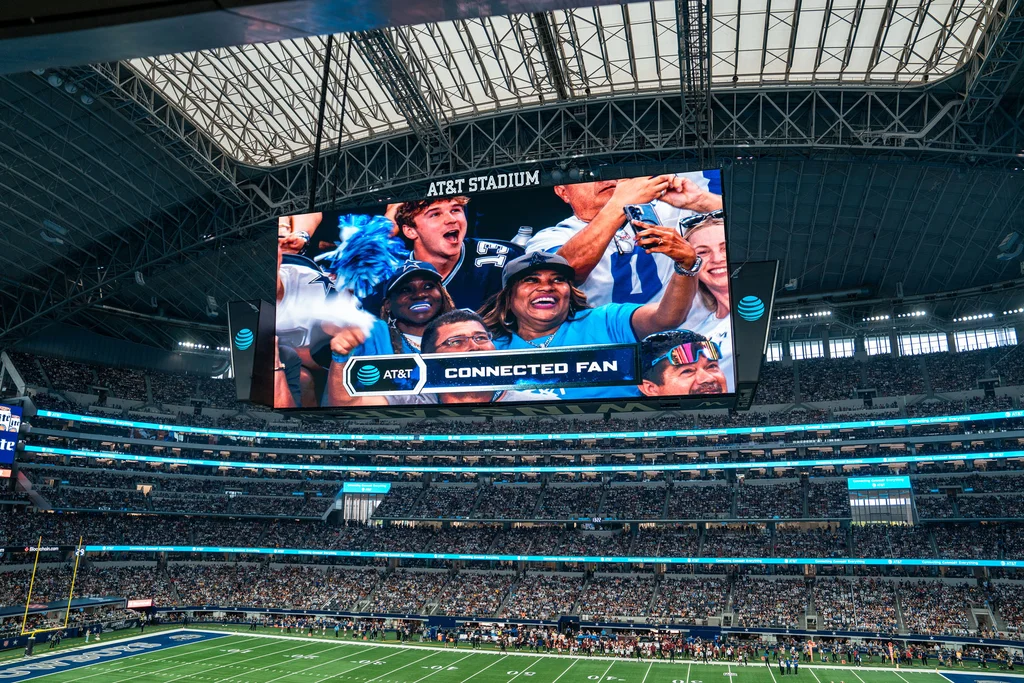
Reception Connection is a new mixed-reality game where fans can play and test their skills against quarterback Dak Prescott for a spot on the leaderboard, while the Starbase Connection Feature highlights fan-submitted photos into AI-generated custom hype videos across stadium boards.
AT&T also introduced digital wayfinding, which embeds interactive mapping directly into the Cowboys app and at eight physical entrance kiosks to help fans navigate the stadium.
Connectivity is about more than speed
Behind the augmented reality and digital games lies a large engineering undertaking.
The stadium has more than 261 miles of fiber and nearly 1,000 antennas throughout the venue, which manages network traffic for a full house, such as the 93,188 fans who attended the home opener against the Washington Commanders.
Zee Hussain, head of global enterprise solutions at AT&T, said connectivity is no longer just about having a high-speed connection, but rather, it’s an invisible thread holding the entire game day operation together, whether it’s to access tickets on apps like SeatGeek and Ticketmaster or powering the checkout counters and digital concourse signs.
“The connectivity experience is so closely tied to what you experience when you go to the venue,” Hussain told Fast Company. “The fan behavior is such that they want to capture that. And not only do they want to capture it—they want to share it as quickly as possible.”
Paying to cut through the bottleneck
Even with the infrastructure handling all of the spikes—like the 175 terabytes that were consumed across the 2025 home season—moments like a walk-off touchdown or the final rush for post-game ride shares can create severe network congestion.
Enter AT&T Turbo Live, a new mobile data feature launched this year designed to cut through that bottleneck. It is available to users across different carriers, including Verizon and T-Mobile, via a temporary eSIM profile and allows fans to reserve high-priority network access for the duration of an event.
Pricing typically starts around $5 to $15 per event depending on the scale and demand of the game, though AT&T is also introducing season-long passes and promotional free entry tiers for select stadium openers.
Along with the home turf of the Dallas Cowboys, the feature has rolled out across 11 major sports and entertainment venues, including Lambeau Field and Gillette Stadium to arenas like the Intuit Dome in Los Angeles and the Sphere in Las Vegas.
“You may be in a venue, and you’re struggling to be able to check your Instagram, or you’re struggling to upload any videos because all of a sudden the macro network that’s used to dealing with hundreds of pings is now getting tens of thousands of pings,” Hussain said. “So there’s certainly congestion and these types of things happen quite a bit.”
For fans already shelling out money for tickets, parking, and food, which are driven up by the digital infrastructure that requires a working phone, a fan might wonder if paying an extra per-event fee to ensure a video upload is worth it.
Telecommunications companies like AT&T point to the sheer financial and physical scale required to keep pace with modern data demands, since building and maintaining high-density Wi-Fi and miles of fiber infrastructure involves a lot of capital.
Hussain compared it to familiar consumer choices in entertainment such as a theme park fast-track.
“People still go to Disney,” Hussain said. “People still wait in lines, and people are still okay with it. But you have folks that are willing to pay for the Lightning Pass and make the financial investment to do that because they want a differentiated experience. Last time I checked, it hasn’t impacted the attendance for Disney. There’s still long lines for the theme park.”
He goes on to say that Turbo Live isn’t a substitute for “making sure that all of the venues have the right amount of connectivity and bandwidth to ensure a strong fan experience.”
But rather, “this is a way to be able to offer a differentiated experience to fans that may really value the ability to share or access critical apps in a guaranteed and highly prioritized manner,” Hussain adds.
Mastering the entire experience
Solving the immediate bandwidth puzzle with features like Turbo Live is only part of the equation. Dallas Cowboys CIO Matt Messick said the real evolution of stadium technology is about mastering that entire experience for a fan as soon as they walk in.
He said that years ago, the baseline battle was simpler and focused more on getting fans inside the gates through a functional Wi-Fi ticket-scanning process. Today, that focus has shifted to leveraging years of accumulated data to anticipate fan behavior and smooth out navigation and concessions so the technology stays in the background.
“How can we take all of that mundane, boring data and create true insights from it?” Messick said. “What I am loving right now is the ability to take all the data we have been generating for years and create a fan experience that they don’t even realize is there and just makes everything so seamless.”