What’s the purpose of a soccer game?
It’s the moment a goal is scored. That ecstatic instant when everyone rises in unison to their feet, held by the primal bonds of human passion and connection. That’s the moment athletes play for and the reason fans attend. As described by Hubert Dreyfus and Sean Dorrance Kelly in their book, All Things Shining, “Something so overpowering happens that it wells up before you as a palpable presence and carries you along, as on a powerful wave.”
Would it make sense to institute any rule or device that completely crushed that soulful whoosh of adrenaline and shared joy? Of course not.
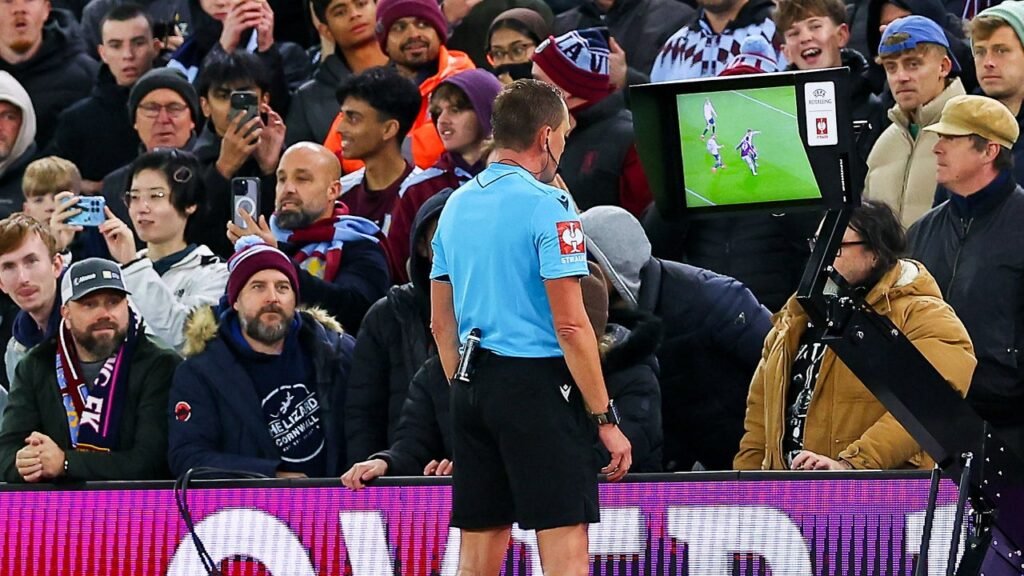
But that’s exactly what Video Assistant Referee, or VAR, has done. Introduced to the English Premier League in 2019 and further ingrained into the global sporting zeitgeist during the 2026 FIFA World Cup, VAR is—for some—a well-intentioned innovation designed to make the game more fair. Other sports have variations on the core technology, and it’s likely to be further explored over the coming years. The NFL, for example, is primed for additional reviews by the current off-site video replay crew.
Functionally, and in most cases, VAR substitutes one subjective call for another. Rather than solely relying on a referee who is embedded into the flow of the game, rule enforcers have delegated key decisions to arbiters in a remote booth, perhaps thousands of miles away, who consult a wall of huge screens, rule book close at hand. Staring at those screens, where the real-time action is slowed down and devoid of context, the VAR crew refines a judgment. Why? And what is the end result?
Every single Premier League goal is automatically reviewed by VAR—and the most disruptive of these reviews cause on-field delays; a player scores, celebrates, then is forced to wait in purgatory for the official verdict. Was someone offside? When were they offside? When did the offensive sequence of play begin? Was there a foul—how long ago was the foul? Was the hand in a natural position—what is a natural position? The list goes on and on.
And then, at the end of this paralegal review, let’s say the goal is allowed to stand. The stadium erupts (though some of the life has been drained out of the secondary roar), and what are we celebrating? It’s like we’re celebrating a win in the courtroom. The appeal has failed, or the appeal has been upheld. In the NFL, how long will it be before we get an add-on to the red challenge flag; perhaps a double-or-nothing appeal for the bonus ball? The entire scene, often lasting several minutes, has descended from the sublime into a whimper of bureaucratic absurdity.
The whole point of rules in sports is to facilitate the playing of the game. And the whole point of playing the game is to reach that magical, ecstatic moment of celebration, to be swept up in what the philosopher Albert Borgmann called a “focal event.” As he pointed out, sport is an important communal catalyst: “No one can produce or guarantee the flow of a game. It unfolds and reveals itself in the playing. It inspires grace and despair, it provokes heroics and failure, it infuses enthusiasm and inflicts misery. It is always greater than the individuals it unites.”
Missing the point
Sports cross social, economic, and political divides, and in an unspoken way transmit to thousands of people what we share in the common. What we value. Historical and modern parallels can be found in live music, religious ceremonies, and festivals of many kinds. VAR disrupts this transmission. Marshall McLuhan, the patron saint of media philosophy, anticipated the intensity of VAR’s disruption more than half a century ago: “Playback in modern sports . . . is surely one of the greatest art forms of our time. The instant replay concentrates attention on the actual process of the game.” By “greatest” here, McLuhan means most impactful, most culturally significant.
With an instant replay we get the meaning, minus the experience; the dissection, minus the ecstatic whoosh. Wayne Rooney, a legend of the Premier League club Manchester United, put it this way: “I’m just so sick of VAR. I think it’s horrendous. It takes all the emotion out of the game, the energy which the game’s played with.”
Rooney had been galvanized into this statement of despair by a clear VAR error in the latest Manchester derby (between his former club and Manchester City), which forced an apology from Pro Ref, the organization behind VAR. But when mistakes involving new technologies are made, in all walks of life, we tend to get caught in a flawed line of “technological thinking,” and VAR is typical in this regard. Our default assumption is often that the technology is good, it’s just not being used correctly. If only we made the reviews faster, or had better sensors, or added more camera angles, etc. . . . If we can do that then we’re golden. In other words, we tell ourselves, “Here’s a technological problem, let’s find a technological solution.”
But that’s not how technology works. It doesn’t knock at the door and ask permission to enter. Once you’ve opened Pandora’s box, you’re dealing with a host of expanding and intractable problems. And the more technical and legal solutions you look for, somehow the deeper mired in it all you get. Before long, you’ve completely lost sight of the only thing that matters: the game. The ecstatic moment.
Like many issues around technology, the core question of whether or not VAR should be used becomes subjective. Whether we deem it benefits or detracts from the essence of a game depends entirely on how we define essence. Is your ecstatic sporting moment, for example, tied to a wager? There’s no doubt that sports betting would be a large obstacle to overcome if you were to try to get rid of VAR. People stake money on games, and on events within games, and they want to know decisions are right. With its multiple camera angles and replays, new technology certainly makes it easier to penetrate the fog of uncertainty. Is the price worth paying?
Ban it
To abandon VAR completely—which is what I’m proposing—would you need to cut a deal with the TV stations to not air certain replays and angles? That would be a tricky proposition in a world where the ubiquity of smartphones has transformed almost every public space into an effective panopticon: an arena of complete surveillance. It’s no surprise that McLuhan followed up his thoughts on the instant sporting replay with the observation that surveillance “has become the main business of mankind: just watching the other guy.”
VAR, as soccer surveillance, has quickly and predictably bled into other aspects of the game. Take the rule, introduced by FIFA for the 2026 World Cup, against players covering their mouths during any type of altercation. I understand where the idea comes from. There have been instances of players saying terrible, sometimes racist things in matches, and people want them to be held accountable. But the rule’s VAR-driven application is disquieting and Orwellian. We’re admitting that everything within a given arena can and should be recorded, judged, and open to future interpretation and litigation. It’s not that the desire for justice or to prevent these things happening is wrong, but the chosen method matters. Once new social norms like this become established, they have meaningful consequences that can be difficult to claw back.
By boring ever deeper into the laws of the game, with VAR as our drill bit, we fracture their basic protective structure and integrity. In our drive to “get the call right” or hold people accountable, what we get is a modern-day variation on the argument the playwright Robert Bolt makes in A Man for All Seasons, when his central character—the Renaissance philosopher Sir Thomas More—challenges the impulse that we should “cut a great road through the law to get after the Devil.” In our case, getting after the Devil would be getting the call “correct.” That kind of thinking, says More, would leave us sorely exposed because “when the last law was down, and the Devil turned round on you, where would you hide, the laws all being flat? D’you really think you could stand upright in the winds that would blow then?”
In addition to the fractal unfolding of consequences that could be generated by ever more intense surveillance (which applies to both sport and society at large), there’s also the question of the flow of the game—and how it affects our experience and enjoyment of the spectacle. Pro basketball and American football have become nearly unwatchable because they are so fragmented by ad breaks, timeouts, and fouls. Attending an NFL game in person is like sitting in the eye of a media hurricane, surrounded on all sides by flashing lights and advertisements with hardly any real action at the center.
‘Not football anymore’
One of the reasons soccer has always been different and is now gaining ground in the United States is its fluidity: 90 minutes, one 15-minute break. That’s it—at least until the most recent World Cup’s contentious “hydration breaks.” (Although I think we can confidently attribute that development to pure capitalism). Now, with VAR, soccer has joined the ranks of paralegal pursuits, in which the game is sliced and diced; staggered and fragmented. In the Premier League, a post-VAR chant has taken root that reflects the near-universal dissatisfaction felt by fans every time the technology gate-crashes a game—“It’s not football anymore”—and there are more salty variations on that theme. Followers of teams relegated from the Premier League to the Championship, the next tier down, where VAR is not used, speak of their euphoric rediscovery of “pure” goal celebrations. That’s not an insignificant consolation.
The overt practical reasons for the use of VAR are fairly simple: The technology exists; sports betting is a juggernaut; and we feel a deep-seated need to get decisions right. But VAR is also something more. It’s symptomatic of deeper currents that run through modern societies, many of them tied to the effects of our media. If we take a step back, away from the use of VAR in any particular game, the broader picture is one of seismic fractures in a culture dominated by cameras and screens, whether they’re our smartphones or the jumbotrons in stadiums.
Do we really want to compromise the connective tissue of our communal events by spiraling down the rabbit hole of rule enforcement and analysis? Why submit to the microscopic dissections of the freeze-frame and the instant rewind that bleed sports of their meaning and joy? Don’t we need less video assistance, not more?
Perhaps it was the Danish philosopher Søren Kierkegaard who summed up our situation best. In 1846 he wrote an essay, The Present Age, which contrasts the decline in revolutionary action with the rise of reflection in the context of mass media. To say he was ahead of his time is a wild understatement. He anticipated the ways our environment of endless analysis, commentary, and debate connect to the broader framework of the age we live in. In his ice-skater analogy, we can clearly see the future specter of VAR and its flattening of the ecstatic instant:
“If a precious jewel, which all desired, lay out on a frozen lake, where the ice was perilously thin, where death threatened one who went out too far while the ice near the shore was safe, in a passionate age the crowds would cheer the courage of the man who went out on the ice; they would fear for him and with him in his resolute action; they would sorrow over him if he went under; they would consider him divine if he returned with the jewel. In this passionless, reflective age, things would be different. People would think themselves very intelligent in figuring out the foolishness and worthlessness of going out on the ice, indeed, that it would be incomprehensible and laughable. Then an inspired venture would be transformed into an acrobatic stunt.”
Perhaps we do live in an age of reflection. Or maybe we’re near the end of one and about to enter something else. Maybe I’m overly optimistic, but I believe that Kierkegaard, Rooney, Dreyfus, and Borgmann can point us towards a more ecstatic alternative: the end of VAR.